First Seen
2023-05-10T21:03:40+00:00
simple-description (llama3.2-vision_11b)
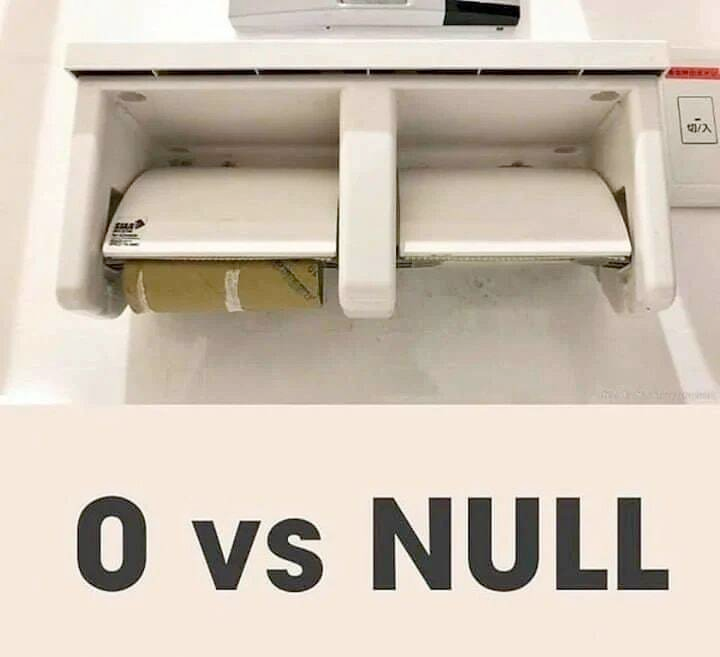
The meme is a play on the concept of "null" in programming, which refers to a value that does not exist or is unknown. The image shows a coffee machine with a button labeled "NULL" and a cup of coffee with a label that says "NULL". The text "0 != NULL" is written above the coffee machine, implying that the machine is still working despite the label saying "NULL".
detailed-analysis (gemma3-27b-vision)
Okay, let's break down this image and apply the requested theoretical frameworks. It’s a surprisingly rich image when examined through these lenses, even given its seeming simplicity.
Visual Description
The image depicts the interior of a paper shredder. A white, rectangular cavity houses two cylindrical shredding rollers, one of which appears to contain a partially shredded piece of paper. The space is contained within a larger, likely office-grade, white machine. There’s a partial view of a control panel above, and a small, red and white panel with some lettering (presumably indicating on/off or settings) on the right. The image is clean, minimalist, and the focus is entirely on the mechanics of the shredder. The contrast is fairly stark, highlighting the emptiness of the right side. Beneath the image are the words “0 vs NULL” in bold, black letters. This textual pairing adds a layer of abstract conceptualization to the visual.
Foucauldian Genealogical Discourse Analysis
The image of the paper shredder lends itself beautifully to a Foucauldian analysis. The shredder isn’t merely a machine; it's an instrument of power/knowledge. It embodies the control of information, the suppression of documentation, and the active erasure of narratives. The "0 vs NULL" text amplifies this.
- Genealogy of Shredding: The act of destroying documents has a long history tied to political control, secrecy, and covering up wrongdoing. Tracing the evolution of document destruction techniques (from simple burning to sophisticated shredding) reveals the changing discursive practices surrounding information management.
- Discipline & Surveillance: The shredder represents a form of self-discipline. Individuals and institutions engage in the act of shredding to maintain order, protect confidentiality, or eliminate evidence. This links to Foucault's ideas about panopticism. The potential for information to be shredded becomes a regulatory force, influencing behaviour.
- Null as Absence: The word "NULL" signifies an intentional absence of information, a purposeful void. This is not simply nothing; it’s an active construction of non-existence. The pairing with “0” implies a binary of existence and non-existence.
The shredder, through a Foucauldian lens, is a microcosm of broader power dynamics—the control of knowledge being a key component.
Critical Theory
The image speaks to the broader themes of reason, control, and the "instrumentalization" of objects—a core concern of the Frankfurt School of Critical Theory.
- Reason as Domination: The shredder embodies a technologically driven rationality. It's a "solution" to the "problem" of unwanted information. However, this rationality is not neutral; it serves to consolidate power and control. The machine is designed to eliminate, a destructive impulse rationalized by efficiency or necessity.
- The Culture Industry: In a broader context, the shredder could be seen as part of the "culture industry"—the mass production of technologies that shape and control our lives. The rise of document shredding is linked to the increasing volume of paperwork and the need to manage sensitive information in a modern bureaucratic society.
- Loss of Authenticity: The destruction of documents raises questions about memory, history, and authenticity. What is lost when information is erased? The image prompts us to consider the value of preserving records, even those that are deemed “unwanted”.
The image can be seen as a subtle critique of the rationalizing forces of modernity and the potential for technology to be used for destructive purposes.
Postmodernism
The stark contrast between the full roll and the empty space, and the “0 vs NULL” text embodies several postmodern themes.
- Deconstruction of Meaning: The “0 vs NULL” pairing highlights the instability of meaning. While “0” can represent quantity or presence, “NULL” signifies absence. This disrupts any easy equation between the two, demonstrating how language and concepts are not fixed but relational and contingent.
- Simulacra and Simulation: The image can be interpreted as a form of simulation. The shredder represents the erasure of information, even before it actively destroys anything. It’s a visual stand-in for a broader process of information control and manipulation.
- Fragmentation and Discontinuity: The act of shredding itself represents fragmentation—the breaking down of whole documents into meaningless pieces. This mirrors the postmodern emphasis on deconstruction and the rejection of grand narratives.
The image suggests a world where meaning is fluid, reality is constructed, and the boundaries between information and its absence are increasingly blurred.
Queer Feminist Intersectional Analysis
This is where the interpretation becomes more subtle and potentially complex. The shredder, while seemingly neutral, can be connected to systems of power and control that disproportionately affect marginalized groups.
- Erasure of Histories: The shredder can symbolize the systematic erasure of the histories, voices, and experiences of marginalized communities. Documents detailing struggles for liberation, evidence of discrimination, or records of resistance can be destroyed, effectively silencing those who have been historically oppressed.
- Control of Narratives: Those in power often control the narratives that are preserved and those that are suppressed. The shredder becomes a tool for maintaining this control, ensuring that dominant perspectives are reinforced and alternative viewpoints are marginalized.
- The Value of Documentation: For queer and feminist activists, documentation is often crucial for holding power accountable, challenging oppression, and building solidarity. The image can be seen as a reminder of the importance of preserving records, even in the face of resistance.
- Intersectional Dimensions: The impact of document destruction is not uniform. Certain groups are more vulnerable to having their histories erased or their voices silenced. Understanding the intersection of various forms of oppression (race, gender, sexuality, class) is crucial for appreciating the full implications of this.
The image, viewed through this lens, serves as a warning about the dangers of erasure and the need to actively resist attempts to silence marginalized voices.
I've tried to provide fairly in-depth analyses within the framework of the requested theories. It's important to remember that these are interpretations, and the meaning of the image will vary depending on the viewer's own experiences and perspectives. Let me know if you’d like me to elaborate on any specific point or explore a different theoretical angle.
simple-description (llama3.2-vision)
This meme is a visual representation of the difference between two programming concepts: "0" (zero) and "NULL" (a null value). The image shows a toilet with a sign that says "0" and a toilet with a sign that says "NULL", implying that the two toilets are empty, but one is labeled as "0" (empty) and the other is labeled as "NULL" (empty, but with a specific label). The text at the bottom of the image reads "0 vs NULL".
tesseract-ocr
——___—-—- O vs NULL