First Seen
2023-05-10T21:03:40+00:00
simple-description (llama3.2-vision_11b)
The meme is a screenshot from the movie "The Hitchhiker's Guide to the Galaxy" where the character Douglas Adams is explaining the universe's origin. The text "If you want to make a good first impression, start with a good last impression" appears at the top.
detailed-analysis (gemma3-27b-vision)
Okay, let's break down this image/meme using the requested theoretical frameworks. It's a rich image lending itself to multiple interpretations.
Visual Description
The image appears to be a still from a possibly older film or television show. Two men are depicted in a richly decorated, traditionally styled room, suggestive of a stately home or a luxurious interior. The lighting is dim and atmospheric, creating a somewhat dramatic effect.
The man on the left is formally dressed in a tuxedo, presenting a conservative and austere appearance. He stands rigidly, maintaining a distant, authoritative pose.
The man on the right is also dressed in formal clothing, but with more relaxed and arguably ostentatious details (a turtleneck under a coat). He has a slightly dazed or sardonic expression, appearing to be delivering a pronouncement.
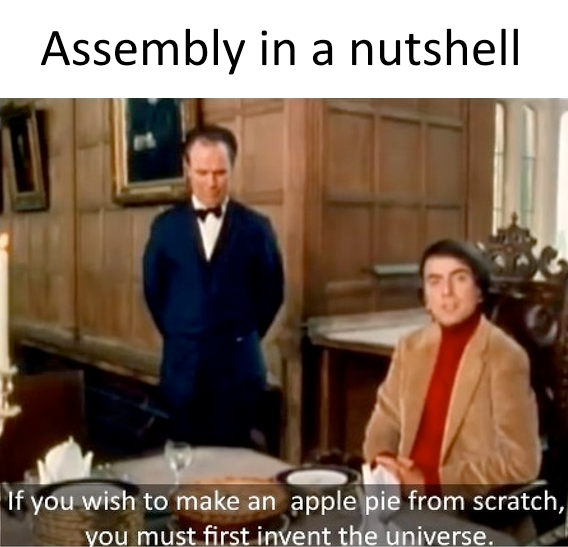
Text overlays the image: “If you wish to make an apple pie from scratch, you must first invent the universe.” The title above the image states "Assembly in a nutshell".
Foucauldian Genealogical Discourse Analysis
The meme speaks to the construction of knowledge and power relationships. Foucault would see the idea of making an apple pie “from scratch” not as a literal culinary process, but as a discourse that defines what constitutes "from scratch." The statement’s absurdity (needing to invent the universe) highlights how even seemingly simple tasks rely on an immense, unseen network of established power/knowledge relations.
The statement exposes the underlying assumptions required to define "scratch." To bake a pie, we require a system of knowledge about ingredients, physics, chemistry, agriculture, cosmology, and the very concept of existence. These are not innate but constructed through historical discourses (scientific, philosophical, culinary, etc.). The meme reveals the impossibility of true originality, as everything is built on pre-existing systems. It could be argued that the 'assembly' referred to in the title is the assembly of concepts, ideologies and processes required to simply make an apple pie.
Critical Theory
From a Critical Theory perspective (especially drawing on the Frankfurt School), the statement can be seen as an indictment of instrumental reason and the relentless drive for control. The insistence on inventing the universe before baking a pie reflects a hyper-rational, totalizing worldview that seeks to reduce all activity to logical, pre-determined steps. It highlights how the pursuit of efficiency and control can lead to absurd and alienating outcomes.
The meme subtly critiques the belief that everything is solvable through reason and planning. It suggests that there's a qualitative aspect to experience (the simple joy of baking) that is lost when everything is subjected to excessive analysis and pre-planning.
Marxist Conflict Theory
This one is a bit more stretched but still viable. From a Marxist lens, one can interpret the statement as reflecting the alienation of labor. The requirement of “inventing the universe” could symbolize the immense, unseen labor and historical processes that go into producing even a basic necessity like an apple pie. The consumer of the pie is detached from this entire system of production, only seeing the finished product.
The absurdity of the statement might be interpreted as a critique of the division of labor within capitalist society. Individuals are increasingly specialized and detached from the overall production process, creating a sense of powerlessness and alienation.
Postmodernism
Postmodernism finds a comfortable home here. The statement embodies the core postmodern rejection of grand narratives and totalizing systems. The idea that you must invent the universe before baking a pie actively dismantles any sense of logical progression or objective truth.
The meme highlights the constructed nature of reality. "Scratch" is not a fixed point, but a fluid concept dependent on the observer and their understanding of the universe. The statement suggests that there is no ultimate foundation of meaning; everything is a simulacrum, a copy of a copy.
Queer Feminist Intersectional Analysis
This is the most challenging lens to apply directly, but we can find some potential connections.
The requirement of "inventing the universe" could symbolize the systemic barriers that marginalized groups face in accessing even basic resources and opportunities. The statement points to the enormous amount of "invisible labor" – emotional labor, care work, etc. – that often falls disproportionately on women and other marginalized groups. They are often expected to create the conditions for others to succeed, even before starting their own projects.
Furthermore, the statement's dismissal of simple processes as insufficient suggests a rejection of everyday experiences and skills often valued in traditional patriarchal structures. It valorizes grand, abstract thought over practical, embodied knowledge, which is often devalued in such contexts.
Let me know if you'd like me to elaborate on any of these interpretations, or if you want me to explore other theoretical frameworks!
simple-description (llama3.2-vision)
This meme is an image of a scene from the movie "The Hitchhiker's Guide to the Galaxy" where a character named Arthur Dent is explaining the universe's origins to his friend. The image shows Arthur and his friend sitting at a table, with a caption below the image that reads: "If you wish to make an apple pie from scratch, you must first invent the universe." This quote is a humorous take on the idea that making something as simple as an apple pie requires a vast amount of knowledge and understanding of the universe.
tesseract-ocr
Assembly in a nutshell V w e° ; 4 v ON ly =f" i y r en _ J If yoU Wish to make an apple\pie from scratch, you must first.invent the Universe». _