First Seen
2023-05-10T21:03:40+00:00
simple-description (llama3.2-vision_11b)
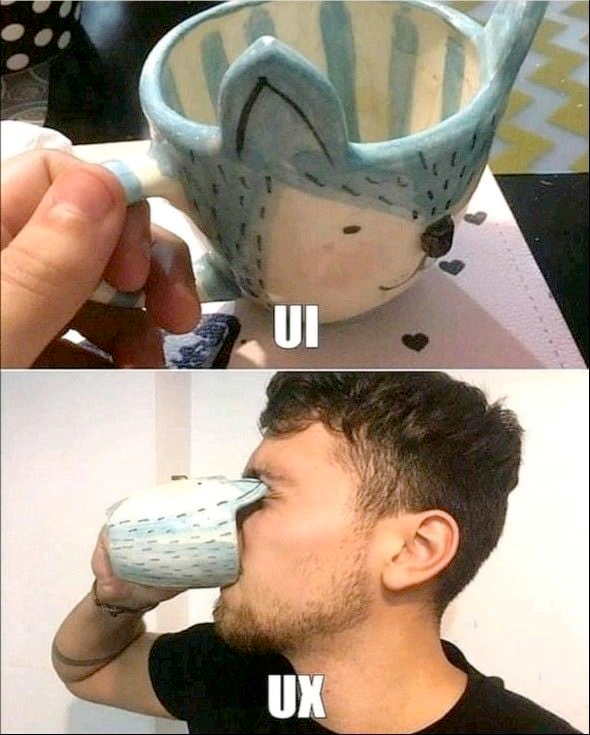
The meme is a humorous illustration of the challenges of designing user interfaces (UI) and user experiences (UX) in software engineering. The image depicts a person struggling to drink from a cup with a poorly designed handle, with the text "UI" and "UX" labels on the cup, implying that the user interface and user experience are flawed. The meme pokes fun at the difficulties of creating intuitive and user-friendly interfaces, highlighting the importance of considering both UI and UX in software design.
detailed-analysis (gemma3-27b-vision)
Okay, let's break down this image, attempting to apply the requested theoretical frameworks. It’s a bit of a playful exercise, given the image itself, but we can find ways to engage with these concepts.
Visual Description
The image is a diptych, split into two panels. The top panel depicts a hand applying what appears to be white paint or glaze to the inside of a ceramic cat-shaped mug. The mug is partially finished, showing the outline of cat ears and a textured glaze pattern. The background is a pink workspace with a blurry glimpse of a yellow patterned object.
The bottom panel shows a young man drinking directly from the same, now finished, cat mug. He’s tilting his head back to get the liquid out, and some liquid is visible around his lips. The background is a plain white wall. The image is labeled "UI" (User Interface) for the top panel and "UX" (User Experience) for the bottom panel, implicitly linking it to design thinking.
Foucauldian Genealogical Discourse Analysis
This image can be explored through a Foucauldian lens, specifically examining the discourse surrounding design and the production of "experiences." The act of crafting the mug (UI) represents a specific power/knowledge relationship. The potter exercises control over the material, defining the mug’s function and form. This is then imposed on the user (the man drinking).
The "UX" panel reveals the contingent nature of that defined function. The man's act of drinking directly from the mug—circumventing the “intended” use of a handle and proper sipping—demonstrates how power dynamics are not monolithic. He renegotiates the intended function, potentially disrupting the potter’s original intention.
A genealogical approach would ask: How did the concept of "User Experience" come to be so central to design? What historical forces shaped the prioritization of user feelings over the purely functional? The image subtly critiques the obsession with perfecting the UX, as the actual experience (drinking awkwardly from a cat mug) might be quite different than the idealized vision.
Critical Theory
The image evokes themes of alienation and objectification explored in Critical Theory. The mug, as a mass-produced or hand-crafted object, represents a form of commodity fetishism. Its aesthetic appeal (the cat shape) overshadows the labor and materials involved in its creation. The man's relationship to the mug becomes one of consumption, reducing it to a means of satisfying a physical need.
The divide between UI and UX highlights the gap between the designer’s intention (the idealized interface) and the user’s lived reality. Critical Theory would question: Does focusing so heavily on UX simply reinforce capitalist structures by making consumption more pleasurable and efficient? Does it obscure the underlying power imbalances inherent in production and consumption? The awkwardness of drinking from the mug could be seen as a momentary break in the seamless illusion of consumer satisfaction.
Marxist Conflict Theory
From a Marxist perspective, the image embodies the inherent conflict between the forces of production (the potter, the materials, the tools) and the relations of production (the designer’s intent, the consumer’s need). The potter, as a laborer, is engaged in a process of creating value, which is then appropriated by the forces of capital (the potential sale of the mug).
The "UX" panel can be interpreted as a disruption of this process. The man is using the mug in a way that wasn’t intended by the designer or potentially expected by the market. This could be seen as a small act of resistance against the commodification of everyday objects. It demonstrates that users are not passive recipients of design, but active agents who can reshape the meaning and function of objects.
Postmodernism
The image is readily amenable to a postmodern reading. The cat-shaped mug itself is an example of pastiche – an imitation or blending of styles, in this case, a functional object (mug) combined with a playful, kitsch aesthetic (cat). This blurring of boundaries and rejection of "high art" or "serious design" is a hallmark of postmodernism.
The juxtaposition of UI and UX is a meta-commentary on the very idea of “experience.” Postmodernism questions the possibility of a stable, authentic experience. The "UX" panel suggests that experience is always mediated, subjective, and potentially ironic. The awkward act of drinking from the mug undermines the notion of a perfect, seamless user experience, highlighting the absurdity and contingency of everyday life.
Queer Feminist Intersectional Analysis
This is the most challenging framework to apply, but it's possible. The act of repurposing the mug could be read as a minor act of subversion – refusing to conform to the expected modes of consumption and interaction. This echoes queer and feminist practices of challenging norms and reclaiming agency.
The focus on "User Experience" can be seen as reinforcing normative standards of usability and accessibility. What about users whose bodies or needs don’t fit neatly into those standards? The awkwardness of drinking from the mug could be interpreted as a commentary on the inherent biases embedded in design and the limitations of a one-size-fits-all approach.
The seemingly frivolous nature of the cat mug also opens up a discussion about the gendered associations often attached to kitsch and "cute" aesthetics. A queer feminist reading might explore how these associations are constructed and how they intersect with power dynamics.
Let me know if you’d like me to elaborate on any of these points or explore other theoretical frameworks!
simple-description (llama3.2-vision)
The meme is a play on the difference between User Experience (UX) and User Interface (UI) design. It shows a person trying to drink from a mug with a hole in the bottom, with the text "UI" above it and "UX" below it. The idea is that a good UX design (UX) would have a mug with a handle, but a poor UI design (UI) would have a mug with a hole in the bottom, making it impossible to drink from.
tesseract-ocr
a -* ra . shots ra me) 60g