First Seen
2023-05-10T21:03:40+00:00
simple-description (llama3.2-vision_11b)
The meme is a screenshot of a GitHub issue report from a user named "k4lt3r", which is a humorous representation of a programmer's frustration with a seemingly simple task. The text in the image reads: "I have no idea what I'm doing. I'm trying to make a simple program that prints 'Hello World' to the screen, but I keep getting errors. Can someone please explain why I'm getting this error?" The meme pokes fun at the common experience of struggling with coding and the frustration that comes with it.
detailed-analysis (gemma3-27b-vision)
Okay, here's an analysis of the provided image and text, broken down into sections based on the theoretical lenses you requested, only including sections where those lenses apply. It's a complex image and text, so I'll try to be thorough.
Visual Description
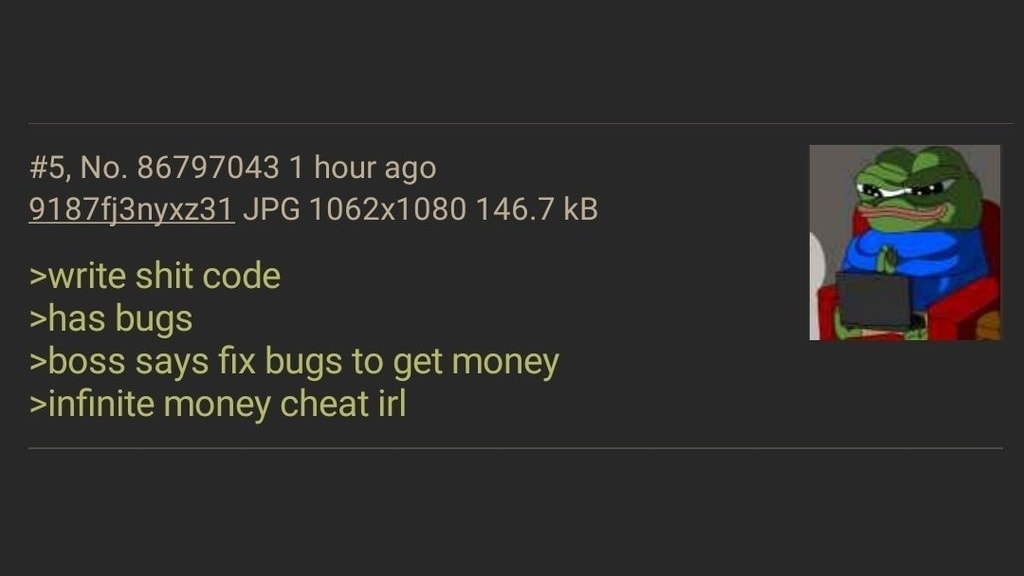
The image is a digital illustration featuring a "Pepe the Frog" cartoon character, depicted as a frustrated programmer. He's seated at a laptop computer, with code displayed on the screen. He's wearing glasses and appears to be visibly stressed. His hands are raised in a gesture of exasperation or defeat. The color scheme is limited, with a dark background emphasizing the green of the frog and the glow of the laptop screen. It's very clearly a meme format from online, likely originating on 4chan given the post's format.
Foucauldian Genealogical Discourse Analysis
This image/text complex is highly amenable to a Foucauldian analysis. Here's how:
- Power/Knowledge: The text highlights a specific relationship between power and knowledge within the context of software development. The "boss" (representing a power structure) demands the "fixing of bugs" (specific knowledge/skill) as a prerequisite for "money" (reward, and therefore, access to resources/power). This isn't just about technical skill; it's about the discipline imposed on the programmer to produce value.
- Discourse of Productivity: The entire setup exemplifies a dominant discourse surrounding productivity and labor. The expectation to "fix bugs" to earn money establishes a normative framework where value is solely determined by output. The language is stark and transactional.
- Genealogy of "Bug": The term "bug" itself has a genealogy. Originally a literal insect interfering with early computers, it evolved into a metaphor for imperfections and errors. This evolution reveals how our understanding of "error" is not natural but constructed within a specific technological and capitalist framework.
- The "Infinite Cheat": The reference to an "infinite cheat" is a fascinating disruption. It suggests a desire to circumvent the disciplinary structures, to gain access to resources without engaging in the normalized process of labor. It’s a yearning for a disruption of the power dynamic.
Marxist Conflict Theory
This image is strongly suggestive of Marxist themes:
- Alienation: The programmer is alienated from the fruits of their labor. They don’t directly benefit from the value they create (fixing bugs); the benefit accrues to the "boss." This is a core tenet of Marx's analysis of capitalist labor.
- Exploitation: The text highlights an exploitative relationship. The programmer's time and skills are commodified, and they are essentially forced to fix bugs to receive compensation. The "infinite cheat" is a desire to break out of this exploitative loop.
- Class Conflict: The "boss" represents the capitalist class, and the programmer represents the proletariat. The demand to "fix bugs" is a manifestation of the capitalist demand for surplus value – extracting maximum labor for minimum cost.
- Commodification of Labor: The skills of the programmer (bug fixing) are treated as commodities, bought and sold in the labor market.
Postmodernism
Elements of postmodern thought are evident:
- Irony and Self-Awareness: The use of the "Pepe the Frog" meme and the framing of the situation as an almost absurd, game-like scenario ("infinite cheat") introduces a layer of irony. It's not a straightforward complaint but a cynical commentary on labor conditions.
- Deconstruction of Grand Narratives: The image implicitly deconstructs the traditional "work ethic" narrative. The programmer isn’t motivated by intrinsic satisfaction but by the external pressure of economic necessity.
- Simulation and Hyperreality: The reference to a "cheat" code hints at a reality that is constructed and mediated through technology. The "real" value isn't in the labor itself but in the manipulation of the system.
Let me know if you'd like me to elaborate on any of these points, or if you'd like me to focus on a specific theoretical lens in more detail!
simple-description (llama3.2-vision)
The meme is a screenshot of a 4chan post with a picture of a frog (Pepe the Frog) in a business suit and tie, holding a laptop and looking smug. The text above the image reads "I can explain how to hack into any website and get away with it".
tesseract-ocr
Foe NOVA CM el Tele <= 9187fj3nyxz31 JPG 1062x1080 146.7 kB = > >write shit code >has bugs ee >boss says fix bugs to get money >infinite money cheat irl