First Seen
2023-05-10T21:03:40+00:00
simple-description (llama3.2-vision_11b)
The meme is a screenshot from the TV show "The Simpsons" where Homer Simpson is naked in front of his daughter Lisa, but with his genitals censored by a "..." symbol. The text "I'm not arguing, I'm just explaining why I'm right" is overlaid on the image, implying that justifying one's opinion is not the same as arguing.
detailed-analysis (gemma3-27b-vision)
Okay, let's break down this image of Homer and Marge Simpson, incorporating the requested theoretical frameworks where relevant.
Visual Description
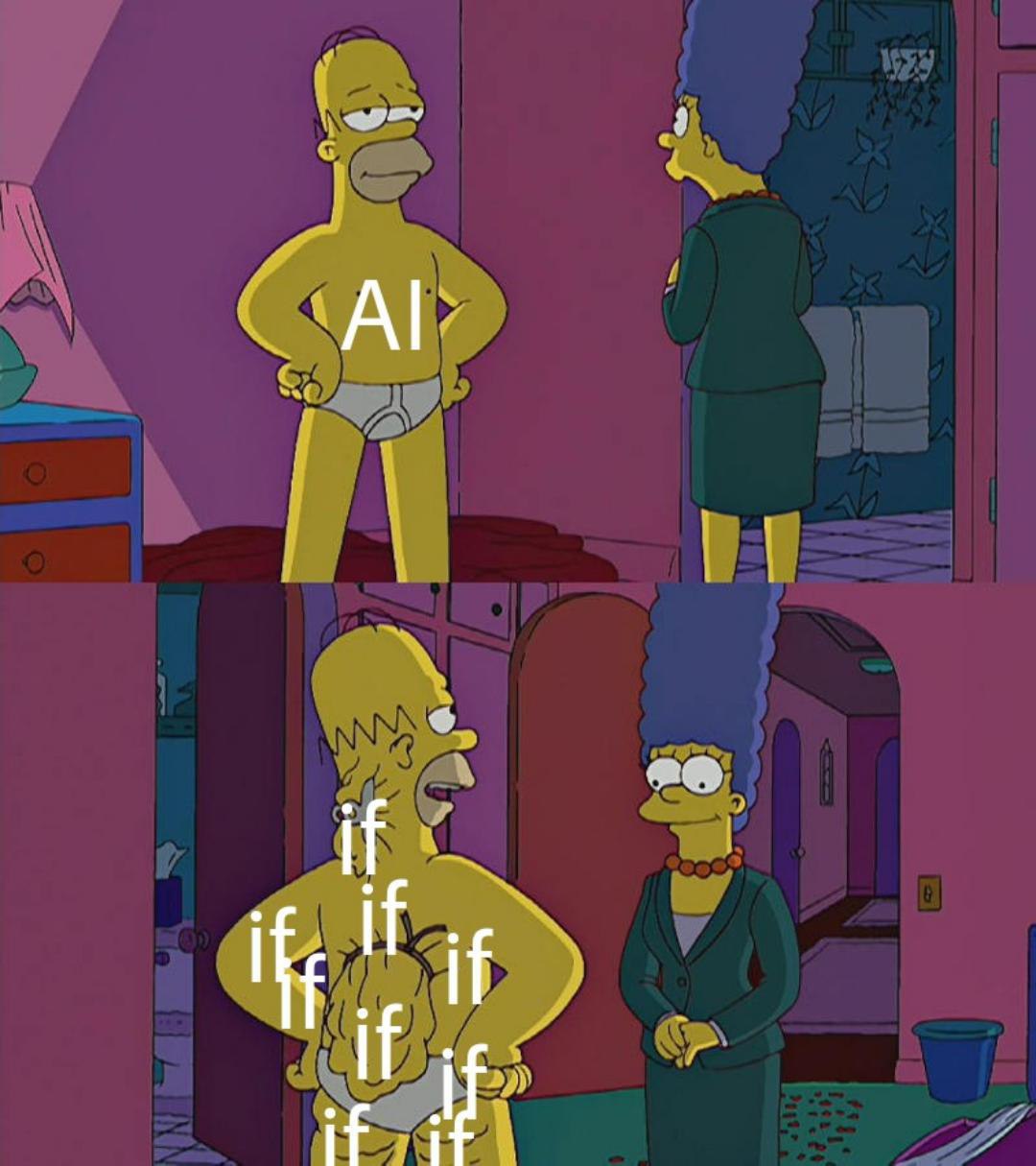
The image is a four-panel cartoon screenshot from The Simpsons. The setting is a pink-colored bathroom. In the top left panel, Homer is depicted standing mostly nude, wearing only white underwear. He is looking at Marge, who is fully clothed in a dark green suit and has her back to him, looking toward the viewer. The bottom two panels show a close-up of Homer's face looking at Marge who is positioned in a power stance and wearing a business suit. The text "AI" and "if if if if if if" are layered over the panels in a graphic format.
The cartoon style is typical Simpsons: bright, exaggerated, and somewhat flat. The pink color scheme is unusual and likely intended for thematic or symbolic effect. The layering of text onto the image further transforms it into a meme-like visual statement.
Foucauldian Genealogical Discourse Analysis
This image lends itself to a Foucauldian reading focused on power dynamics, surveillance, and the construction of the self. The bathroom, traditionally a private space, becomes a site of scrutiny and performance.
- Power/Knowledge: Marge, in her professional attire, represents a system of power (likely work or social norms). Homer's nudity disrupts this system, making him vulnerable to Marge’s gaze and potentially to the implied judgment of societal standards. The power dynamic is immediately visible, with Marge as the more powerful figure through her posture and clothing.
- Discipline & Panopticism: Though not explicitly shown, the bathroom setting suggests a space of self-regulation. Homer’s near-nudity implies a loss of control or a deliberate performance of vulnerability. Marge's position, with her back partially turned, mimics the gaze of the “watcher” in a Panoptic structure.
- Genealogy of Gender Roles: The contrast between Marge’s "professional" attire and Homer’s undress reinforces traditional gender roles. A genealogical analysis would trace how these roles have been constructed and maintained through societal discourse. The meme-like layering of “AI” and “if if if” could be a commentary on algorithmic or systemized performance of gender.
Critical Theory
This image evokes themes found in Critical Theory, particularly concerning societal norms and the construction of identity.
- Deconstruction of the Domestic Ideal: The Simpsons frequently subverts the idealized image of the American family. This image, with Homer in a state of undress while Marge assumes a position of power, challenges the traditional patriarchal structure of the family.
- False Consciousness: Homer's vulnerability and the power dynamic may be seen as reflecting a broader societal "false consciousness" – a state in which individuals are unaware of the true forces shaping their lives. Homer’s actions could be seen as a form of unconscious resistance or a critique of societal expectations.
- Alienation: The awkwardness of the situation and the disrupted domestic scene could be seen as reflecting the alienation inherent in modern life.
Marxist Conflict Theory
From a Marxist perspective, the image can be interpreted through the lens of class and power relations.
- Power Imbalance: The contrast between Marge's professional attire and Homer's state of undress symbolizes a power dynamic. Marge’s attire suggests she engages in a capitalist labor structure, while Homer appears to be outside of it. This imbalance creates a conflict within the domestic sphere.
- Commodification of the Body: The exposure of Homer's body might be seen as a subtle commentary on the commodification of the body in capitalist culture.
- Ideological Hegemony: Marge's role in a professional setting reinforces the dominant ideology of work and success. Her positioning in the image may reflect the ideological control that capitalism exerts over individuals and their relationships.
Postmodernism
The image embraces several elements of Postmodernism:
- Irony & Parody: The Simpsons is fundamentally a work of parody and self-referential irony. This image exemplifies that approach, disrupting conventional expectations and challenging established norms.
- Fragmentation & Simulacra: The layering of text ("AI" and "if if if") onto the image introduces a layer of fragmentation and artificiality. The layering of text suggests a meta-narrative and creates a simulacrum of meaning.
- Deconstruction of Narrative: The image doesn't tell a clear story. It presents a frozen moment that invites multiple interpretations. The meme-like quality adds to the deconstruction of traditional narrative structures.
Queer Feminist Intersectional Analysis
This image invites a queer feminist reading concerning power, gender performance, and the disruption of traditional binaries.
- Disrupting Gender Roles: The image subverts the traditional gender roles within the family. Marge, usually depicted as a homemaker, is presented in a professional, powerful stance. Homer's state of undress challenges the expectation of male dominance.
- Gender Performance: Homer’s vulnerability and exposure can be seen as a performance of gender. This challenges the notion of fixed gender identities and opens up possibilities for subversion and fluidity.
- Power Dynamics: The power imbalance between Homer and Marge, particularly in relation to societal expectations of gender, is central to the image. This can be analyzed through an intersectional lens, recognizing how gender intersects with other social categories to create systems of oppression.
Disclaimer: These interpretations are not exhaustive. Art and images are open to multiple readings depending on the viewer’s own background and theoretical framework.
simple-description (llama3.2-vision)
The meme is a play on the classic "I'm not a lawyer, but..." phrase, with a humorous twist. It features a character from The Simpsons, Homer, in a compromising situation, with the phrase "I'm not a doctor, but..." written above him, but the text is replaced with "I'm not a doctor, but I've AI'd".
tesseract-ocr
Lr] | e « e | Xi | | Se a : A rd , s 4 4 ‘i ) be A