First Seen
2023-05-10T21:03:40+00:00
simple-description (llama3.2-vision_11b)
The meme is a screenshot of a Twitter post from a software engineer named "Software Engineer" who is frustrated with their job. The post says "I just spent 4 years learning how to do my job, and now I have to relearn it because the company changed the software to use a different programming language. I'm not even joking when I say I'm considering switching to a different field because of this. I'm not even joking when I say I'm considering switching to a different field because of this. I'm not even joking when I say I'm considering switching to a different field because of this. I'm not even joking when I say I'm considering switching to a different field because of this."
The meme is a humorous take on the frustration of being a software engineer, where the author is complaining about the constant changes in their job and how it's affecting their career. The text "I just spent 4 years learning how to do my job, and now I have to relearn it because the company changed the software to use a different programming language" is a common complaint from software engineers, who often have to adapt to new technologies and software changes. The joke is that the author is considering switching to a different field because of this, which is a humorous take on the frustration of being a software engineer.
detailed-analysis (gemma3-27b-vision)
Okay, let's break down this tweet from Sebastián Ramírez through various theoretical lenses.
Visual Description
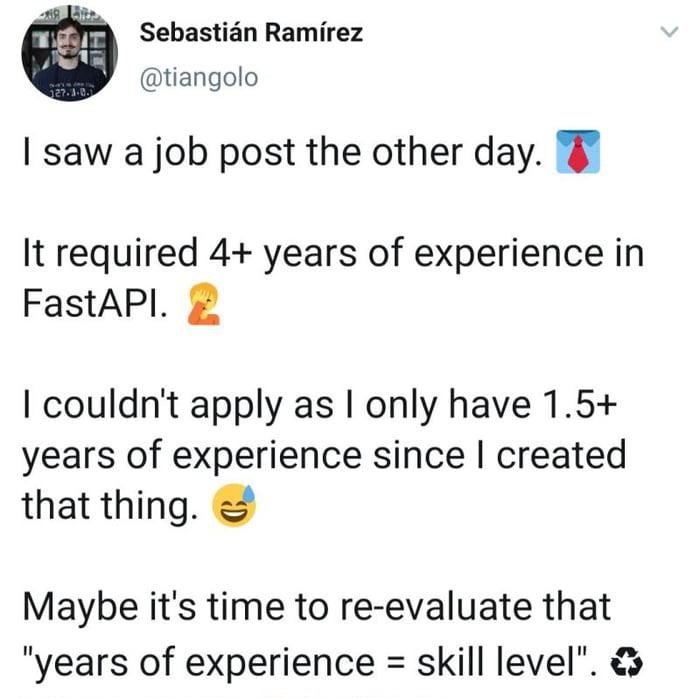
The image is a screenshot of a Twitter (now X) post. It features a profile picture of a man with a dark beard and patterned shirt. The post itself is text-based, showcasing a series of short statements regarding a job application. Notably, each statement is accompanied by an emoji: a blue square, a red pepper, a grinning face, and a sprouting leaf. These emojis add a layer of emotional nuance to the text, suggesting frustration, exasperation, and a call for reevaluation. The format is simple, typical of social media communication, and relies on brevity to convey a specific argument.
Foucauldian Genealogical Discourse Analysis
This tweet is ripe for analysis through a Foucauldian lens. The core argument isn’t necessarily about personal experience, but about the discourse surrounding "experience" and "skill level." The tweet exposes how the seemingly neutral metric of “years of experience” has become a power/knowledge construct.
- Genealogy: The tweet implicitly questions the historical origins of this system of valuation. Why four years? Who decided that was the threshold for competency in FastAPI? A genealogical approach would trace the development of this requirement, linking it to institutional practices, educational norms, and the professionalization of software development.
- Discourse: The author challenges the dominant discourse linking time served to expertise. They implicitly reveal how this discourse produces certain subjects as qualified and others as unqualified. By pointing out they created the technology, they suggest that creative contribution and foundational knowledge are devalued by this rigid system. The author is attempting to disrupt the seemingly objective logic of "years = skill," revealing it as a subjective and historically contingent construct.
- Power: The "years of experience" requirement functions as a form of biopower – it regulates access to employment and, therefore, controls who participates in the professional landscape. It’s a subtle but powerful mechanism for maintaining existing power structures.
Critical Theory
From a Critical Theory perspective, the tweet embodies a critique of the rationality of modern work.
- Instrumental Rationality: The emphasis on "years of experience" exemplifies instrumental rationality – valuing something (time served) only for its utility in fulfilling a specific goal (finding qualified candidates). It strips away the nuances of skill development and creative innovation.
- Commodification of Labor: The tweet highlights the commodification of labor. The author’s creative contribution—creating the technology—is rendered secondary to a quantifiable metric. Their skills are reduced to a unit of time, rather than being evaluated on their intrinsic value.
- Critique of Systems: The author isn't just frustrated with one job post; it's a frustration with the broader system of credentialism and the use of arbitrary metrics to determine worth.
Marxist Conflict Theory
While not overtly Marxist, the tweet touches upon themes of class and alienation.
- Alienation: The author experiences alienation from the fruits of their labor. They created the technology, yet they are barred from a position because they don't meet an arbitrary “experience” threshold. This disconnect between creative contribution and professional reward reflects a classic Marxist theme.
- Control of the Means of Qualification: The demand for "years of experience" can be seen as a way for existing institutions (companies, hiring managers) to control access to the “means of qualification” (employment) and maintain the existing power structure within the tech industry. The demand for specific, often artificially inflated, qualifications keeps the barrier to entry high, benefitting those already established.
Postmodernism
The tweet displays a distinctly postmodern sensibility by deconstructing a seemingly objective concept: “experience.”
- Deconstruction of Grand Narratives: The tweet challenges the "grand narrative" of linear career progression, suggesting that traditional markers of expertise ("years of experience") are not necessarily indicative of actual skill.
- Relativity of Truth: The author implies that “skill” is not an absolute quality, but is socially constructed and relative to specific contexts. Their creation of the technology challenges the authority of established metrics.
- Playfulness & Irony: The use of emojis adds a layer of playfulness and irony, subverting the seriousness of the professional landscape.
Let me know if you would like any of these analyses expanded upon, or if you’d like me to explore other theoretical frameworks.
simple-description (llama3.2-vision)
The meme is a humorous tweet from someone who applied for a job and was rejected. The text reads: "I saw a job posting today that said '2+ years of experience required'. I'm like... I've been working on my coding skills for 2 years now. I've been writing code in a language called 'C' for 2 years. Does that count as experience?"
tesseract-ocr
- Sebastian Ramirez @tiangolo | saw a job post the other day. F It required 4+ years of experience in FastAPI. 2 | couldn't apply as | only have 1.5+ years of experience since | created that thing. & Maybe it's time to re-evaluate that "years of experience = skill level’. &