First Seen
2023-05-10T21:03:40+00:00
simple-description (llama3.2-vision_11b)
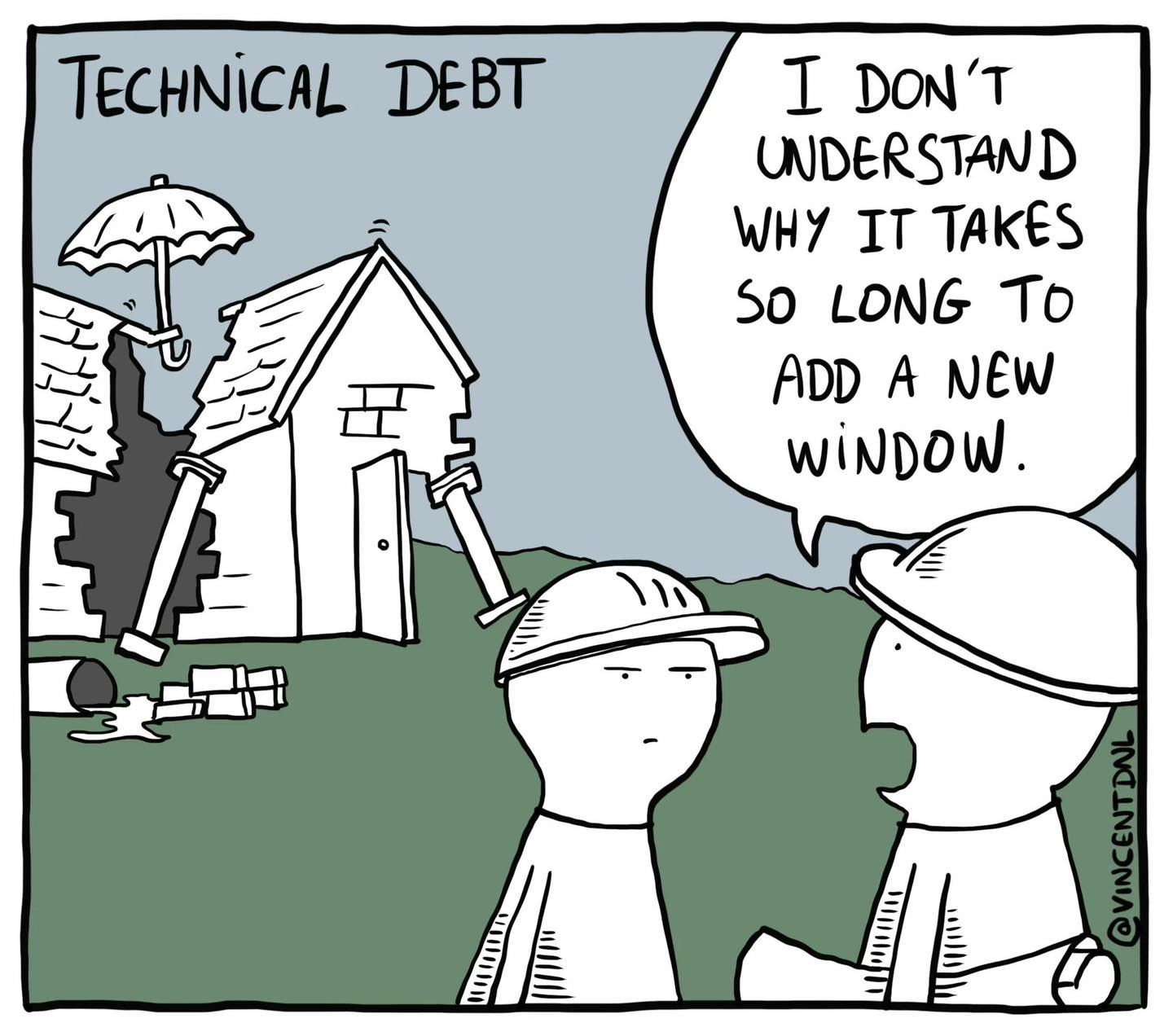
The meme is a humorous take on the frustration of dealing with technical debt, a concept in software engineering where old, inefficient code or design is left to accumulate, making it harder to maintain and update. The image shows a person trying to repair a broken house, with a caption "I don't understand why it takes so long to fix" implying that even simple tasks can be complicated due to the weight of accumulated technical debt. The text "I don't understand why it takes so long to fix" is a tongue-in-cheek commentary on the frustration of dealing with legacy code.
detailed-analysis (gemma3-27b-vision)
Okay, here's an analysis of the cartoon, broken down into sections according to the requested theoretical frameworks. I'll indicate where a framework doesn't readily apply.
Visual Description
The cartoon depicts a somewhat dilapidated, precarious house. It’s constructed with a haphazard mixture of materials—some planks, beams, and what appear to be hastily attached support structures. Parts of the house seem to be in disrepair, with some leaning precariously and held up by temporary bracing. Rain clouds and lightning are looming overhead. A pile of boxes, symbolic of perhaps initial, planned, or incomplete building blocks, sits at the base.
Two figures in hard hats are standing in front of the house, seemingly looking at it with bewilderment. One figure speaks in a speech bubble, saying, "I don't understand why it takes so long to add a new window.” Above the house is the text "Technical Debt." The style is simple, black and white line drawing with shading. The framing of the image, the skewed perspective, and the general sense of instability contribute to an overall impression of something being fundamentally wrong with the foundation of the structure.
Foucauldian Genealogical Discourse Analysis
This cartoon is very amenable to a Foucauldian reading. "Technical Debt" can be understood not as a purely technical term, but as a discourse that has emerged within software development (and increasingly, other fields) to normalize cutting corners and prioritizing speed over quality.
- Genealogy: Tracing the history of the term “technical debt” reveals its origins in the idea of quick fixes that will inevitably require "paying interest" later. The cartoon visualizes that “interest” as the chaotic, unstable structure representing the accumulated cost of those shortcuts. This isn’t just about bad coding; it’s about a way of thinking about project management.
- Power/Knowledge: The discourse of technical debt isn't neutral. It operates within a power dynamic where managers or clients often demand rapid development, and developers are pressured to incur debt. The statement, “I don't understand why it takes so long to add a new window” embodies this power dynamic. It illustrates how those external to the development process fail to grasp the complexities created by the accumulated "debt." The cartoon subtly suggests that the very question is rooted in a flawed understanding generated by the discourse of prioritizing speed.
- Discipline: The precarious structure disciplines developers. They are forced to work within a system built on instability and are constantly trying to keep it from collapsing, rather than building something solid and maintainable.
Critical Theory
The cartoon critiques the rationalization and efficiency-obsessed logic of contemporary project management.
- Instrumental Reason: The focus on speed and quick fixes (technical debt) represents a triumph of instrumental reason (Horkheimer & Adorno). The goal isn’t building something good, but achieving a short-term objective, regardless of the long-term consequences. The cartoon shows the disastrous outcome of this mindset: a structure that is inherently fragile and difficult to maintain.
- Alienation: The developers are alienated from the product of their labor. They aren't creating something they can be proud of; they’re merely patching up a flawed system. The constant need for repairs and maintenance prevents them from engaging in truly creative and fulfilling work.
- Domination: The cartoon can be seen as a subtle commentary on the domination of the market forces (demand for rapid delivery) over the craftsmanship and long-term health of the product.
Marxist Conflict Theory
A Marxist reading sees inherent class conflict at play.
- Labor & Capital: The developers (the labor) are forced to create "technical debt" to satisfy the demands of capital (managers, clients, shareholders). They are effectively exploited, forced to compromise quality to meet deadlines.
- Alienation: As in the Critical Theory reading, the developers are alienated from the product of their labor and from each other, as they are forced to work under these compromising conditions.
- Contradiction: The cartoon visualizes the inherent contradiction of capitalism: the drive for profit and speed leads to instability and ultimately threatens the sustainability of the whole project. The "debt" represents the accumulation of contradictions within the system.
Postmodernism
A postmodern reading could highlight the deconstruction of the idea of a “stable” or “finished” product.
- Simulation & Simulacra: The house isn't a "real" structure; it's a simulation built on layers of debt and quick fixes. It represents a hyperreality where the representation of a house is more important than the actual structural integrity.
- Rejection of Grand Narratives: The cartoon challenges the "grand narrative" of technological progress. It suggests that simply "building faster" isn’t necessarily progress, and that shortcuts can lead to a chaotic and unsustainable system.
- Fragmentation: The fragmented and precarious nature of the house reflects the fragmentation of modern experience.
Queer Feminist Intersectional Analysis
This framework is less directly applicable, but we can find subtle resonances.
- Invisible Labor: The cartoon can be interpreted through the lens of "emotional labor" or "invisible labor". The developers may be expected to absorb the stress and anxiety of managing this unstable system, without adequate support or recognition. This disproportionately affects marginalized groups within the tech industry.
- Precariousness: The precarious nature of the house parallels the precarity faced by many workers in the gig economy or in marginalized positions within the tech industry. The constant threat of collapse reflects the instability of their employment or career paths.
I hope this thorough analysis is helpful! Let me know if you’d like me to elaborate on any of these points.
simple-description (llama3.2-vision)
The meme is a cartoon of a person with a puzzled expression, standing in front of a house that is literally falling apart, with a broken roof, crumbling walls, and a door hanging off its hinges. The person is saying "I don't know why it takes so long to fix a house" in a sarcastic tone, implying that the house is in a state of disrepair due to a lack of funding or resources, rather than a lack of skill or effort. The caption "Technical Debt" is likely a reference to the concept of technical debt, which is a metaphor for the cost of delaying or putting off a task, similar to how a house can become worn down and require repairs.
tesseract-ocr
TECHNICAL DEBT T DON’T UNDERSTAND Loin 4 WHY IT TAKES 7 $0 LONG To | = ADD A NEW x Z WINDOW. Wi hy ae ~< A Orn YD ~~ fa 1,