First Seen
2023-06-09T21:14:15+00:00
simple-description (qwen3.5_2b-q8_0)
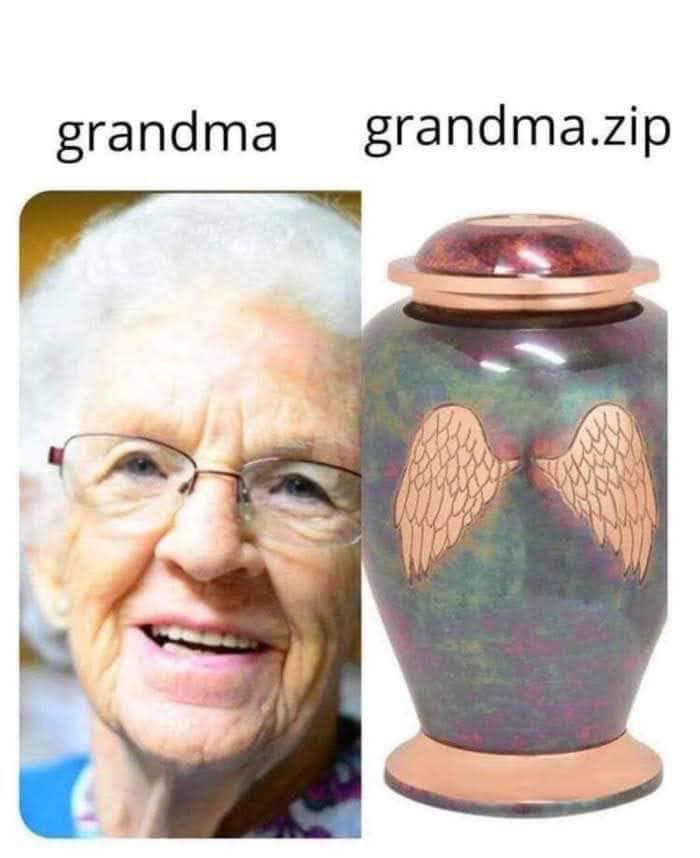
The image uses the software analogy of a zip file to describe the end of life of a person. The text "grandma.zip" labels the urn, representing the data object that has been compressed and archived. The person on the left represents the original instance of the data in memory. The wings on the urn further symbolize the object's transition to a final state where the "grandma" is no longer physically accessible but is stored as an archived zip file.
simple-description (llama3.2-vision_11b)
The meme is a humorous example of a "deepfake" image, where a person's face is superimposed onto a different body. In this case, the face of a young woman is transplanted onto an elderly woman's body, creating a surreal and comedic visual effect. The text "grandma" appears above the image, while "grandma" is written in a playful, childlike font below the image, highlighting the absurdity of the situation.
detailed-analysis (gemma3-27b-vision)
Okay, here's an analysis of the image, broken down into sections addressing the requested theoretical lenses, only where those lenses meaningfully apply. This image is rich in potential interpretations, so I'll try to be thorough but also avoid forcing frameworks where they don't fit well.
Visual Description
The image presents a diptych—a work composed of two panels. On the left is a close-up, color photograph of an elderly woman with short, white hair and glasses. She is smiling broadly, appearing friendly and approachable. The photograph quality suggests a professional portrait, perhaps a memorial picture. On the right is a photograph of a green urn. The urn is decorated with a pair of golden, stylized wings and has a reddish-brown lid. Above each photo, the word “grandma” is written over the first and “grandma.zip” is written over the second.
Postmodernism
The image strongly invites a postmodern reading. The juxtaposition of the smiling grandmother with the "grandma.zip" label is the central element. This is a clear instance of digital reductionism. The grandmother, a complex, lived individual, is reduced to a digital file—a "zip" file. This is not merely a statement about digital archiving of photographs. It's a commentary on how we increasingly experience and remember people through mediated digital forms.
- Simulacra & Simulation: The image hints at the concept of simulacra – copies that precede the original. The digital “grandma.zip” arguably becomes a kind of representation more readily available and circulated than actual memories of the grandmother herself. The line between the original "grandmother" and the digital copy blurs, leading to a hyperreality where the representation takes on a life of its own.
- Fragmentation & Loss of Authenticity: The "zip" file suggests a compartmentalization of the grandmother—her life, memories, and personality broken down into manageable digital components. The warmth and vitality of the living grandmother are replaced by the cold, static reality of a digital file. This fragmentation speaks to the postmodern concern with the loss of a stable, authentic self in a world defined by information overload and mediated experience.
- Irony & Playfulness: There is a clear sense of irony in the image. The smiling portrait clashes with the cold, technical language of "grandma.zip". This ironic contrast is characteristic of postmodern aesthetic strategies, which often involve a playful deconstruction of traditional values and conventions.
Foucauldian Genealogical Discourse Analysis
While not as dominant as the postmodern interpretation, a Foucauldian analysis can add nuance. The image demonstrates how discourse shapes our understanding of death, memory, and identity in the digital age.
- Power/Knowledge: The term "zip" is not neutral. It's a technological term associated with compression, archiving, and control. The act of "zipping" the grandmother suggests a desire to contain and control her memory, to make it easily accessible and manageable. This control, however, is not necessarily benevolent. It can also be seen as a form of power exerted over her legacy.
- Genealogy of Memory: We can trace the genealogy of how we remember and preserve the memories of loved ones. Historically, this was done through oral storytelling, handwritten letters, photographs preserved in albums, etc. Now, we increasingly rely on digital archives. This shift represents a change in the technologies of memory and a change in the power dynamics surrounding who controls those memories.
- Disciplinary Practices: The “zipping” of the grandmother's life can be viewed as a kind of disciplinary practice – a way of ordering and categorizing her existence. By reducing her to a digital file, we impose a structure and a logic onto her life that may not reflect its complexity or ambiguity.
Why other frameworks don’t apply well:
- Critical Theory: While there's a critique of how technology shapes memory, the image isn't centrally focused on broad societal structures of domination.
- Marxist Conflict Theory: There's no readily apparent class conflict or struggle over material resources at play in the image.
- Queer Feminist Intersectional Analysis: The image doesn't lend itself directly to an analysis of gender, sexuality, or intersectionality, unless one were to apply such a framework hypothetically, which would be a stretch.
In conclusion, the image is a visually striking and thought-provoking commentary on the digital age, memory, and the changing ways we experience loss. The most compelling readings come from a postmodern perspective, but a Foucauldian analysis adds further depth and nuance.
simple-description (llama3.2-vision)
The meme is a humorous comparison between two images. On the left is a picture of a grandmother, while on the right is a screenshot of a webpage with the URL "grandma.zip". The text "grandma" and "grandma.zip" are juxtaposed, implying that the grandmother's name has been shortened to a zip file extension, suggesting that the grandmother has been compressed or "zipped" into a digital file.
tesseract-ocr
grandma _— grandma.zip ; —" «a “ 7 | ef nee”