First Seen
2024-02-22T06:38:46.344606+00:00
simple-description (qwen3.5_2b-q8_0)
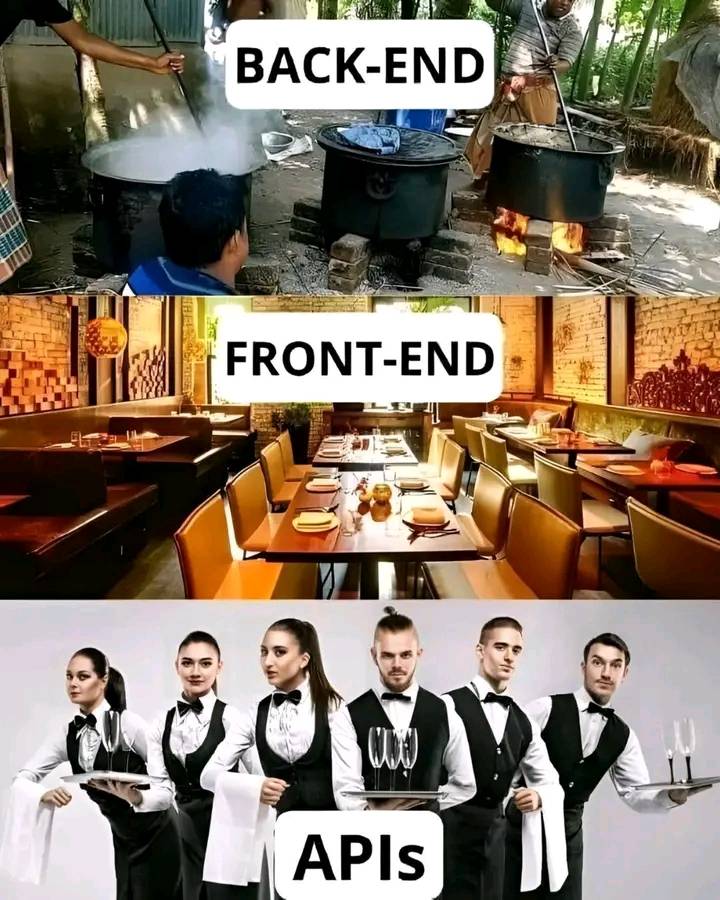
This meme uses a software development lifecycle analogy. The top section, labeled "BACK-END," depicts a rustic cooking scene representing the raw data, database management, and underlying server logic required to build the application. The middle section shows an empty, set restaurant labeled "FRONT-END," symbolizing the user interface or the "app" that the customer sees. Finally, the bottom section features servers on a tray labeled "APIs," referencing the popular internet meme "servers running on a tray," which highlights the middleman layer of communication connecting the user to the backend.
simple-description (llama3.2-vision_11b)
This meme is a humorous take on the software engineering concept of the "backend" (server-side) and "frontend" (client-side) of a web application, with a twist on the "backend" and "frontend" roles in a restaurant. The image shows a chef (backend) and a waiter (frontend) working together to serve a customer, but with the chef being a wild animal and the waiter being a robot. The text "backend" and "frontend" are displayed above the chef and waiter, respectively, with "APIs" (Application Programming Interfaces) written above the chef, implying that the chef is using APIs to prepare the meal.
detailed-analysis (gemma3-27b-vision)
Okay, let's break down this layered image, applying the requested theoretical lenses.
Visual Description
The image is a triptych, divided into three horizontal bands, each labeled with a computer science term that can also be metaphorically applied to a restaurant setting.
- Top Panel (Labeled "BACK-END"): Depicts a bustling, somewhat chaotic kitchen scene. Multiple chefs are visible, focused on cooking and plating food. A large cooking apparatus appears central, with smoke and steam suggesting intense activity. The color scheme is dominated by stainless steel and dark surfaces.
- Middle Panel (Labeled "FRONT-END"): Shows a well-appointed dining room, seemingly upscale. Tables are meticulously set with fine china, glasses, and silverware. The room is warm-toned, with decorative elements and a generally refined ambiance. The scene suggests a public-facing, polished presentation.
- Bottom Panel (Labeled "APIs"): Features a line of servers or waitstaff, standing at attention. They are formally dressed in uniforms (black jackets, white shirts, and bowties) and present a polished, homogeneous image. They are holding silver trays. The background is a simple, bright white.
Foucauldian Genealogical Discourse Analysis
This image is ripe for Foucauldian analysis. The labels "Back-End," "Front-End," and "APIs" immediately invoke a discourse of systems, control, and normalization.
- Power/Knowledge: The division itself demonstrates the construction of power/knowledge relationships. The "back-end" (kitchen) is where raw materials are transformed, where the "truth" of production is located. However, it’s concealed from the "front-end" (dining room), where a curated representation of that production is presented. The "APIs" (servers) act as interfaces, mediating access to the product and enforcing the rules of the "front-end" experience.
- Discipline & Normalization: The kitchen, while appearing chaotic, is likely governed by strict rules of hygiene, timing, and order. This is a site of disciplinary power. The front-end requires its own disciplined performance – servers adhering to specific protocols, diners expected to behave in certain ways. The "APIs" represent the perfect execution of that performance. The image suggests that the restaurant is a machine for producing a normalized dining experience.
- Genealogy: Tracing the genealogy of the “restaurant” concept reveals a complex history of evolving social practices, shifting food technologies, and changing ideas about hospitality and public space. It’s not a natural or inevitable structure, but a historically contingent one.
Critical Theory (Frankfurt School)
From a critical theory perspective, the image can be read as a microcosm of broader societal alienation.
- Commodification: The entire scene is built around the commodification of food and experience. The labor of the kitchen staff is obscured, and the focus shifts to the polished presentation and the consumer's enjoyment of the “product.”
- Culture Industry: The restaurant itself can be seen as part of the "culture industry," creating standardized, predictable experiences designed to pacify and control the consumer. The uniformity of the servers reinforces this standardization.
- Loss of Authenticity: The "front-end" hides the "back-end," creating a distance between the production and the consumption. This can be seen as a symptom of the broader loss of authenticity in modern society.
Marxist Conflict Theory
A Marxist reading focuses on the inherent class conflict within the image.
- Means of Production: The kitchen represents the "means of production" – the labor and resources required to create the food. The owners/management are absent but implied as the controllers of these resources.
- Exploitation of Labor: The image hints at the exploitation of labor in the kitchen. The chefs and cooks are doing the hard work, but the benefits accrue to the owners and shareholders. The servers, while visible, are also a component of this labor structure, mediating the extraction of value.
- Alienation: The division between "back-end" and "front-end" reinforces the alienation of the worker from the product of their labor. The chefs likely have little connection to the diners who ultimately consume the food.
Postmodernism
The image lends itself to a postmodern interpretation by highlighting the constructedness of reality and the blurring of boundaries.
- Simulacra and Simulation: The "front-end" can be seen as a simulacrum – a copy without an original. It presents an idealized version of the dining experience, divorced from the messy reality of the kitchen.
- Deconstruction: The labeling with computer science terms actively deconstructs the traditional understanding of a restaurant. It challenges us to see the restaurant as a system of codes and interfaces, rather than a natural or organic social space.
- Loss of Grand Narratives: The image suggests a loss of the grand narratives of tradition and authenticity. The restaurant is no longer simply a place to eat; it’s a carefully constructed performance, a simulation of a dining experience.
Queer Feminist Intersectional Analysis
This is the most challenging lens to apply directly, but it's possible:
- Gendered Labor: The kitchen is often a historically gendered space, with many positions traditionally held by men. The servers, particularly in formal settings, are often women. This image implicitly highlights the division of labor along gender lines.
- Performance of Gender/Service: The servers are performing a role, enacting a specific set of expectations related to politeness, deference, and appearance. This performance is intertwined with gendered expectations of service work.
- Intersectional Power Dynamics: The image hints at power dynamics that cut across class, gender, and potentially race/ethnicity (based on the apparent diversity of the servers). The owners/management (absent) hold the most power, while the workers (both kitchen and servers) have less agency.
- Standardization & Conformity: The uniformity of the servers can be seen as a form of control that enforces conformity to specific standards of appearance and behavior. This conformity can be particularly restrictive for individuals who do not fit within those norms.
Let me know if you'd like me to elaborate on any of these analyses, or explore other theoretical frameworks!
simple-description (llama3.2-vision)
This meme is a play on the concept of a restaurant's service hierarchy, with the top being the "front-end" (the waiters and hosts), the middle being the "back-end" (the kitchen staff), and the bottom being the "APIs" (the behind-the-scenes workers who make sure everything runs smoothly). The text in the image reads "front-end", "back-end", and "APIs". The joke is that the "APIs" are the ones who actually do all the hard work, but are often overlooked.
tesseract-ocr
8 = Ss BLS WARES a hs 6) - a = = BACK-END ds : — I an ml ; Se ~~ | A FRONT-END =f. |f a : Sateen — aes Sais, a i ry } = IP: NS MAK = i A = aa Ly 4 ae aie a ee os APIs