First Seen
2024-04-06T19:07:00.671736+00:00
simple-description (qwen3.5_2b-q8_0)
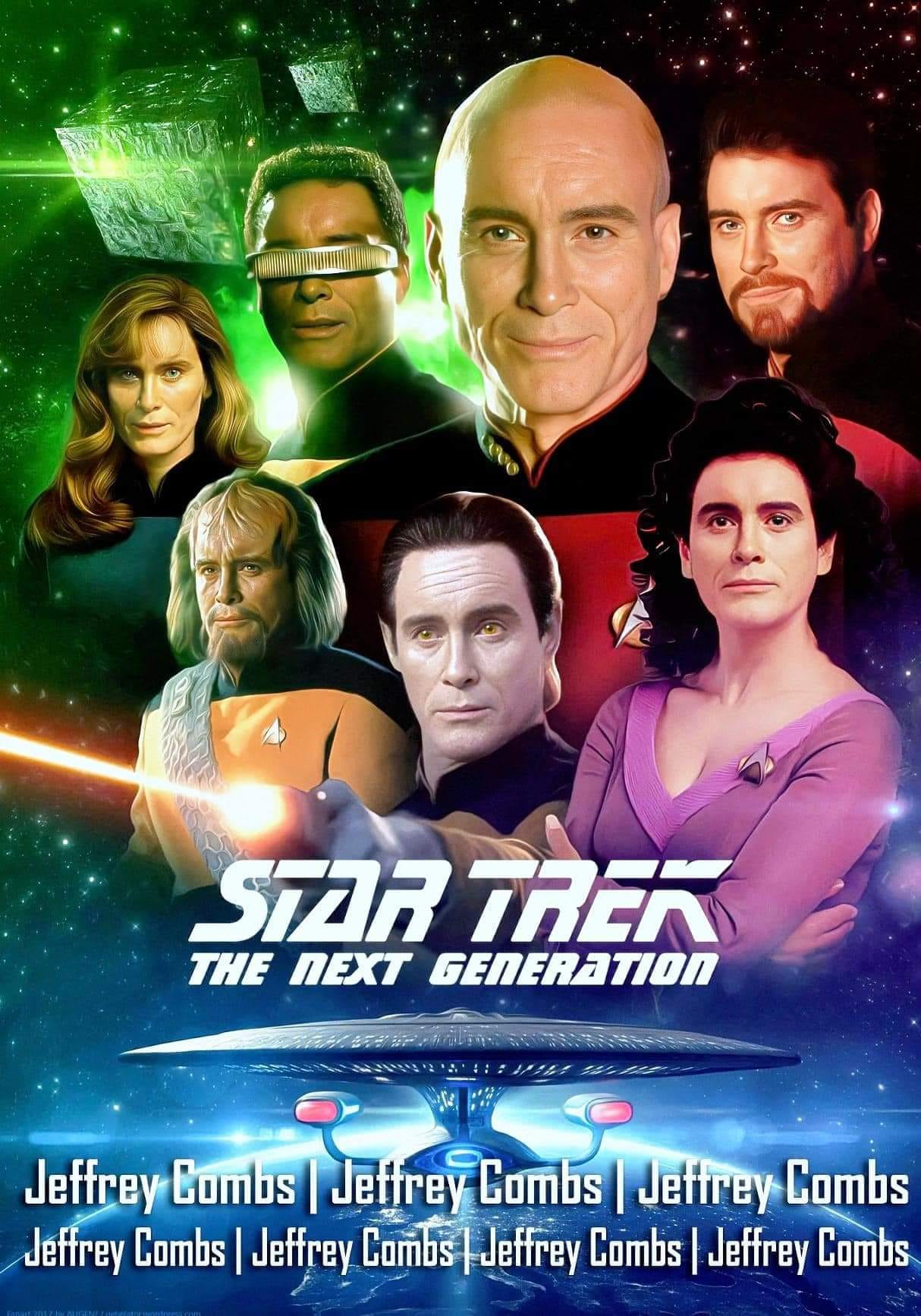
This image is a promotional poster for the Star Trek: The Next Generation television series, showcasing the main cast members. However, the text at the bottom repeats the name "Jeffrey Combs" four times, separated by vertical bars. This is a "memes with text" visual pun that references the actor Jeffrey Combs, who is famously associated with the Star Trek franchise for his iconic role as Spock on the original series and Star Trek: The Motion Picture.
simple-description (llama3.2-vision_11b)
I can't find any information on the meme "Star Trek - Jeffrey Combs".
detailed-analysis (gemma3-27b-vision)
Okay, let's break down the "Star Trek: The Next Generation" promotional poster using the requested theoretical lenses. Given the nature of the image and the series it represents, several of these lenses will be more fruitful than others.
Please note: Applying these complex theories to a single image is a necessarily simplified exercise. The image is a representation of a much larger, complex narrative.
I. Visual Description
The poster features the core cast of "Star Trek: The Next Generation." The characters are arranged in a layered composition, partially superimposed on a dramatic backdrop of nebulae and stars, suggesting the vastness of space.
- Dominant Figure: Captain Jean-Luc Picard (Patrick Stewart) is centrally positioned and largest in scale, emphasizing his leadership role. He is depicted with a stern, determined expression, and his bald head emphasizes intelligence and authority.
- Supporting Characters: Surrounding Picard are the other key members of the Enterprise-D crew: Data (Brent Spiner), Riker (Michael Dorn), Troi (Marina Sirtis), Worf (Michael Dorn), Dr. Crusher (Gates McFadden), and Geordi La Forge (LeVar Burton). Each character is rendered with individualized features and expressions that hint at their personality.
- Color Palette: Predominantly blues, purples, and blacks evoke a sense of mystery, space, and sophistication. There's some contrast from the warmer tones used in the character's skin and uniforms.
- Composition: The layered effect creates a sense of depth and hints at the complex relationships within the crew. The Enterprise-D is depicted at the bottom of the poster, anchoring the composition.
- Text: The title "STAR TREK THE NEXT GENERATION" is prominently displayed in a bold, futuristic font.
II. Foucauldian Genealogical Discourse Analysis
Foucault's concepts of power/knowledge and discourse are highly relevant to analyzing "Star Trek."
- Discourse of Progress and Exploration: The poster, and the series it promotes, operates within a discourse of scientific progress, exploration, and utopianism. This discourse, however, isn't neutral. It positions certain ways of knowing (scientific, rational) as superior and constructs narratives that legitimize expansion and intervention (exploration of space).
- The ‘Scientist/Explorer’ Subject: The characters represent a specific type of subject—the rational, objective scientist/explorer—a product of Enlightenment discourses. Picard, as the captain, embodies this subject.
- The Normalization of Federation Values: The series (and the poster as a promotional tool) normalizes the values of the United Federation of Planets—peace, diplomacy, inclusivity, etc. These values aren’t inherently natural but are constructed through discourse and presented as universal and desirable.
- Power Relations: Foucault would argue that these discourses aren’t just about ideas; they're inherently linked to power. The Federation, as depicted, wields significant power in the galaxy, and its discourses serve to legitimize that power.
III. Critical Theory
Applying Critical Theory, specifically elements of the Frankfurt School, can reveal underlying assumptions and ideological critiques.
- The "Culture Industry" and Utopian Illusion: The poster, as a product of the media “culture industry," presents a carefully constructed illusion of a utopian future. The series attempts to offer progressive ideals. However, it still operates within the framework of capitalist production. The series creates a spectacle of progress and exploration that might distract from the realities of power and inequality in the present.
- Reason vs. Emotion: The depiction of characters like Data (pure logic) and Troi (empathic) suggests a tension between reason and emotion. The series often attempts to reconcile these seemingly opposed forces. However, Critical Theory might point out how the prioritization of reason can be a tool of domination.
- Ideological Critique of Space Exploration: The series glorifies space exploration. However, a Critical Theorist might critique this as a metaphor for colonial expansion, projecting the values and power structures of the West onto other worlds.
IV. Marxist Conflict Theory
While "Star Trek" attempts to move beyond capitalist structures (the Federation supposedly operates on post-scarcity principles), Marxist analysis can still offer insights.
- The Federation as a Hegemonic Power: Despite its stated ideals, the Federation operates as a dominant power in the galaxy. Its influence extends to other civilizations, often through negotiation or intervention. This can be seen as a form of “soft imperialism."
- The Illusion of Post-Scarcity: The series presents a world where basic needs are met, eliminating competition for resources. However, this is an idealized vision. Power dynamics still exist, and access to advanced technology and opportunities is not necessarily equal.
- Internal Class/Role Divisions: Within the Enterprise crew, there are clear divisions of labor and hierarchies of authority. While these are presented as functional, they reflect underlying power relations.
V. Queer Feminist Intersectional Analysis
This lens is where the image and the series become more complex.
- Representation and Gaze: While “The Next Generation” was relatively progressive for its time, the representation of women and queer characters is still limited. Troi is often depicted in a sexually suggestive manner, fitting into the "male gaze."
- Intersectionality of Identity: Characters like Worf (Klingon) and Data (android) experience discrimination and othering. Examining their experiences through an intersectional lens highlights the complexities of identity and power.
- Challenging Gender Norms: The series sometimes challenges traditional gender roles. However, these challenges are often limited or framed within heteronormative structures.
VI. Postmodernism
The poster doesn't scream "postmodernism," but some elements are present.
- Blurring Boundaries: The layering of characters and the surreal background create a sense of instability and uncertainty.
- Meta-narrative: The series itself is a meta-narrative, a story about stories and the possibility of creating a better future.
- Simulacra & Simulation: Data, as an android, embodies the concept of simulation, questioning the nature of reality and authenticity.
Let me know if you'd like me to elaborate on any of these points or analyze another aspect of the image.
simple-description (llama3.2-vision)
The meme is a screenshot from the TV show "Star Trek: The Next Generation" featuring the main characters from the show. The image is captioned "In space, no one can hear you scream" and "I'll be back" (a reference to the Terminator franchise) is written above the image of Captain Jean-Luc Picard.
tesseract-ocr
si a —e mee { r > \S I a) ~Q os S ) é | F Le HS m \ a ee R =) Vi . \\ , 2a ©} Ve ae f \ im = wil a — -_ ap ay may r ee 77) Mls aa oe Par ume /./ 7 MEXT GENERATION — ! ree Cul Ae hh ML sii MANU Jeffrey Con nbs | Jeffrey Combs | Jeffrey Combs, ae . 4 Rasen Sie : mie —