First Seen
2023-05-10T21:03:40+00:00
simple-description (llama3.2-vision_11b)
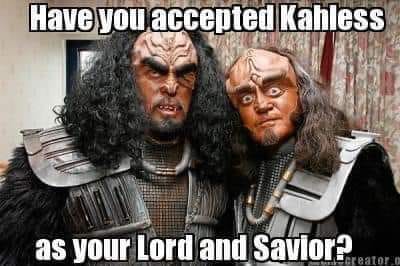
This meme is a play on the Star Trek character Worf, a Klingon warrior, and the concept of honor in Klingon culture. The meme shows a picture of Worf with the caption "I do not want to live in a Klingon honor society" with the text "I do not want to live in a Klingon honor society" and "I want to live in a society where honor means not killing your friends and acting like an idiot." The meme is poking fun at the idea that Klingon honor is about killing and acting aggressively, rather than about being honorable.
detailed-analysis (gemma3-27b-vision)
Okay, here's an analysis of the image and the meme text, broken down into sections based on the requested theoretical frameworks. I'll indicate where a framework doesn't particularly apply.
Image Description
The image features two characters from Star Trek: The Next Generation, specifically Gul Dukat and Damar, who were Cardassian officials. Both are depicted in severe close-up, with exaggerated expressions. Dukat (on the left) has a fierce, almost predatory glare. Damar (on the right) appears fearful, distressed, and perhaps subservient. They are both wearing dark, ornate Cardassian uniforms with high collars and shoulder armor. The background is indistinct, suggesting an interior space. The image is formatted as a meme with text superimposed on it. The text asks the question, "Have you accepted Kahless as your Lord and Savior?".
Foucauldian Genealogical Discourse Analysis
This image powerfully evokes a discourse around power, domination, and the construction of belief.
- Power/Knowledge: The image represents the imposition of a particular belief system (the worship of Kahless, the mythological Klingon leader) through the lens of Cardassian authority. The facial expressions suggest a power dynamic in which Dukat attempts to enforce belief, while Damar experiences a struggle between resistance and submission. This aligns with Foucault’s understanding of how power isn’t simply repressive, but productive; it creates subjects who internalize norms.
- Discourse & Discipline: The question posed in the meme functions as a disciplinary tool. It's not merely an inquiry; it's an attempt to categorize individuals, to assess their alignment with the imposed ideology. Accepting Kahless becomes a marker of ‘correct’ belief, while non-acceptance implies deviance.
- Genealogy: The meme taps into the history of both the Klingon and Cardassian cultures as depicted in Star Trek, highlighting the ways in which belief systems are constructed and evolve over time. The question forces a confrontation with this inherited cultural understanding.
Critical Theory
The meme engages with Critical Theory by exploring themes of ideology and domination.
- Ideology: The meme critiques the notion of "lord" and "savior," revealing how these concepts can be used to legitimize power structures. It points to the inherent dangers of unquestioning allegiance to any leader or ideology.
- Hegemony: The question subtly exposes the attempt to establish a Cardassian hegemony. By forcing the acceptance of a Klingon religious figure (Kahless), Dukat and Damar are attempting to impose a new order that serves their political agenda.
- False Consciousness: Damar’s fearful expression may suggest an individual trapped within a “false consciousness,” where they have internalized the dominating ideology despite its inherent contradictions or exploitative nature.
Marxist Conflict Theory
While not the primary focus, elements of Marxist thought can be applied:
- Power Dynamics: The image depicts a clear power imbalance between the two Cardassians. Dukat's dominant posture and expression contrast sharply with Damar’s fear, indicating a conflict over authority and control.
- Ideology as Control: The question about Kahless serves as a means of ideological control. It’s a way to unify a population through shared belief, thereby suppressing dissent and maintaining the ruling class's (Cardassian) power.
- Class Struggle: In a broader sense, the conflict between the Klingons, Cardassians, and the Federation (the overarching context of Star Trek) can be interpreted as a struggle for resources, territory, and ideological dominance.
Postmodernism
The meme inherently embodies postmodern elements through its playful and ironic use of cultural references:
- Intertextuality: It draws upon two distinct fictional universes – Star Trek and Klingon mythology. It relies on the viewer’s knowledge of both to understand the humor and critique.
- Deconstruction of Grand Narratives: The question challenges the traditional notions of leadership, salvation, and religious belief. It exposes the constructed nature of these concepts and suggests that there is no single “truth.”
- Parody/Irony: The juxtaposition of the Cardassian characters with the question about Kahless creates a deliberate irony. It highlights the absurdity of attempting to impose one culture's beliefs onto another.
Queer Feminist Intersectional Analysis
This framework doesn’t particularly apply to the image’s surface content, but a stretch could be made. One could interpret the power dynamics as reflecting broader patterns of domination. The expectation of complete submission from Damar, enforced by Dukat, could be seen as a metaphor for oppressive patriarchal structures. However, this is a tenuous connection. The meme doesn't inherently engage with themes of gender, sexuality, or intersectionality.
Let me know if you'd like any of these sections expanded or clarified!
simple-description (llama3.2-vision)
This meme is a play on the iconic Star Trek: The Next Generation "I am Locutus" scene, where a Borg drone says "You will be assimilated. Resistance is futile." Here, it's been modified to say "You will be assimilated. You will be... Klingon." The image shows a Borg drone with a Klingon's head superimposed over it, with the Borg drone's voice saying "You will be... Klingon."
tesseract-ocr
CEA De! ETT CA ine Bd! : ; aN F fi ye ee ovale I> PSM ECE CUE. Ca