First Seen
2023-05-10T21:03:40+00:00
simple-description (llama3.2-vision_11b)
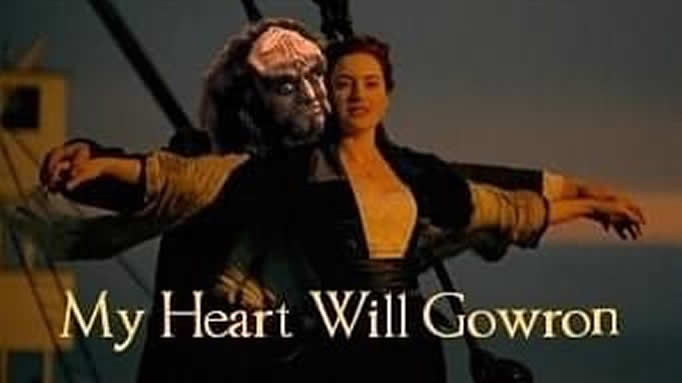
The meme is a screenshot from Star Trek: The Next Generation, featuring a Klingon warrior's honor speech, "I am Gorthok the Unyielding, and I will not be...". The image is captioned with a humorous twist, "I am Gorthok the Unyielding, and I will not be... hungry until I eat this sandwich".
detailed-analysis (gemma3-27b-vision)
Okay, here's an analysis of the image, broken down into the requested sections. Given the imagery, several sections are strongly applicable, while others are less direct.
Visual Description
The image is a composite, digitally manipulated, meme-like scene juxtaposing elements from two iconic sources: the film Titanic and Pirates of the Caribbean. The foreground features Jack Sparrow (Johnny Depp) from Pirates, his face partially obscuring Rose (Kate Winslet) from the famous "flying" scene in Titanic.
- Composition: The arrangement deliberately places Sparrow in a dominant position, partially covering Rose, suggesting a power dynamic shift. This isn’t a natural, in-universe scene, but a constructed image designed to evoke a reaction.
- Color & Lighting: The color palette is dark and dramatic, typical of both source films. The background appears to be a seascape with the mast of a ship visible on the left.
- Emotional Tone: The combination of images is humorous and slightly jarring. Titanic is associated with romance and tragedy, while Pirates is adventure and swashbuckling. Combining them creates a sense of irony and plays with audience expectations.
- Text: The text "My Heart Will Gowron" is superimposed over the image, alluding to the famous song from Titanic, "My Heart Will Go On", but replaces it with the name of a character from Star Trek: The Next Generation, a Klingon commander named Gowron.
Foucauldian Genealogical Discourse Analysis
The image operates as a disruption of established discourses around romance, heroism, and even "canon" itself. A Foucauldian approach would examine the power dynamics inherent in the appropriation of these two film narratives.
- Discourse of Romance: Titanic established a dominant discourse around romantic tragedy. The image challenges this by introducing a figure (Sparrow) who is decidedly not a traditionally romantic lead. He is a trickster, a rogue, and his presence undercuts the idealized romantic imagery.
- Discourse of Masculinity: Titanic presents Jack Dawson as a romantic hero. Jack Sparrow represents a different type of masculinity — one that is unconventional, chaotic, and resistant to traditional heroic tropes. The placement of Sparrow over Rose could be interpreted as an assertion of this alternative masculinity.
- Disruption of Canon: The combination of the two films, the altered phrase, and the visual manipulation all demonstrate a disruption of "canon"—the established, accepted narratives of both franchises. The meme format itself is a key part of this disruption, as it invites remixing and reinterpretation.
- Power/Knowledge: The image functions by deploying pre-existing "power/knowledge" structures (the cultural understanding of both films) and subverting them for comedic effect. The viewer's knowledge of both narratives is necessary to 'get' the joke, but that same knowledge is then playfully undermined.
Critical Theory
From a broader critical theory perspective, the image can be seen as a commentary on cultural appropriation, the remixing of symbols, and the deconstruction of narrative.
- Intertextuality: The image is deeply intertextual – it relies on the viewer’s understanding of both Titanic and Pirates. It's not a self-contained artwork but a product of its references.
- Spectacle & Simulacra: (Drawing from Baudrillard) The image is a simulacrum – a copy of a copy, detached from any "original" meaning. It’s not about the actual characters or events, but about the idea of them. The image is a spectacle – designed to grab attention and provoke a reaction.
- Deconstruction: The image deconstructs the "romantic ideal" presented in Titanic by introducing an element of chaos and subversion. The clean, emotionally earnest pose of Rose is interrupted by the messy, unconventional figure of Sparrow.
- Cultural Commentary: The humorous combination can be seen as a playful commentary on popular culture, fan culture, and the tendency to mash up different narratives.
Marxist Conflict Theory
A Marxist reading would focus on the inherent power dynamics and class implications, though this is less direct in this image.
- Cultural Capital: Understanding the reference to both movies and Star Trek demonstrates a level of "cultural capital." Those with this knowledge are "in the know," while those without might be excluded from the joke.
- Commodification of Culture: The image itself is a product of the commodification of culture. Both Titanic and Pirates are blockbuster franchises designed for mass consumption. The meme format is also a form of cultural production with its own economic value.
- Subversion of Ideology: The image can be interpreted as a subtle subversion of the dominant ideology surrounding romance and heroism. By juxtaposing these narratives with a more unconventional figure, it challenges the traditional values they represent.
Postmodernism
The image is a quintessential example of postmodern art:
- Pastiche & Intertextuality: The deliberate combination of elements from two distinct sources is a hallmark of pastiche.
- Irony & Self-Reflexivity: The image is ironic and self-aware. It doesn’t take itself seriously and acknowledges its own artifice.
- Blurring of Boundaries: It blurs the boundaries between high and low culture, between original and copy, between narrative and parody.
- Rejection of Grand Narratives: The image rejects the idea of a single, overarching narrative. It celebrates fragmentation, remixing, and the multiplicity of interpretations.
- Hyperreality: The image doesn't refer to reality, but to signs of signs (movie clips, memes). It's a simulation of a scene rather than a genuine moment.
Queer Feminist Intersectional Analysis
While not immediately obvious, a Queer Feminist Intersectional reading can unpack interesting layers.
- Disruption of Heteronormative Narrative: Titanic is a famously heteronormative love story. Introducing Jack Sparrow disrupts this framework. Sparrow’s own ambiguous sexuality (often played for comedic effect) can be read as a subtle undermining of traditional gender and sexual roles.
- Reclaiming Space: Visually positioning Sparrow over Rose can be interpreted as a playful act of reclaiming space – asserting a non-heteronormative presence within a traditionally romantic narrative.
- Intersectionality: The combination of the characters from different franchises could be seen as a playful assertion of difference and a rejection of rigid categorization.
- Power Dynamics: The image subtly challenges the traditional power dynamics within romantic narratives. By placing Sparrow, a more chaotic and unpredictable figure, in a dominant position, it disrupts the traditional male/female power dynamic.
Let me know if you'd like any of these sections expanded, or if you'd like me to focus on a specific aspect of the image!
simple-description (llama3.2-vision)
This meme is a screenshot from the movie "Pirates of the Caribbean: The Curse of the Black Pearl" featuring Captain Jack Sparrow (played by Johnny Depp) standing on the edge of a ship, with his arms outstretched and a pirate hat on his head. The text overlayed on the image reads "I don't have a heart, I don't have a soul, I don't have a name... I don't have a heart, I don't have a soul, I don't have a name... My heart will go on... to hate you."
tesseract-ocr
\ aad) a We Sem Al oe