First Seen
2023-05-10T21:03:40+00:00
simple-description (llama3.2-vision_11b)
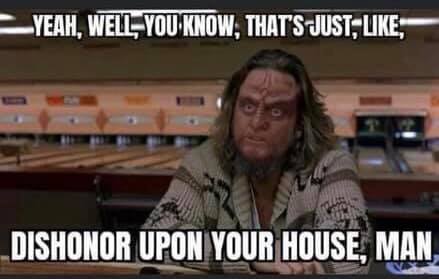
The meme is a screenshot from the Star Trek movie "Star Trek II: The Wrath of Khan" featuring Captain Kirk's (William Shatner) famous line "I want my ship back, you hear me, Kirk! I want my ship back!" However, in this meme, the line has been altered to "I want my ship back, you hear me, Klingon!" and the image is captioned "When you're trying to honor your Klingon ancestors but you're actually a dishonor".
detailed-analysis (gemma3-27b-vision)
Okay, here's an analysis of the image using the requested theoretical frameworks, with sections only where applicable. It's a bit…unusual, given the source material, but we'll try to apply the lenses thoughtfully.
Image Description
The image is a still from the 1998 cult classic film "The Big Lebowski" featuring John Goodman as Walter Sobchak. He’s shown in a bowling alley, looking directly at the camera with a somewhat aggressive, distressed expression. He’s wearing a patterned button-down shirt, and his hair is long and unkempt. Above him is text in white, reading “Yeah, well–you know, that’s just–like.” Below him is the iconic phrase, also in white, “Dishonor upon your house, man.” The lighting is somewhat dim, characteristic of a bowling alley, and the background shows bowling lanes and blurred figures. The image is clearly formatted as a meme, with the text emphasizing the character's particularly dramatic and over-the-top delivery.
Foucauldian Genealogical Discourse Analysis
The phrase “dishonor upon your house, man” is interesting when viewed through a Foucauldian lens. The term "dishonor" itself is deeply embedded in historical power structures. It references a code of conduct, familial reputation, and societal standing. Tracing the genealogy of this concept reveals that "dishonor" isn't a natural, universal value; it’s constructed through centuries of social norms, patriarchal systems, and religious codes.
Walter's aggressive invocation of this concept within the context of bowling – a seemingly trivial pursuit – is a disruption of expected discourse. He takes a concept tied to ancient forms of social order and applies it to a minor disagreement. This illustrates how discourses (ways of speaking and understanding) are constantly shifting and being applied in unexpected ways.
The power dynamic at play isn’t necessarily about literal lineage or ancestral reputation, but rather about Walter asserting dominance and control over the situation through dramatic language. It highlights how language itself is a form of power, and Walter weaponizes it.
Critical Theory
From a Critical Theory perspective, the meme taps into a broader cultural anxiety about societal norms and challenges to authority. The character Walter is intentionally presented as outside the mainstream. He is a Vietnam veteran with a penchant for aggression and a disregard for conventional social behavior.
The phrase "dishonor upon your house" is a rejection of the accepted rules of social interaction. It's an expression of defiance and a refusal to conform. The fact that it is often used humorously in meme culture doesn't diminish its subversive potential. It can be read as a commentary on the absurdity of social expectations and the ways in which individuals can resist being controlled by them. The meme’s popularity suggests a resonance with audiences who feel alienated from or critical of dominant social structures.
Postmodernism
The meme is distinctly postmodern in its embrace of pastiche, irony, and fragmentation. It takes a quote from a relatively obscure film and detaches it from its original context, repurposing it as a generic expression of outrage or disapproval. The phrase, divorced from the film’s narrative, becomes a signifier of hyperbole, theatricality, and exaggerated emotional response.
The meme also demonstrates the postmodern deconstruction of meaning. The original intent behind the phrase in the film (a reference to a specific cultural and historical understanding of honor and shame) is lost, replaced by a generalized sense of disapproval. This fragmentation of meaning is characteristic of postmodern thought.
The image's reliance on intertextuality—the understanding that meaning is created through references to other texts and cultural artifacts—is another hallmark of postmodernism. The success of the meme depends on the viewer's familiarity with "The Big Lebowski," turning the film into a shared cultural reference point.
Note:
- Marxist Conflict Theory and Queer Feminist Intersectional Analysis don't feel particularly relevant to the core themes present in the image or the quote. While these frameworks could be applied in a forced way, they wouldn't provide particularly insightful analysis. The meme doesn't directly address class struggle, labor relations, or issues of gender/sexual oppression.
Let me know if you’d like me to elaborate on any of these points or explore a different angle of analysis!
simple-description (llama3.2-vision)
The meme is a screenshot from the 1999 film "The Big Lebowski" featuring The Dude (played by Jeff Bridges) looking unimpressed. The text overlayed on the image reads "Dude, you're not even supposed to be here today. This is a bad time. This is a bad time for you to be here." The meme is likely being used to express frustration or annoyance at a situation, implying that it's a bad time for someone to be present.
tesseract-ocr
my TMS CTCL iS ol Sp MISCO OS 0