First Seen
2023-05-10T21:03:40+00:00
simple-description (llama3.2-vision_11b)
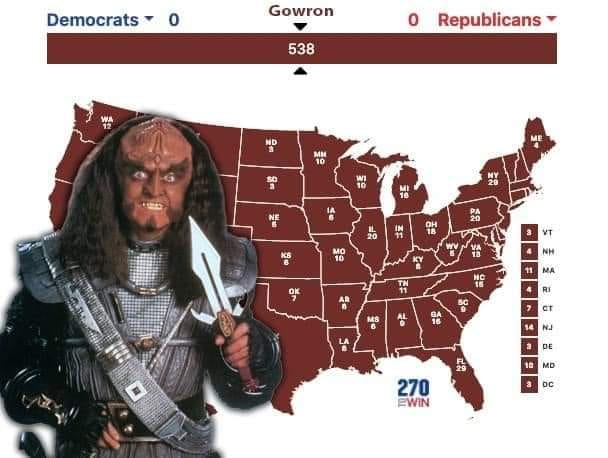
This meme is a reference to Klingon culture from the Star Trek universe, specifically the concept of honor. The meme shows a Klingon warrior, Worf, holding a bat'leth, a traditional Klingon sword, with a caption that reads "I do not fight. I kill. I do not kill. I destroy." This is a quote from the Star Trek: The Next Generation episode "The Icarus Factor," where Worf is struggling with his Klingon heritage and the need to uphold its honor. The meme is likely referencing this episode and the Klingon concept of honor, implying that the person is not just fighting, but destroying their opponent.
detailed-analysis (gemma3-27b-vision)
Okay, here's a breakdown of the image, analyzing it through the lenses you've provided. It's a complex image, and the interpretations below are attempts to unpack its potential meanings based on the frameworks you requested.
Visual Description
The image is a digitally manipulated political map of the United States. The map has been overlaid with a depiction of the character Gul Dukat from the science fiction television series Star Trek: Deep Space Nine. Gul Dukat, a Cardassian known for his ambition, ruthlessness, and complex morality, is posed in the foreground with a distinctive Cardassian blade. The map itself is colored to show which states support Democrats, Republicans, or are undecided. The numbers within each state represent electoral votes. The overlay shows Dukat is winning with 538 electoral votes, while Democrats and the “EWIN” candidate (possibly a user name) are at zero.
Foucauldian Genealogical Discourse Analysis
A Foucauldian analysis would focus on the discourses at play and how power operates through them. This image creates a discourse connecting political power with the character of Gul Dukat. We need to ask what historical archaeology (the underlying assumptions and rules) is being revealed.
- Power/Knowledge: The image links Dukat—a figure associated with authoritarianism, strategic manipulation, and a disregard for ethical norms—to the idea of political victory. This implies a discourse where effectiveness and domination are valued above moral considerations.
- Disciplinary Practices: The map itself represents a disciplinary practice—the act of categorizing and mapping political allegiance. By assigning Dukat a complete victory, the image imposes a specific order and reinforces the idea that certain ideological positions (those embodied by Dukat) are dominant.
- Genealogy of Victory: A genealogical analysis would trace the historical connections between ambition, ruthless leadership, and success in political systems. The image suggests a cyclical history where those willing to use any means necessary ultimately prevail. The "Star Trek" reference adds a layer by positioning this history within a future/fictional context, implying that this pattern is enduring.
Critical Theory
From a Critical Theory perspective (drawing from thinkers like Adorno and Horkheimer, and potentially the Frankfurt School), the image is a form of cultural critique.
- Culture Industry: The image utilizes a recognizable figure from popular culture (Star Trek) to comment on political processes. This aligns with the concept of the "culture industry," where mass-produced cultural products are used to reinforce existing power structures.
- False Consciousness: The image might be interpreted as highlighting a kind of “false consciousness,” where people are drawn to strong, even dangerous, leaders due to psychological and social factors. Dukat’s persona—charismatic but deeply flawed—could represent the seductive power of authoritarian figures.
- Critique of Enlightenment Reason: Dukat's disregard for ethics and his reliance on power and manipulation can be seen as a critique of the idea that reason and rationality inevitably lead to progress.
Marxist Conflict Theory
A Marxist analysis would focus on the power dynamics and class struggles reflected in the image.
- Dominant Ideology: The image suggests a scenario where a ruthless, self-serving individual (Dukat) has achieved complete control. This can be seen as representing the dominance of a particular class or ideology (in this case, the ideology of power and control).
- Class Struggle: While not explicitly depicted, the image implies a lack of resistance. The zero electoral votes for Democrats suggest a suppression of alternative voices or a complete dismantling of opposing forces. This can be interpreted as reflecting a situation where the ruling class has successfully neutralized any potential threat to its authority.
- False Needs: The image might subtly suggest that the masses are being manipulated into accepting a system that benefits only a select few. Dukat’s victory could be seen as a result of a carefully constructed narrative that appeals to people's base desires or fears.
Postmodernism
A postmodern reading would focus on the deconstruction of meaning and the blurring of boundaries between reality and representation.
- Simulacra and Simulation: The image is a simulation of a political landscape. It's a constructed reality that draws upon recognizable symbols and figures (the US map, Star Trek) but does not necessarily reflect actual political conditions. This aligns with Baudrillard's concept of simulacra, where signs and symbols become detached from reality.
- Deconstruction of Political Authority: By placing a fictional character in a position of political power, the image challenges the notion of legitimate authority. It suggests that political power is ultimately arbitrary and based on performance and manipulation rather than genuine representation.
- Meta-Narratives: The image implicitly critiques the idea of grand narratives (like the "American Dream" or the inevitability of democracy) by suggesting that power is often achieved through unscrupulous means. The dystopian undertones reinforce this sense of disillusionment.
Important Note: These interpretations are subjective and depend on how you read the image and apply these theoretical frameworks. The image is deliberately ambiguous, and its meaning is open to multiple interpretations.
Let me know if you'd like me to elaborate on any of these analyses or explore other theoretical perspectives.
simple-description (llama3.2-vision)
The meme is a picture of the 2020 US presidential election results, with each state colored red or blue to indicate which candidate won it. The text "2020" appears at the top, and the numbers "270" and "202" are shown, indicating the number of electoral votes won by each candidate.
tesseract-ocr
Democrats + 0 = 0 Republicans ~ 4. yea 4 Res fet \ - rg B Nee | > ao