First Seen
2023-05-10T21:03:40+00:00
simple-description (llama3.2-vision_11b)
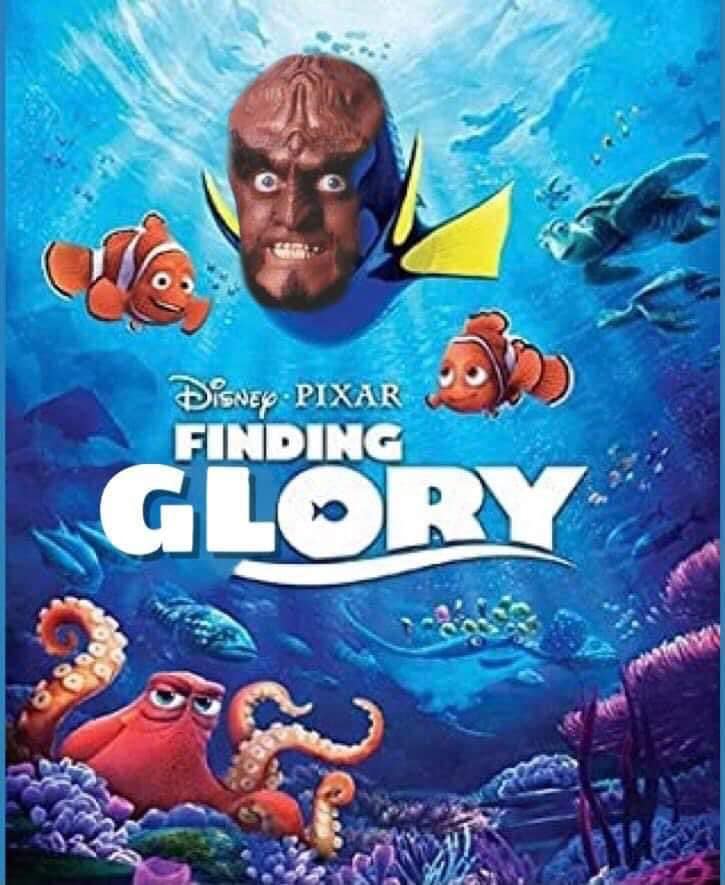
The meme is a photo of a Klingon warrior from the Star Trek franchise, with a caption that says "Klingon Honor" in a bold, dramatic font. The image is meant to be humorous, implying that the Klingon warrior is so proud of his honor that he's willing to die for it. The meme is poking fun at the Klingon culture's emphasis on honor and loyalty, exaggerating it to absurd levels.
detailed-analysis (gemma3-27b-vision)
Okay, let's analyze this image, playfully titled "Finding Glory," through the requested lenses. It's… a fascinating and unsettling mashup.
Visual Description
The image is clearly a parody of the Disney-Pixar film "Finding Nemo." The background is the vibrant, underwater scene familiar from the original movie – coral reefs, blue water, and various fish. However, superimposed onto this backdrop, in place of the character Nemo, is the face of Kanye West (aka Ye). The title has been altered to “Finding Glory,” likely a reference to Kanye's song of the same name. The juxtaposition of the cartoon aesthetic and a realistic portrait is jarring. The placement suggests Kanye is the new Nemo, but the effect is more unsettling than endearing. Other elements of the original poster, like Dory and the other fish, remain, amplifying the contrast.
Foucauldian Genealogical Discourse Analysis
The image functions as a subversive disruption of the carefully constructed "Finding Nemo" narrative, and with that, the image establishes a new discourse. "Finding Nemo" as a Disney-Pixar film is embedded with discourses surrounding family, loss, disability, and overprotectiveness. This altered image interrupts that discourse by inserting Kanye West—a figure heavily coded with discourses of celebrity, creative genius, controversy, and increasingly, political extremism.
A genealogical approach would trace the historical conditions that allow for this specific pairing. We see the increasing trend of meme culture, the rapid dissemination of imagery through digital networks, and the blurring of boundaries between the "high" and "low" cultures. The image isn't simply about Kanye West or "Finding Nemo"; it’s about the power dynamics that allow for the hijacking of established cultural symbols and the re-inscription of meaning. It raises questions about who controls the narratives and how those narratives are remixed and contested. The re-titling to “Finding Glory” specifically utilizes Kanye’s own branding to further control the narrative.
Critical Theory
From a critical theory perspective, the image can be seen as an example of culture jamming or subversive parody. The act of replacing Nemo with Kanye West disrupts the seemingly innocent message of family and overcoming adversity.
The image invites a critique of the contemporary celebrity complex and its influence on popular culture. The Disney-Pixar franchise is a powerful and pervasive force; to insert such a polarizing figure into this space highlights the way celebrities are constructed and positioned as cultural icons. We're prompted to ask: What is the meaning behind this specific appropriation? Is it a critique, a celebration, or simply an attempt to generate shock value? The image’s jarring nature suggests a commentary on the commodification of emotions and the tendency to project meaning onto celebrity figures.
Marxist Conflict Theory
From a Marxist lens, the image highlights the struggle for symbolic capital and control over cultural narratives. Disney-Pixar represents a powerful force within the capitalist system of media production. Inserting Kanye West, a controversial figure who has actively challenged established structures and norms, can be seen as a symbolic rebellion against corporate control.
Furthermore, the image can be interpreted as a critique of the commodification of childhood. Disney films are targeted toward children and families, and their narratives are often imbued with capitalist values. By disrupting this narrative, the image suggests a questioning of the ways in which childhood is constructed and exploited within the capitalist system. It could be argued that the image aims to “destabilize” the market for the “Finding Nemo” franchise, or at least highlight its reliance on profit.
Postmodernism
This image screams postmodernism. It is fundamentally a pastiche—a blending of disparate elements (animated Disney, a celebrity portrait) in a way that creates a new, often ironic, meaning. It is inherently intertextual—relying on our understanding of both "Finding Nemo" and Kanye West to create meaning.
The image exemplifies the postmodern rejection of grand narratives. “Finding Nemo” offers a fairly straightforward message about familial love and overcoming obstacles. The insertion of Kanye West, a figure associated with chaos, contradiction, and constant self-promotion, undermines that neat narrative. It embraces ambiguity and fragmentation. The overall effect is not to tell a story, but to comment on the act of storytelling itself and the way meaning is constructed.
Queer Feminist Intersectional Analysis
This is the most difficult lens to apply directly, as the image doesn't overtly address gender, sexuality, or intersectionality. However, we can speculate. Kanye West’s public persona and controversial statements have, at times, been criticized for misogynistic and homophobic undertones. The image, therefore, can be seen as an ironic commentary on his public image.
The act of “replacing” Nemo—a vulnerable, dependent character—with Kanye West can be read as a subversion of traditional power dynamics. The image challenges the expectation that positive role models need to be traditionally “wholesome” or uncontroversial. It’s a provocative and disturbing image that potentially invites discussion about gender and power. However, it’s important to note that the image is complex and open to interpretation, and its implications for queer feminist analysis are not immediately obvious.
Disclaimer: This analysis is based on the image provided and relies on interpretation. The intended meaning behind the image is unknown.
simple-description (llama3.2-vision)
The meme features a still image from the movie "Finding Nemo" with the title "Finding Nemo" replaced by "Finding Nemo: The Search for Dory's Lost Socks". The image shows a scene from the movie where Dory is searching for her lost socks, but instead of finding them, she finds a giant, menacing-looking fish with a menacing expression.
tesseract-ocr
‘ %* ee su 4A ». | ig Epic aaa ) LO! .f oa Paw ee ee i el ea « cia Sow ie pre