First Seen
2023-05-10T21:03:40+00:00
simple-description (llama3.2-vision_11b)
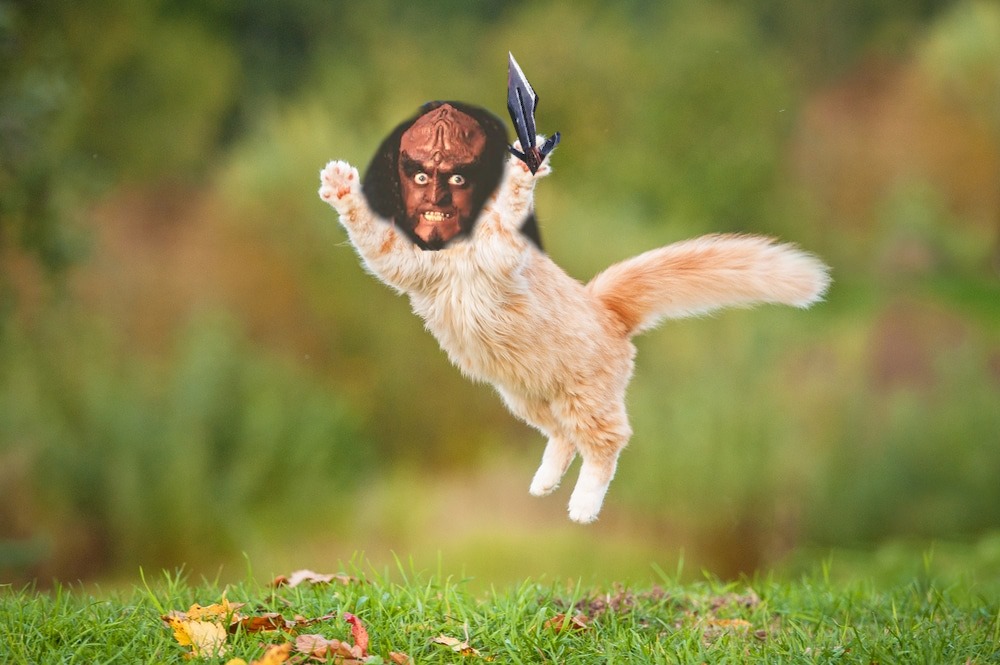
The meme features a photo of a Klingon warrior from the Star Trek universe, with a caption that reads "I am Gorthok, son of Gorthok, but you may call me Gorthok". The image is likely Photoshopped to include a cat's body, with the Klingon warrior's head superimposed onto the cat's body. The meme is a humorous take on the Klingon honor code, exaggerating the warrior's pride and loyalty to his family name.
detailed-analysis (gemma3-27b-vision)
Okay, let's break down this wonderfully bizarre image using the requested theoretical frameworks. It's a challenging image, so some sections will be more developed than others.
Visual Description
The image depicts a digitally altered photograph. It shows a cream-colored cat mid-leap, seemingly caught in an energetic jump. However, instead of a cat's head, the image has superimposed the face of the character Gul Dukat from the science fiction series Star Trek: Deep Space Nine. Dukat is depicted with his signature dark makeup and intense expression. He is holding a small, dark object (likely a Pah-wraith dagger, a significant symbol within the series). The background is a blurry, lush green field with scattered autumn leaves. The lighting appears natural and outdoors. The effect is inherently absurd and surreal.
Foucauldian Genealogical Discourse Analysis
This image, as a constructed artifact, immediately becomes a site of discourse. A Foucauldian approach would examine the power dynamics at play in creating this image. The digital manipulation itself is an act of power – taking the image of an animal and imposing the visage of a complex fictional character.
- Discursive Formation: The image blends two distinct discourses: the discourse of "cute animals" (cats are often positioned as harmless and endearing) and the discourse of Star Trek, specifically the morally ambiguous, often villainous character of Gul Dukat. This clash forces a re-evaluation of both.
- Power/Knowledge: The image relies on pre-existing knowledge of the character Gul Dukat to have any impact. The audience must recognize him to understand the inherent incongruity. The power lies in the creator's ability to leverage this existing cultural knowledge and remix it.
- Genealogy: A genealogical analysis might trace the evolution of the 'meme' aesthetic – the practice of digitally altering images for comedic or satirical effect. This image participates in that genealogy, but the specific combination of elements (Gul Dukat, a cat) is novel.
- Discipline & Subjectivation: While subtle, the image might be seen as disrupting our easy categorization of animals and fictional characters. It destabilizes the 'natural' order, forcing us to reconsider the roles we assign them.
Critical Theory
Applying Critical Theory, particularly a Frankfurt School lens, reveals that the image operates on several layers of critique and reflects wider societal anxieties.
- Culture Industry: The image is a product of the 'culture industry' - a digitally created remix dependent on pre-existing cultural products (Star Trek, cat imagery). It is a form of passive consumption of pre-packaged symbols, albeit with a layer of ironic creativity.
- Commodification of Meaning: The image might be seen as commodifying both the character of Gul Dukat (reducing him to a humorous meme) and the inherent 'cuteness' of a cat. Authentic meaning is stripped away in favor of surface-level spectacle.
- Ideology: The image challenges the notion of simplistic good/evil binaries. Dukat is a complex villain whose motivations are rooted in a warped sense of cultural superiority and entitlement. Placing his face on a seemingly innocent animal creates a disturbing juxtaposition that subtly forces the viewer to reconsider the nature of evil.
Postmodernism
This image is inherently postmodern.
- Pastiche & Intertextuality: The image is a clear example of pastiche – blending elements from disparate sources (Star Trek and animal imagery) without a unifying aesthetic. It's heavily reliant on intertextuality - the meaning derived from the audience's pre-existing knowledge of both sources.
- Deconstruction of Meaning: The image actively destabilizes meaning. The incongruity between the cat's body and Dukat's face undermines any easy interpretation. Is it funny? Disturbing? Ironic? The ambiguity is deliberate.
- Hyperreality & Simulation: The image exists entirely as a simulation – a digitally constructed reality. It doesn’t refer to anything 'real,' but rather to other representations (the actor, the character, the cat). It’s a hyperreal spectacle.
- Irony & Playfulness: The image embraces irony and playful subversion. It’s not attempting to convey a 'serious' message, but rather to entertain through incongruity.
Queer Feminist Intersectional Analysis
This is where things get tricky. While not immediately apparent, a Queer Feminist Intersectional lens can be applied, but requires a degree of extrapolation.
- Subversion of Expectations: Traditionally, cats are often gendered feminine and positioned as 'domestic' and 'passive.' Superimposing the face of a powerful, often predatory character like Dukat onto the cat's body disrupts this expectation. This can be seen as a queer disruption of conventional gender roles and power dynamics.
- The 'Monstrous Feminine': Dukat, as a character, often embodies traits that traditionally fall into the "monstrous feminine" archetype – ambition, cunning, a disregard for conventional morality. Placing his face on a cat, an animal often associated with feminine mystique, further complicates this trope.
- Intersectionality & Power: Dukat’s character embodies the intersection of cultural and political power dynamics within the Star Trek universe. His Cardassian background, his position within the Dominion, and his own personal ambitions all contribute to his power. The image subtly underscores these intersections by placing his face on an animal that is often subject to human power dynamics.
- Reclaiming the Gaze: The image can also be interpreted as a reclaiming of the gaze. Dukat is known for his manipulative and predatory behavior. Placing his face on a cat allows the audience to potentially reframe this gaze, turning it back on him.
It's important to note that this image is open to multiple interpretations, and these analyses are just a few possible readings. The power of the image lies in its ambiguity and its ability to spark conversation.
simple-description (llama3.2-vision)
The meme is an image of a cat in mid-air, with its paws outstretched and its tail fluffed up. The cat's face is superimposed with a Klingon warrior's head from the Star Trek franchise, complete with a fierce scowl and a raised eyebrow. The text "I can smell the fear of my enemies" is written in a bold, Klingon-style font across the top of the image.
tesseract-ocr
‘e x . er : - ¥ Al 4 a s dla) = * ¢ ee SAS ‘ws ARS WS iS dente hy IFA De IN alee ee dee hy i gs ge ng Sa. Yay Clea | Screen ve im 7 id SS fia noes ON PPSES AN Rs AS VL RIN oe se geen es