First Seen
2023-05-10T21:03:40+00:00
simple-description (llama3.2-vision_11b)
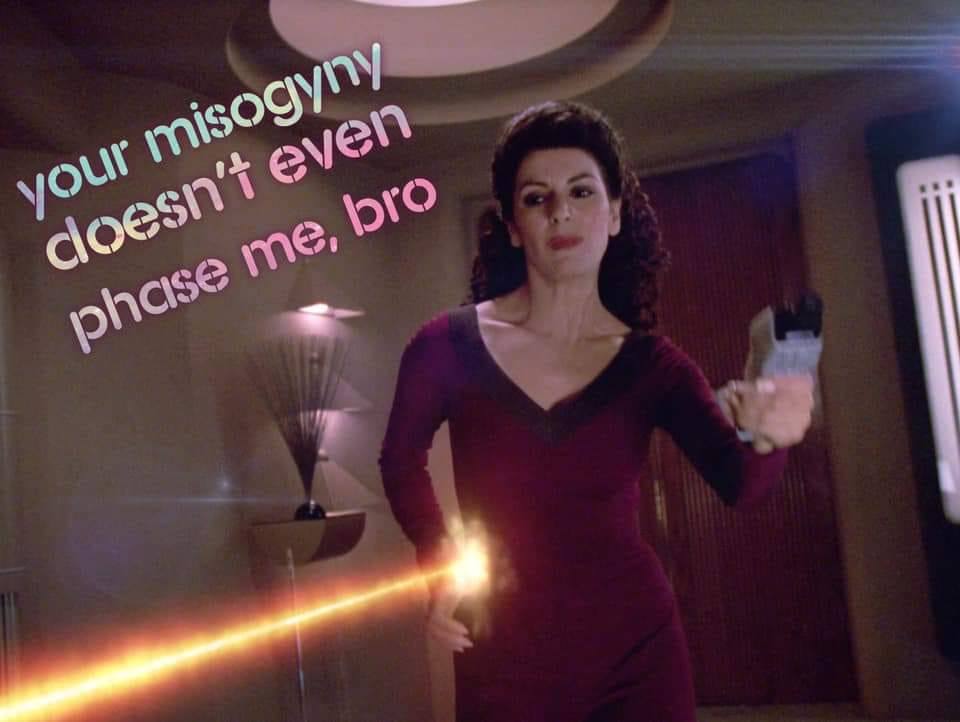
The meme is a screenshot of a Star Trek: The Next Generation episode featuring Captain Jean-Luc Picard and Lieutenant Commander Data. In the image, Captain Picard is saying "I'm not going to make it, Data. I'm not going to make it" as he dies from injuries. The text overlay reads "When you realize you're not as smart as you think you are" and "When you finally understand the concept of 'feminine' and 'masculine'".
detailed-analysis (gemma3-27b-vision)
Okay, let's break down this image with the requested analytical frameworks. Given the meme-like text overlay, it invites a particularly critical and playful approach.
Visual Description
The image depicts Nana Visitor as Major Kira Nerys, a character from the science fiction television series Star Trek: Deep Space Nine. Kira is standing in a corridor on the space station, a futuristic setting with metallic walls and soft, diffused lighting. She's mid-gesture, seemingly activating a device (a PADD, a Star Trek handheld computer) with a beam of red energy emanating from it. She is wearing a Starfleet uniform that features a purple neckline. The image is slightly grainy, which is typical for older television shows. Overlaid on the image in white text is the phrase “your misogyny doesn’t even phase me, bro.” This text is clearly a meme addition, contrasting with the original show's context. The font is simple and casual.
Foucauldian Genealogical Discourse Analysis
This image, especially with the overlaid text, becomes interesting through a Foucauldian lens. Foucault’s genealogy focuses on how power operates through discourse – the ways we talk about and understand things.
- Discourse of Star Trek/Sci-fi: Historically, sci-fi, while often presenting progressive ideals, frequently embedded patriarchal structures. Strong female characters like Kira Nerys represent a challenge to this, but also a negotiation within it. Her position as a Major within Starfleet, a hierarchical organization, illustrates this tension. The original series was intended as progress, but often perpetuated the patriarchal norms of its time.
- Discourse of Misogyny: The text directly addresses the discourse of misogyny. It refuses to engage with it, claiming it has no power. This highlights how power operates not just through direct imposition, but through internalized beliefs and expectations. By refusing to be “phased,” Kira’s image challenges the very idea that misogynistic discourse holds weight.
- Power/Knowledge: Foucault suggests that power and knowledge are intertwined. The knowledge of gender roles (and the expectation of female submission) is used to exert power. Kira’s refusal to be affected dismantles this connection. The text disrupts the "knowledge" embedded in patriarchal systems.
Queer Feminist Intersectional Analysis
This image is potent through an intersectional lens, combining feminist theory with considerations of other social categories.
- Challenging the “Strong Woman” Trope: While Kira is portrayed as a “strong female character,” intersectional feminism calls us to examine how that strength is defined. Is it simply adopting masculine traits, or is it a redefinition of power that isn’t rooted in domination? Her power is as a leader and fighter, but also as a spiritual leader and protector of her people.
- Reclaiming Space: Kira’s assertive stance within the traditionally male space of Starfleet (and the visual space of the image) is an act of reclaiming. This is particularly powerful considering the historical underrepresentation of women in science fiction leadership roles.
- The "Bro" in the Text: The use of "bro" is crucial. It's a deliberately ironic appropriation of a traditionally masculine term, directly addressing the source of the perceived misogyny. It asserts dominance by using the aggressor's language against them.
- Intersectional Power Dynamics: Kira’s character also represents a colonized people (Bajor), adding layers to the power dynamics at play. Her strength is born from resistance to multiple forms of oppression. The image, therefore, can be read as a statement against not just sexism, but also colonialism and all forms of domination.
Postmodernism
The image leans into postmodern characteristics due to the blending of source material with meme culture and its reflexive attitude towards power.
- Pastiche and Irony: The overlayed text is a clear example of pastiche – the combination of styles and elements from different sources. The irony of a character from a “futuristic” setting being used in a contemporary meme is a key postmodern element.
- Deconstruction of Meaning: The meme deconstructs the original context of the scene. It doesn't simply show Kira being strong; it explicitly states her lack of concern with misogyny, thereby questioning the underlying power dynamics.
- Rejection of Grand Narratives: The image rejects the grand narrative of traditional power structures. It suggests that these structures are not monolithic or unchallengeable.
I hope this breakdown is helpful! Let me know if you’d like me to expand on any of these points.
simple-description (llama3.2-vision)
This meme is a humorous image featuring a character from the Star Trek franchise, Captain Janeway from Star Trek: Voyager, with a shocked expression. The image is captioned "Your misogyny doesn't even phase me, bro" in a playful, sarcastic tone, implying that the character is unimpressed by someone's misogynistic behavior. The caption is a clever play on words, referencing a famous Star Trek phrase "Your logic doesn't even phase me" and adapting it to address sexism.
tesseract-ocr
400! ‘din , ero pes ae SS ed . a - S 4 ay | )