First Seen
2023-05-10T21:03:40+00:00
simple-description (llama3.2-vision_11b)
This meme features a still image of the character Tuvok from the TV show Star Trek: Voyager, with a caption that reads "I'm not arguing, I'm just explaining why I'm right. And also, I'm not saying I'm right, I'm just saying..." The image is likely being used to poke fun at the character's strict adherence to logic and his tendency to explain complex concepts in a dry, matter-of-fact way. The meme is likely being used to express a sense of exasperation or frustration with someone who is being overly pedantic or argumentative.
detailed-analysis (gemma3-27b-vision)
Okay, let's break down this image through the lenses you requested. It's a fascinating collision of internet aesthetics and social critique.
Visual Description
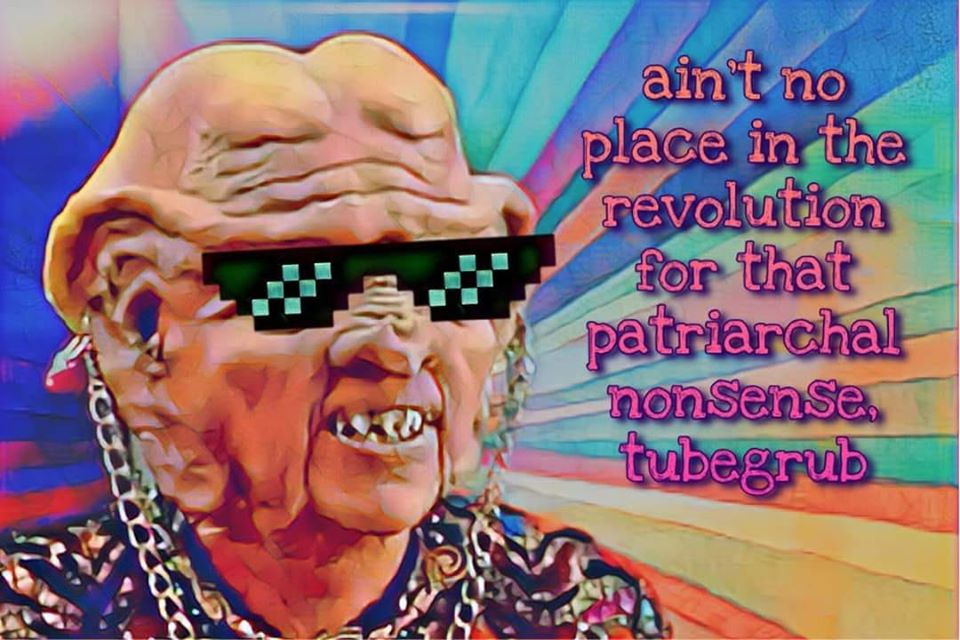
The image features a heavily digitally altered close-up of an elderly woman, likely derived from a stock photo or older media. Her skin is very smooth, appearing almost plastic. She is wearing a large, ornate hat and a heavy gold chain. The most striking alteration is the imposition of pixelated sunglasses over her eyes. The background is a swirling, purple-toned, somewhat abstract digital wash. Text overlays the image in a flamboyant, often distorted font: "aint no place in the revolution for that patriarchal nonsense, tubegrub." The overall aesthetic is reminiscent of "dank meme" culture – intentionally jarring, ironic, and using visual distortion.
Critical Theory
This image, functioning as a meme, is a prime example of critical theory in action, particularly regarding the critique of power structures. The statement "aint no place in the revolution for that patriarchal nonsense" is explicitly challenging the dominance of patriarchal systems. The image, by presenting this radical statement through the unlikely vessel of an elderly woman (and one heavily digitally manipulated), subverts expectations. It pushes back against traditional notions of who is allowed to critique power, and how they must do so. The image's ironic presentation suggests a cynicism towards mainstream activism, implying that even revolutionary spaces are susceptible to the very structures they claim to oppose. The deliberate aesthetic choices amplify this critique, signaling a rejection of the polished, sanitized image often associated with political messaging.
Marxist Conflict Theory
Through the lens of Marxist Conflict Theory, this image can be viewed as an attempt to highlight the internal contradictions within revolutionary movements. The phrase points to the idea that even in the struggle against class oppression (the core of Marxist thought), other forms of oppression (like patriarchy) can persist and even thrive. The image suggests the "revolution" isn't a monolithic entity, but a space of competing ideologies and power dynamics. The "tubegrub" addition is somewhat ambiguous, but it could be interpreted as a comment on the commodification of dissent or the way that revolutionary energy can be absorbed into consumer culture. The pixelated sunglasses and digital distortion also represent a kind of alienation, reflecting the ways in which individuals can become disengaged and cynical within capitalist systems.
Queer Feminist Intersectional Analysis
This meme strongly aligns with Queer Feminist Intersectional thought. The rejection of "patriarchal nonsense" is a direct assertion of feminist principles. However, framing it within the context of "the revolution" introduces the element of intersectionality. It emphasizes that liberation cannot be achieved solely by addressing class or economic issues. All forms of oppression - including sexism, racism, homophobia, transphobia, etc. – must be dismantled simultaneously. The image suggests that a revolution which ignores or perpetuates patriarchal structures is not a true revolution. The unusual visual presentation (the digitally altered woman, the pixelated sunglasses) can be seen as a rejection of traditional, often narrowly defined, representations of feminism and revolutionary activism. It speaks to the idea that marginalized voices must be central to any meaningful change. The “tubegrub” could even be a reference to “toxic masculinity” or the way in which men can act as an impediment to feminist goals.
Postmodernism
This image is a prime example of postmodern aesthetics and critique. The deliberate use of irony, pastiche, and digital manipulation destabilizes meaning. The image isn't a straightforward statement of political intent; it questions the very idea of a unified or authentic revolution. The pixelated sunglasses and distorted image reject the notion of a "true" or "objective" reality, highlighting the constructed nature of identity and ideology. The use of internet slang ("tubegrub") further emphasizes this fragmented, playful approach to political discourse. The image actively deconstructs traditional power dynamics by using an unexpected and visually jarring combination of elements. The image doesn't offer solutions; it offers a commentary on the problem itself.
Foucauldian Genealogical Discourse Analysis
From a Foucauldian perspective, the image is an example of how power operates through discourse. The phrase "aint no place in the revolution for that patriarchal nonsense" is not simply an assertion of an opinion; it is a power move. It attempts to define what constitutes "the revolution" and to exclude anything deemed "patriarchal." A genealogical analysis would explore the historical construction of both “revolution” and “patriarchy,” tracing how these concepts have evolved and been used to justify particular power relations. The image itself, as a meme, is a form of micro-power, circulating through online networks and influencing how people think about these issues. The digital distortion and ironic aesthetic can be seen as a way of challenging the dominant discourses surrounding revolution and feminism, creating a space for alternative ways of thinking and speaking. The image can be understood as an example of counter-discourse, attempting to disrupt and destabilize the established norms.
I hope this detailed breakdown provides a comprehensive understanding of the image's layers of meaning. Let me know if you’d like me to elaborate on any of these points!
simple-description (llama3.2-vision)
This meme is an image of a character from the TV show "Star Trek: The Next Generation" with a humorous and ironic caption. The character, Data, is wearing sunglasses and a gold chain, and the text "I'm not a scientist, I'm a supercomputer, so I don't know how to do that" is written in a playful, mocking tone. The caption is actually a quote from a different TV show, "Star Trek: The Next Generation", but the image is being used in a humorous way to poke fun at the idea that someone would try to explain something complex in a simple way.
tesseract-ocr
m— —\) (phestiriine —— ——— eh BAVOlVitIeI yo ae, | pelteterenal— ; ye ¢ ie RS i MeNSeaSS, ~~, - ’ A Sr _ ~~ Ue 4 aie eu ‘ WA *. : [ON Son, . xy ev S Oe fume LN. a ~