First Seen
2023-05-10T21:03:40+00:00
simple-description (llama3.2-vision_11b)
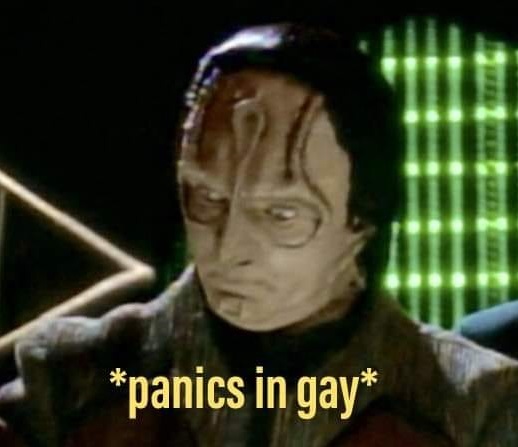
The meme is a screenshot from the Star Trek: The Next Generation episode "The Outcast," where Commander Will Ransom is experiencing a mental breakdown. The image shows Ransom with a shocked expression, and the text "I'm experiencing... panics in gay" is overlaid on top of the image. This meme is a humorous take on the character's emotional breakdown, poking fun at the stereotype that gay people are more emotional or high-strung.
detailed-analysis (gemma3-27b-vision)
Okay, let's break down this image with the requested theoretical lenses. It's a bit of a playful image, so the analyses will have to be adapted to fit the humor.
Image Description:
The image is a close-up shot of a character, likely from a science fiction setting (specifically, this is Gul Dukat from Star Trek: Deep Space Nine). He's a humanoid alien with distinct facial ridges and dark skin. His expression is one of mild discomfort and apprehension, perhaps even a flustered concern. The lighting is dramatic, with dark shadows emphasizing his features. Behind him is a blurred background with a grid of green lights, suggesting a technologically advanced environment. The text "panics in gay" is superimposed on the image in a playful, meme-style fashion.
Queer Feminist Intersectional Analysis
This is where the image really "hits". The humorous caption directly relates to queer identity. The image, coupled with the caption, immediately subverts the traditionally "masculine" presentation of the character (Dukat is often portrayed as seductive, calculating and a somewhat villainous figure). The phrase "panics in gay" plays on the trope of heteronormative discomfort around queer expression or even the internalised homophobia of characters. It suggests a sudden recognition of attraction/desire that is disrupting a perceived sense of power.
Intersectional layers are present. The image also relates to the depiction of alien characters and how those depictions can be infused with coded sexuality, often mirroring human anxieties and desires. The idea of "otherness" in science fiction can map onto the experience of being marginalized for queer identity. The image works by reappropriating the figure of Dukat, a villain within the Star Trek universe, and turning his power dynamic on its head, implying that he is affected by, and disrupted by, the queer gaze.
Foucauldian Genealogical Discourse Analysis
Foucault's work deals with power, knowledge, and discourse. Here, the "discourse" could be considered the broader cultural narrative surrounding masculinity, power dynamics, and sexuality. The phrase "panics in gay" disrupts this discourse. Traditionally, dominant discourses have positioned the male gaze as active and the object of desire as passive. This image inverts that dynamic. It proposes a scenario where the subject (Dukat) is caught as the object of desire, leading to a breakdown in his asserted control.
A genealogical approach would investigate how the idea of 'panic' has become associated with queer expression (historically through homophobia, pathologizing language, and fear-mongering). The image’s meme quality is important here, because memes act as micro-discourses, spread quickly through digital networks, creating and reinforcing (or disrupting) social norms.
Critical Theory
The image can be seen as critiquing the construction of power and authority. Critical Theory often examines how seemingly neutral structures maintain inequalities. Gul Dukat, in Star Trek, embodies a specific type of oppressive power. This image mocks that power by suggesting that it is fragile and vulnerable to something as simple as attraction. The "panic" exposes the character's underlying insecurities and contradictions, showing that even those who appear powerful have limits. It deconstructs his authority figure by stripping away the control and presenting him as susceptible to the same human (or alien) emotions and desires as anyone else.
Postmodernism
The image is thoroughly postmodern. It relies on irony, pastiche, and the blurring of boundaries. The juxtaposition of a serious science fiction character with a playful, informal caption creates a deliberate incongruity. It’s self-aware, acknowledging its own status as a meme and playing with the audience's expectations. The image is also deliberately ambiguous, leaving the interpretation of the "panic" open-ended. The use of memes is itself a postmodern phenomenon, reflecting a culture of remix and hyperreality.
Marxist Conflict Theory
While not the most obvious fit, you could frame it in terms of power dynamics. Marxist conflict theory centers on the struggle between classes, but it can be broadened to any conflict between groups with competing interests. Here, you could interpret it as a subversion of patriarchal power. The "panic" represents a disruption of the traditional masculine power structure. Dukat, as a figure of authority, is destabilized by something that challenges his control. While this is a playful reading, it connects to broader themes of challenging oppressive hierarchies.
Let me know if you'd like me to elaborate on any of these analyses!
simple-description (llama3.2-vision)
The meme is an image of a character from the TV show "Star Trek: The Next Generation" named Lieutenant Worf, who is a Klingon warrior. He is depicted with a worried and anxious expression on his face. The text overlay on the image reads "panics in gay" which is a humorous way of saying "I'm panicking in a gay bar" or "I'm freaking out in a gay setting".
tesseract-ocr
. é oT ihe T 7 ass TE a