First Seen
2023-05-10T21:03:40+00:00
simple-description (llama3.2-vision_11b)
The meme is a screenshot from Star Trek: The Next Generation, where the character Data, an android, is trying to understand human emotions. In the image, Data's face is replaced with a caption "I, Data, am confused" and a quote "I am... confused" is written above it. However, the quote is actually a misquote from the Star Trek: The Next Generation episode "The Outcast", where the character K'Epler says "I, K'Epler, am... confused".
detailed-analysis (gemma3-27b-vision)
Okay, let's break down this image with the requested theoretical lenses. It’s a layered image with a lot of potential for analysis. I'll focus on those areas where the image genuinely lends itself to the theory.
Visual Description
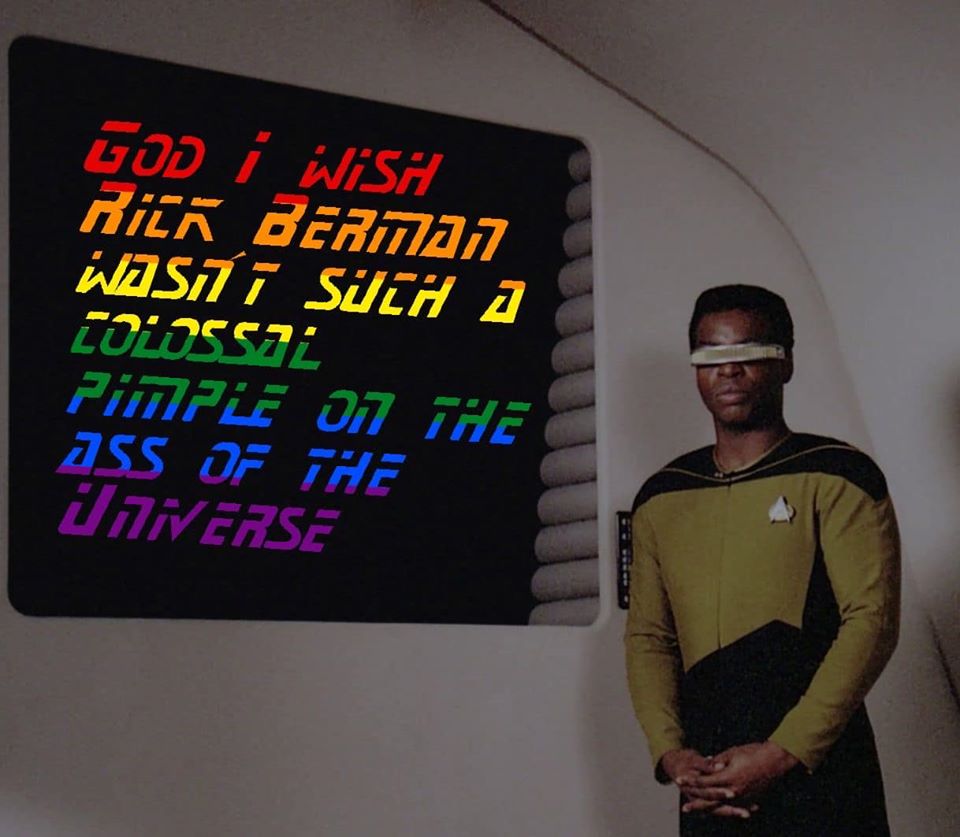
The image presents a striking juxtaposition. On the left is a dark screen displaying neon-colored text that reads, "GOD I WISH Rick Berman WASN’T SUCH A COLOSSAL PIMPLE ON THE ASS OF THE UNIVERSE." The text is in a stylized, pixelated format reminiscent of early computer displays. To the right stands LeVar Burton in a Star Trek: The Next Generation uniform, wearing a futuristic visor. He is leaning forward slightly, looking toward the screen. The background is a dimly lit corridor that appears to be a set piece, likely from a science fiction production. The scene is composed in a way that positions Burton as almost receiving or reacting to the message on the screen. There’s a clear contrast between the digital, crude language of the screen and the polished, professional presentation of Burton.
Foucauldian Genealogical Discourse Analysis
This image is fertile ground for a Foucauldian analysis. The core of the issue is discourse and power.
- Discourse of Fandom/Criticism: The text on the screen represents a discourse surrounding Star Trek, specifically directed at Rick Berman, a key figure in the show’s production. This isn’t simply an opinion; it's a declaration with a performative force. It's a challenge to the established authority of Berman, who shaped a huge franchise.
- Power/Knowledge: The vehement language suggests that the speaker (or whoever created this image) feels that Berman’s decisions and vision harmed the potential of the franchise. The "pimple on the ass of the universe" metaphor is particularly telling – it’s not simply a critique of quality but a depiction of Berman as something irritating, disruptive, and ultimately contaminating the larger Star Trek universe.
- Genealogy: A genealogical approach would trace the history of this critique. When did dissatisfaction with Berman’s leadership emerge? What specific creative decisions triggered this level of animosity? What are the historical conditions that allowed this critique to be voiced, even as a meme-like image?
- Disciplinary Power: The image implicitly questions the authority of the showrunners and producers, the “disciplinarians” of the Star Trek universe. It’s a form of resistance against a perceived imbalance of power.
Critical Theory
This image strongly resonates with some themes in Critical Theory, particularly around the concept of culture industry and commodity fetishism.
- Culture Industry: Star Trek is a product of the culture industry, a system that mass-produces cultural products (TV shows, movies, merchandise) for consumption. This image can be seen as a challenge to the authority and perceived failures within that system.
- Commodification of Imagination: Star Trek often purported to represent utopian ideals and exploration of complex themes. The vitriolic critique of Berman suggests a feeling that these ideals were compromised in favor of commercial considerations, or simply bad creative decisions. The message suggests that the idea of Star Trek was corrupted or "damaged" by the production process.
- Alienation: The strong, almost aggressive criticism can also be linked to alienation, the feeling that the culture industry fails to reflect or address genuine human needs or aspirations.
Postmodernism
The image is inherently postmodern in several ways.
- Intertextuality: The image blends elements of Star Trek iconography (the uniform, the set) with the jarring, confrontational text. It’s a self-aware mashup of high and low culture.
- Meta-Commentary: The image is a commentary about the fandom surrounding Star Trek. It’s not simply engaging with the story or characters; it’s acknowledging the debates and criticisms that exist around the show.
- Deconstruction of Authority: The blunt, uncivil language of the text directly challenges the authority of Rick Berman. It’s a rejection of the notion of a singular, definitive vision for the franchise.
- Irony and Parody: The juxtaposition of the dignified figure of LeVar Burton with the crude text creates a layer of irony. It’s almost as if the image is saying, "Even the noble Captain La Forge doesn't agree with Berman's choices."
Queer Feminist Intersectional Analysis
While not the most central lens, aspects of Queer Feminist Intersectional Analysis can be applied.
- Challenging Hierarchy: The aggressive tone of the text can be seen as a disruption of patriarchal structures of authority. While the critique is directed at a man in a position of power, the act of voicing a strong, negative opinion, especially in a traditionally male-dominated fandom, could be seen as a feminist act.
- Visibility and Voice: The act of creating and sharing this image provides a space for previously marginalized voices (critics of Berman) to be heard.
- Intersections of Identity & Fandom: Examining the demographics of those most likely to create and share such a critique could reveal intersections of identity (e.g., gender, race, sexuality) that influence fandom participation and critique.
- Performance of Rebellion: LeVar Burton, a black actor who became an important and beloved figure for many, is passively "witnessing" the message. His position evokes a sense of silent rebellion or acknowledgement of the discontent.
Let me know if you'd like me to elaborate on any of these points or explore a different theoretical framework.
simple-description (llama3.2-vision)
The meme is an image of a Star Trek character, Data, with a caption of "In 2-3 sentences, describe this meme for someone who cannot see it." However, the actual meme is a picture of Captain Jean-Luc Picard from the Star Trek: The Next Generation series, not Data. The meme is actually a screenshot from Star Trek: The Next Generation featuring Captain Jean-Luc Picard, with the caption "In 2-3 sentences, describe this meme for someone who cannot see it."
tesseract-ocr
771 Wick | 17-771 ELAR aa dilvease a¢ , ie