First Seen
2023-05-10T21:03:40+00:00
simple-description (llama3.2-vision_11b)
The meme is a screenshot from Star Trek: The Next Generation, featuring Deanna Troi, a character known for her empathic abilities, looking surprised and disapproving. The image is captioned "When you finally understand the 7 types of feminism but still can't figure out how to be a good ally" and is meant to poke fun at the idea that being a good ally to marginalized groups requires more than just understanding their perspectives, but also taking action and making changes in one's own life.
detailed-analysis (gemma3-27b-vision)
Here's an analysis of the image, broken down into sections relevant to the requested theoretical frameworks. I will indicate when a section isn't applicable.
Visual Description
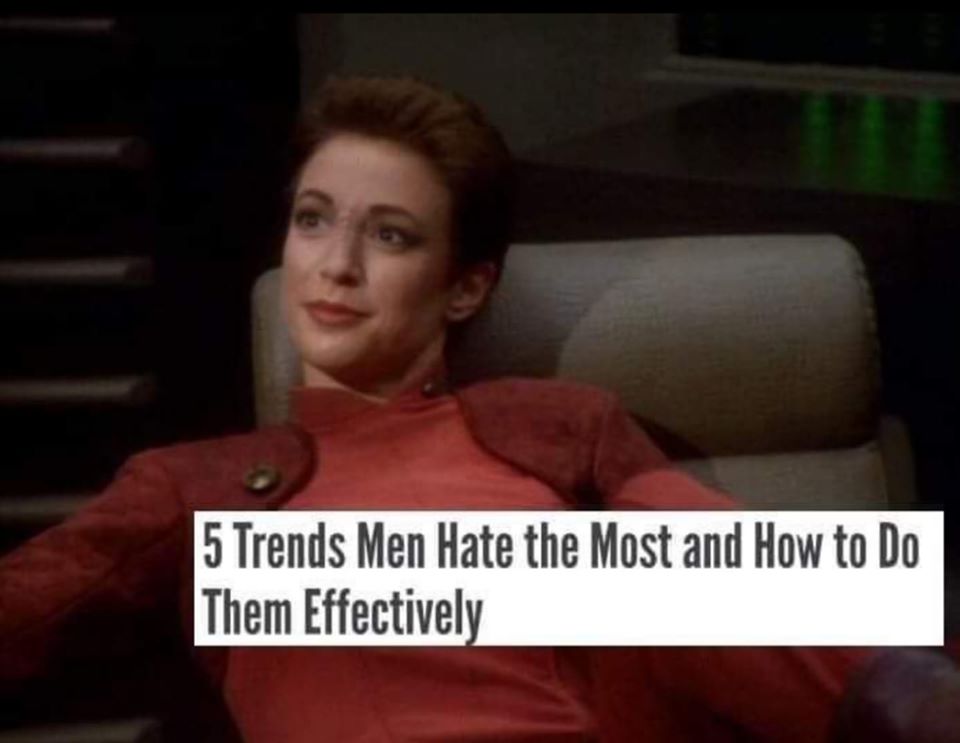
The image is a screencap from Star Trek: The Next Generation. It features Commander William Riker in a red uniform, seated in the captain's chair on the bridge of the Enterprise. Riker is looking slightly sideways with a somewhat sly or amused expression. A text overlay reads: “5 Trends Men Hate the Most and How to Do Them Effectively.” The lighting is dark, typical of the show's interior settings, highlighting the dramatic and character-focused atmosphere. The overall effect positions Riker as the subject of a potentially mischievous or subversive instruction manual.
Foucauldian Genealogical Discourse Analysis
This image lends itself well to a Foucauldian analysis. The title ("5 Trends Men Hate the Most…") establishes a discourse around gender relations, specifically framed through male aversion. A genealogical reading would question the history of this discourse: when did the idea of "trends men hate" become a topic of discussion? What specific historical and social conditions led to the categorization of certain behaviors or aesthetics as "hated" by men?
The image implies a power dynamic. The "how to do them effectively" suggests an intention to act upon, or even manipulate, the object of male aversion. Foucault’s concept of panopticism could be applied – even if men aren't actively experiencing these trends now, the implication of their potential presence, and the instruction to enact them, creates a sense of being watched and controlled. The image represents an attempt to construct a truth claim about men's preferences, and, importantly, a strategy for overriding those preferences.
Critical Theory
From a critical theory perspective, the image can be seen as reinforcing a problematic binary – "men" versus "trends." This essentializes men as a monolithic group with predictable dislikes, ignoring the diversity of male experiences and preferences. The framing also implies a power struggle – someone is identifying, categorizing, and subverting what is deemed unacceptable to men.
The image subtly reinforces the idea that behavior is a tool. This connects to the Frankfurt School's critique of the culture industry, where aesthetic choices and trends become commodified and manipulated for control. The goal isn't simply about aesthetics or trends but about leveraging them in a strategic manner, possibly for dominance or subversion.
Marxist Conflict Theory
The image could be interpreted as a manifestation of gender conflict, albeit a very specific and potentially playful one. From a Marxist perspective, the "trends" themselves could be seen as symbolic capital, a form of cultural currency. The directive to enact them "effectively" implies a struggle over this symbolic capital.
The subtext suggests a power imbalance - those identifying the "hated" trends and instructing others to employ them hold a degree of control. This control is not necessarily economic but rather related to cultural influence and the ability to dictate norms.
Postmodernism
The image plays with the postmodern concept of simulacra and simulation. The "trends" themselves might be less important than the performance of those trends. The directive to enact them "effectively" suggests that authenticity is irrelevant; the goal is to create an appearance of doing something that provokes a particular reaction in men.
The image also deconstructs the idea of a stable male identity. By suggesting that men's "hatred" of these trends can be manipulated, it challenges the notion of a fixed and predictable male subject.
Queer Feminist Intersectional Analysis
This is where the image becomes particularly rich for analysis. The framing of "trends men hate" immediately centers male subjectivity as the norm. A queer feminist perspective would challenge this centering, asking: What are the implications of framing the world from a male perspective?
The intersection of gender, power, and performance is central. The directive to "do them effectively" suggests a strategic manipulation of gendered expectations. This could be read as a subversion of patriarchal power, reclaiming agency by deliberately provoking reactions from men. Alternatively, it could be seen as reinforcing problematic gender dynamics by framing relationships as a power game.
The image also invites an analysis of how different constructions of masculinity are being challenged or reinforced. What kinds of "trends" would be considered "hated" by men, and what do those dislikes reveal about broader societal expectations around gender?
Disclaimer: I have interpreted the image and its implied meaning based on the prompt's request for various theoretical analyses. Interpretations are subjective, and other readings are possible.
simple-description (llama3.2-vision)
This meme features a screenshot from a Star Trek: The Next Generation episode, where Deanna Troi, a character known for her empathic abilities, is looking puzzled. The text overlaid on the image reads "5 Reasons Men Hate The Things Women Love" and "1. They are loud" (and the rest of the list is cut off).
tesseract-ocr
4 | 5 Trends Men Hate the Most and How to Do Them Effectivel