First Seen
2023-05-10T21:03:40+00:00
simple-description (llama3.2-vision_11b)
This meme is from the Star Trek universe and is related to the character Data, a android who is trying to understand human emotions and relationships. The meme shows Data holding a sign that says "I don't understand why you're upset. I'm reading your emotions as 'I'm reading your emotions as 'I'm reading your emotions as...'". This is a play on the character's android nature and his struggles to understand human emotions.
detailed-analysis (gemma3-27b-vision)
Okay, here's an analysis of the image, broken down into relevant sections based on the requested theoretical frameworks. It's a bit of a quirky image, so not every section will be extensive, and some won't apply at all.
Visual Description
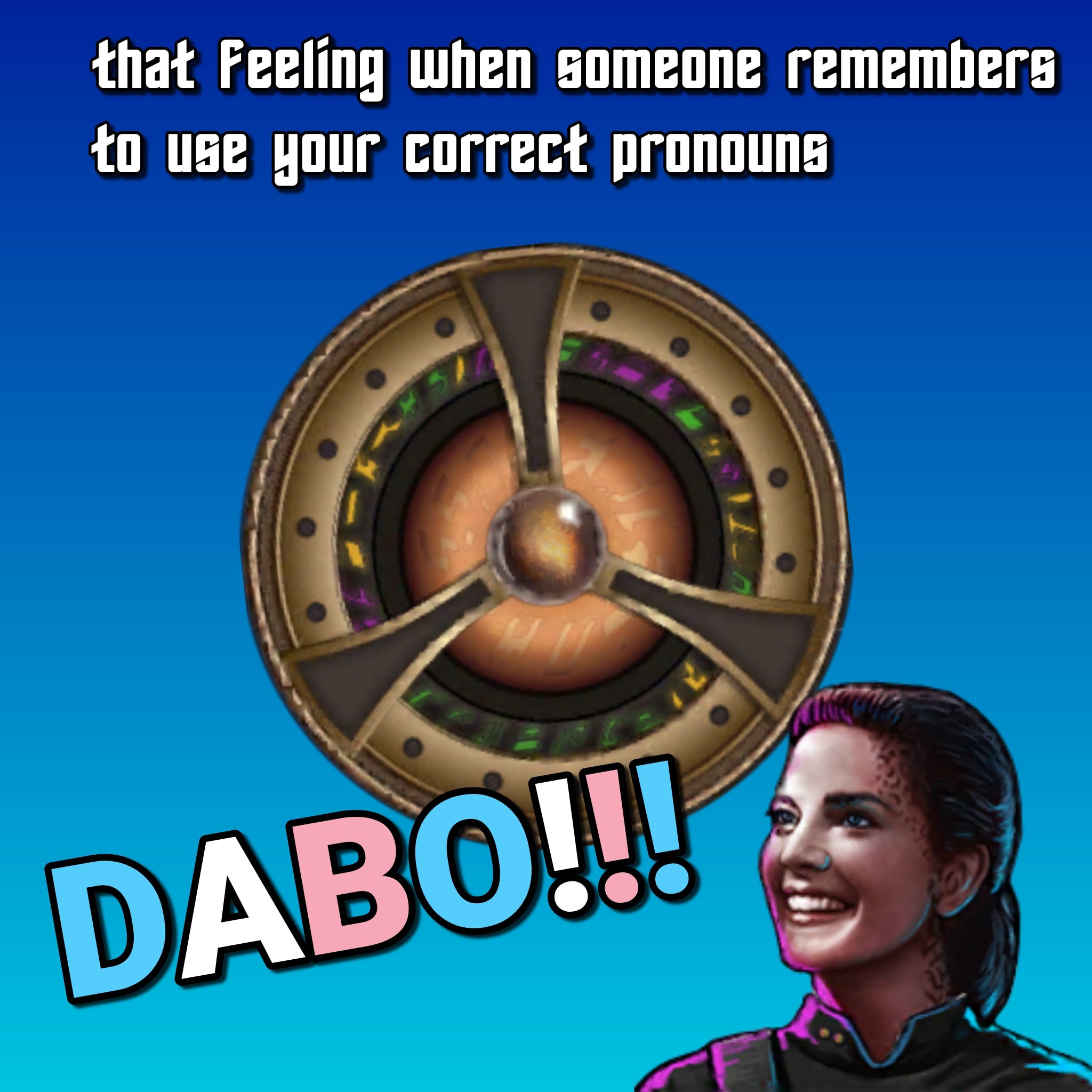
The image is a brightly colored meme, employing a deep blue background. At the top, white text reads, "that feeling when someone remembers to use your correct pronouns." Below this text is a circular graphic resembling a futuristic, mechanical iris or dial. This is set on the blue background. In the bottom right corner is a smiling face of a person in a dark purple uniform, with the name "DABO!!!" overlaid in a large, stylized purple font with a white outline. The "DABO!!!" text is exclamation marked three times. The overall aesthetic is high-contrast and visually busy, typical of internet meme culture. The use of the "DABO!!!" is linked to a fictional character/universe.
Foucauldian Genealogical Discourse Analysis
This image, while seeming simple, touches on the discourse surrounding gender identity, language, and power. A Foucauldian analysis would look at how the act of correctly gendering someone through pronouns became a site of power negotiation.
- Discourse of Pronouns: The emphasis on "correct pronouns" isn’t merely about linguistic accuracy. It’s about recognizing and affirming an individual’s self-identified gender, and the discourse around this has become increasingly visible in recent decades. This is tied to a power dynamic: the speaker holds power to recognize or misgender another.
- Genealogy of Recognition: A genealogical approach would trace how the importance of pronoun usage emerged historically. Prior to increased visibility of transgender and non-binary identities, pronoun usage wasn’t typically a central focus in social interactions. The demand for correct pronoun use is a relatively recent development, born from activist work and increased awareness.
- Power/Knowledge: Correct pronoun usage is part of a “power/knowledge” regime. Those who know the importance of pronouns (and enact that knowledge by using them correctly) demonstrate awareness and inclusivity. Those who don’t demonstrate a lack of awareness or, potentially, a disregard for individual identity.
- The Meme as Discourse: The meme itself participates in this discourse. It acknowledges the emotional significance of pronoun recognition, framing it as a positive, even euphoric, experience.
Queer Feminist Intersectional Analysis
This analysis is perhaps the most directly applicable. The image centers on a deeply personal experience that often impacts marginalized genders, and resonates strongly within Queer and Feminist theory.
- Affirmation and Recognition: The image is fundamentally about the power of affirmation. Having one's pronouns correctly used is not just a matter of politeness, but a validation of one’s existence, identity, and selfhood. It is an act that communicates respect and recognition.
- Gender Performance and Expectations: The issue of pronouns directly engages with the concept of gender performance. Pronouns are a linguistic marker of gender, and insisting on correct usage challenges traditional binary gender norms.
- Intersectionality: While the image focuses on pronouns, it’s important to recognize that pronoun misgendering often occurs within a broader context of other forms of discrimination (e.g., racism, ableism, classism). The experience of misgendering can be amplified for individuals with intersecting marginalized identities.
- Emotional Labor & Invisibility: The meme subtly touches on the emotional labor often undertaken by marginalized individuals who must constantly educate others about their identities and pronouns. The relief experienced when someone finally remembers reflects the weight of that labor.
- 'DABO!!!' as Camp and Hypervisibility: The use of the character 'DABO!!!' is an interesting element. From its fandom context, the character embodies a form of flamboyant hypervisibility. This could be seen as a playful subversion of traditional gender roles, or a way of reclaiming visibility and joy.
Postmodernism
Postmodern perspectives can be applied to understand the underlying logic of the meme and its use of imagery.
- Simulacra & Hyperreality: The image can be viewed as a simulacrum – a copy without an original. The "feeling" of affirmation is represented by a visual cue (the character and meme format) rather than an authentic emotional experience. This fits the postmodern idea that reality is increasingly mediated by signs and representations.
- Deconstruction of Gender: The meme, by focusing on pronouns, implicitly deconstructs the idea of fixed, essential gender identities. It suggests that gender is performative and constructed through language and social interactions.
- Meta-Commentary: The image is a meta-commentary on the online discourse surrounding gender identity. It acknowledges and playfully references the anxieties and experiences associated with pronoun usage.
Critical Theory
Critical theory focuses on power structures and social inequalities.
- Ideology: The meme can be read as challenging the dominant ideology that reinforces binary gender norms. By highlighting the importance of correct pronoun usage, it promotes a more inclusive and equitable understanding of gender.
- Emancipation: The meme, while seemingly lighthearted, can be seen as contributing to a broader project of social emancipation. By raising awareness and challenging oppressive norms, it contributes to a more just and equitable society.
Marxist Conflict Theory
While less directly applicable, a Marxist lens could consider:
- Social Power Dynamics: Misgendering (or any form of disrespecting someone's identity) can be viewed as a form of social control. Recognizing and affirming identities challenges the status quo.
- Class & Identity: While the meme doesn’t explicitly address class, it's important to consider how access to affirmation and recognition might be unequally distributed. Marginalized individuals from lower socioeconomic backgrounds may face additional barriers to having their identities respected.
Let me know if you'd like me to elaborate on any of these sections or explore a different theoretical perspective!
simple-description (llama3.2-vision)
This meme features a cartoon character from the animated series "Futurama" named Leela, who is known for her one-eyed appearance. The image is a play on a common phrase, "I remember" (often shortened to "I re meme"), but replaces "I" with "Leela" and "re" with "Le". The text "I Le meme" is a humorous take on the phrase, implying that Leela is trying to remember something, but the phrase is actually a joke about Leela's one eye, implying that she can't "see" (get) the meme.
tesseract-ocr
that Feeling when someone remembers ALT ia TTT at yo TTT Ee t Sn ee qt! a Neg “iain