First Seen
2023-05-10T21:03:41+00:00
simple-description (llama3.2-vision_11b)
The meme features a screenshot of Seven of Nine, a character from the TV show Star Trek: Voyager, with a caption that reads "When you're a lesbian but you have to use a male pronoun because you're in a Starfleet uniform." The image is a humorous take on the challenges of being a member of the LGBTQ+ community in a fictional universe where characters are expected to conform to traditional gender roles. The meme is a lighthearted way to poke fun at the difficulties of navigating identity in a sci-fi setting.
detailed-analysis (gemma3-27b-vision)
Okay, let's break down this image, titled "Leftists who get called 'Liberal,'" with the requested analytical lenses. The image is a grid of close-up shots of Deanna Troi, a character from Star Trek: The Next Generation, played by Marina Sirtis, with various alien augmentations and makeup applied to her face.
1. Visual Description
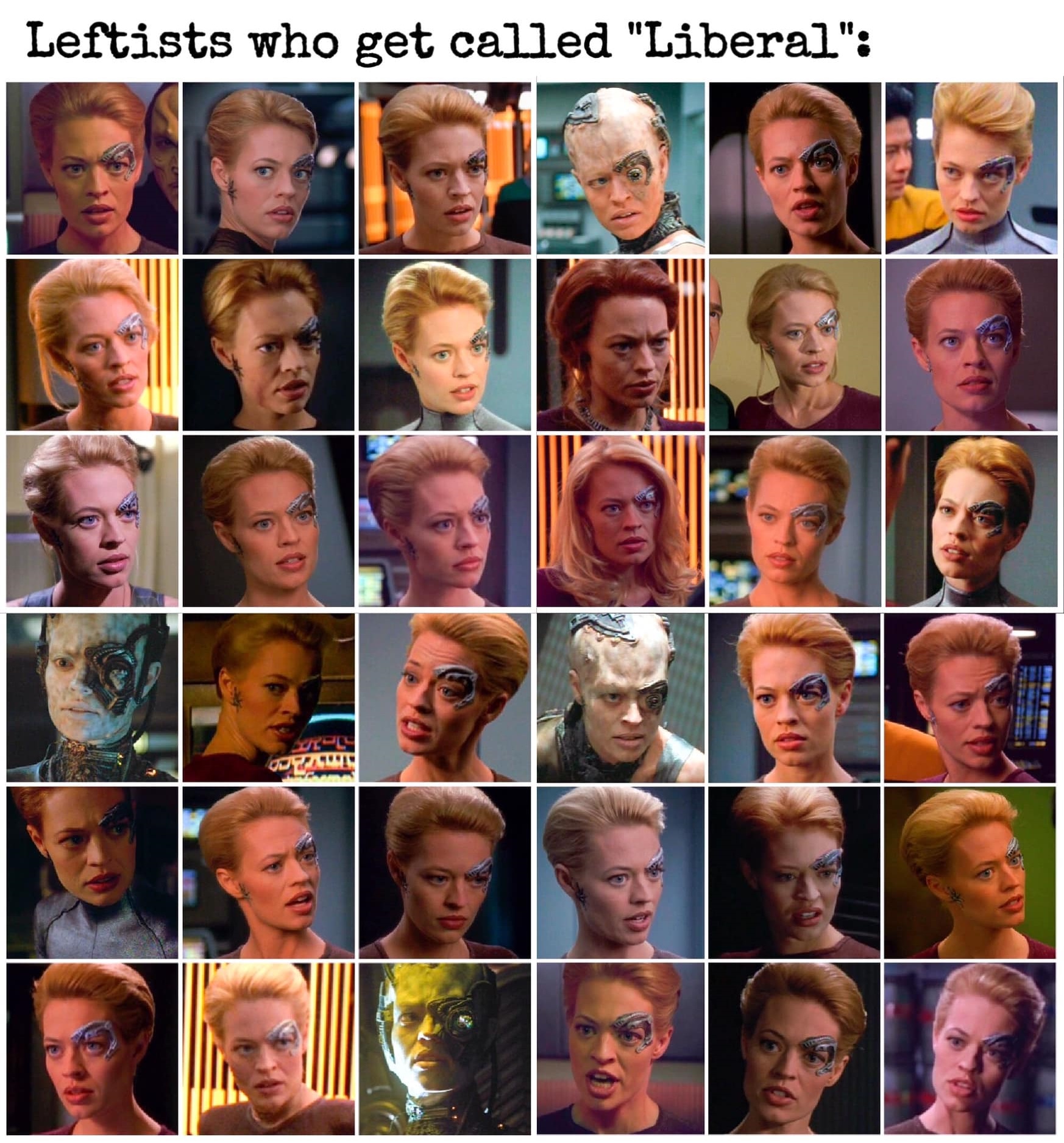
The image is a grid of roughly 36 headshots of Deanna Troi. The core element is the consistent presence of Troi's face, but with an array of modifications. Some modifications are relatively subtle, involving different hairstyles or slightly altered makeup. Others are dramatic, featuring full Betazoid facial ridges, alien prosthetics around the eyes, and bizarre color schemes.
The lighting varies across the grid, but predominantly focuses on illuminating her face and the applied alien features. The backgrounds are primarily the interiors of the Enterprise-D (Star Trek set).
The effect is repetitive, almost like a mosaic or a series of variations on a theme. It visually suggests a sense of “othering,” of taking a familiar face and layering upon it marks of difference. It also feels slightly unsettling because of the sheer number of variations.
2. Foucauldian Genealogical Discourse Analysis
This image lends itself beautifully to a Foucauldian analysis. The title “Leftists who get called ‘Liberal’” is crucial. This isn’t about Troi as a character; it's about how labels are applied to individuals or groups within political discourse.
Foucault would argue that the term "Liberal" (and its associated implications) isn’t a neutral descriptor. Instead, it’s a historically constructed discourse. The alien augmentations applied to Troi can be seen as visual metaphors for the "othering" tactics used in political labeling. The term "Liberal" is used by more extreme groups (often right-leaning) to define and control those they perceive as insufficiently radical. The augmentations symbolize the ways in which the labeled group (in this case, those called "Liberal") are seen as "different," "strange," or even monstrous.
The repetition emphasizes the pervasiveness of this labeling and the way it’s used to create a normalized binary: us (the 'correct' political position) vs. them (the 'Liberal'). Foucault would emphasize the power dynamics at play: those who wield the label ("Liberal") exert control by defining and categorizing others. The variations on Troi's face could represent the multitude of ways that "Liberal" is used as a catch-all for any deviation from a specific, often reactionary, norm.
3. Critical Theory
This image resonates with Critical Theory, particularly the Frankfurt School’s examination of mass culture and the ways in which it reinforces dominant ideologies. The image takes a recognizable figure (Troi) and distorts her, presenting her as “alien” or “other.” This can be interpreted as a critique of how those who deviate from perceived norms are marginalized and demonized.
Critical Theory would ask: Who is constructing this image (the meme creator)? What is their intent? The meme implicitly suggests that those labeled "Liberal" are somehow not fully part of the ‘normal’ political landscape, or are viewed with suspicion and prejudice.
The repetitive nature of the image can be seen as mirroring the cyclical nature of political discourse and the constant repetition of labels and stereotypes. The image implicitly critiques the tendency to essentialize political identities—to reduce complex individuals and ideologies to simplistic categories.
4. Marxist Conflict Theory
From a Marxist perspective, this image could be interpreted as a symbolic representation of class conflict and the struggle for ideological hegemony. The 'Liberal' label often functions as a tool to divide the working class and prevent the formation of a unified front against capitalist exploitation.
The alien augmentations can be seen as representing the ways in which the ruling class demonizes those who challenge the status quo, painting them as "other" or "dangerous." The image might be suggesting that those labeled "Liberal" are perceived as a threat to the existing power structure.
The grid format could represent the multitude of ways in which the ruling class manipulates and controls the masses through propaganda and ideological manipulation. The repetition of the label reinforces the dominant narrative and prevents critical thinking.
5. Postmodernism
From a postmodernist perspective, this image challenges the notion of fixed identities and stable meanings. The image deliberately blurs the lines between what is considered "normal" and "alien," "human" and "other."
The multiple variations on Troi’s face deconstruct the idea of a single, essential identity. It suggests that identity is fluid, constructed, and contingent on social and political context. The title is ironic, inviting the viewer to question the validity of political labels and the ways in which they are used to create artificial divisions. The image rejects the idea of a grand narrative or universal truth, instead emphasizing the multiplicity of perspectives and the subjective nature of reality.
6. Queer Feminist Intersectional Analysis
This image can be read through an intersectional lens, highlighting how marginalized identities are often subjected to increased scrutiny and demonization. The 'Liberal' label is often used to silence and discredit voices that challenge patriarchal norms and advocate for social justice.
The alien augmentations can be seen as representing the ways in which queer and feminist individuals are often perceived as "other" or "abnormal" by mainstream society. The image may be suggesting that those who challenge traditional power structures are subjected to increased scrutiny and demonization.
The grid format could represent the multitude of ways in which marginalized identities are intersected and how their experiences are shaped by multiple forms of oppression. The repetition of the label reinforces the dominant narrative and prevents critical thinking about power and privilege.
In conclusion: This image is a surprisingly layered piece of internet art. It utilizes a visual metaphor to critique the ways in which political labels are used to marginalize, demonize, and control individuals and groups. It’s a thought-provoking commentary on power dynamics, identity construction, and the complexities of political discourse.
simple-description (llama3.2-vision)
The meme is a humorous image of the character Seven of Nine from the Star Trek: Voyager TV show. The image shows Seven of Nine with a "I'm with stupid" sign on her forehead, referencing the classic 80s "I'm with stupid" t-shirt. The text at the top of the image reads "Leftists who get called 'Liberal'".
tesseract-ocr
Leftists who get called "Liberals 4 | 4 3 > at . | oa a we eA , \! Nate? is ; i | > -EaNU Ss a F = =" ~ i. ae = = | 2 d ~~ a ; é Za | > “- , ie x iP Be ay ak i he Ta i UE a" wx ee cs : 4 Se Ps ane Alii re SD \ 2 | : nM "(aaa ot PP: i “a me) ‘a Q \ a Y I ‘ 4 re. uk re “ ‘ NV VI x a a _ \: i a a. / ak, 4 it P e Ea ‘ Ke | | a x i .