First Seen
2023-05-10T21:03:41+00:00
simple-description (llama3.2-vision_11b)
This meme is from the Star Trek franchise and is related to the character Data, who is an android and a queer icon. The meme is a quote from the show, but the quote is modified to be about Data's interest in queer relationships, rather than his android nature. The text "I'm interested in the concept of love" is a quote from the show, but the meme adds "but not in that way" to imply that Data is interested in queer relationships, but not in a romantic way.
detailed-analysis (gemma3-27b-vision)
Okay, let's break down this image and meme overlay with the requested theoretical lenses.
Visual Description
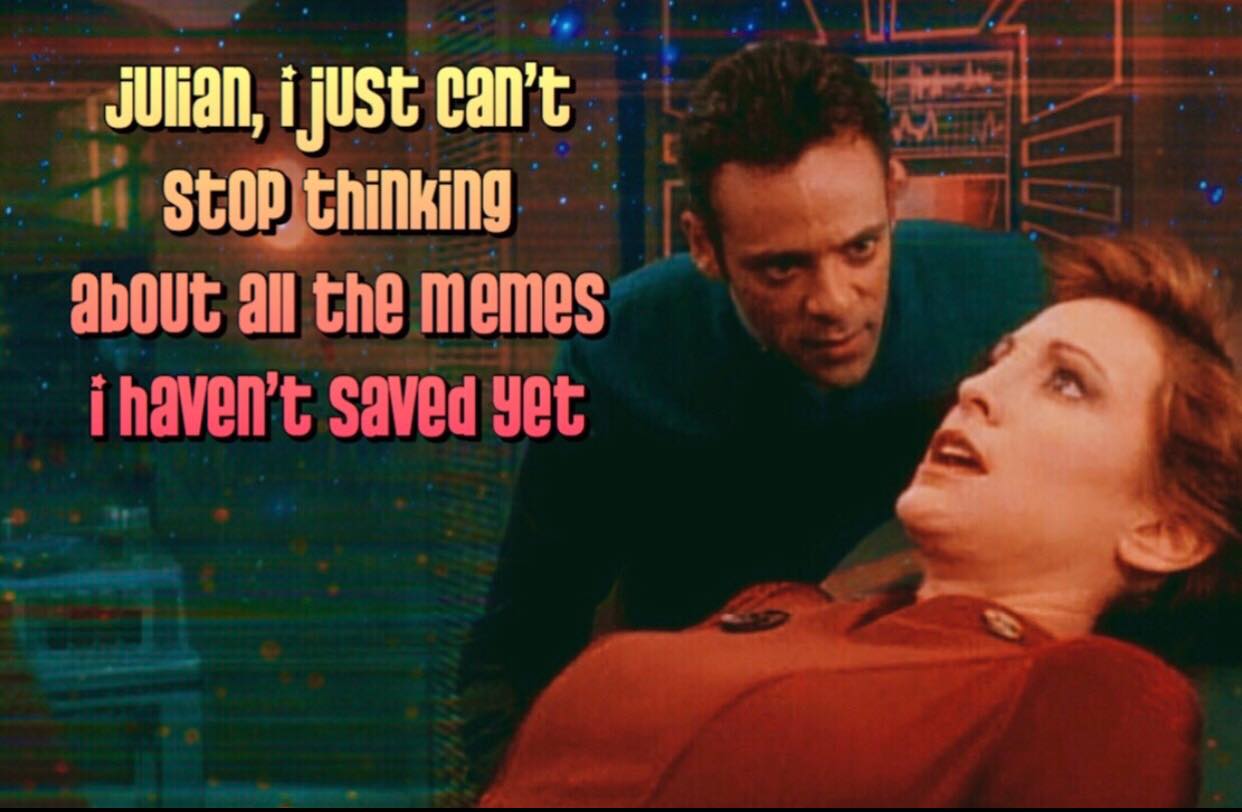
The image is a screengrab from a scene in Star Trek: Voyager depicting a dramatic moment between Captain Kathryn Janeway (Kate Mulgrew) and Seven of Nine (Jeri Ryan). Janeway is kneeling, cradling Seven of Nine, who is lying supine. Seven of Nine appears unwell, pale, and with eyes closed. Janeway has a concerned, almost anguished expression. The background is a typical Star Trek set—a vaguely futuristic, metallic corridor with illuminated panels and lighting. The lighting is moody, with a focus on the characters and their emotional state. The entire image is overlaid with red text: "Julian, I just can't stop thinking about all the memes I haven't saved yet."
Postmodernism
This meme is postmodernism in action. Here’s why:
- Juxtaposition & Irony: The core of the meme’s humor lies in the drastic juxtaposition of a serious, emotionally charged Star Trek scene (suggesting potential life/death crisis) with the incredibly trivial concern of "not saving memes." This creates a comedic irony, highlighting the absurdity of modern digital obsession.
- Intertextuality: The meme relies on audience familiarity with both the Star Trek scene and the cultural phenomenon of memes. It requires a level of shared cultural knowledge to be understood.
- Deconstruction of Meaning: The meme actively destabilizes the original meaning of the scene. It doesn't reinforce the emotional weight of the Star Trek moment; it undermines it with a lighthearted, relatable anxiety about the vastness of internet content.
- Simulacra & Hyperreality: The meme arguably points to the hyperreality of our digital lives. The anxiety over un-saved memes becomes a 'real' concern, taking precedence over (or becoming a parallel to) the fictional drama on screen.
Critical Theory
This meme engages with the broader critical analysis of media, technology, and societal obsession with online content.
- Commodification of Attention: The constant stream of memes represents a commodification of attention. The anxiety about "not saving" all the memes speaks to the feeling of being overwhelmed by content and the perceived need to consume and archive it all. The meme itself, as a unit of shareable content, participates in this system.
- The Spectacle: Drawing from Debord, the constant flow of memes contributes to the society of the spectacle, where images and fleeting sensations have become more important than genuine lived experiences. The character’s 'anguish' over lost memes functions as a parody of the dramatic spectacle presented in Star Trek.
- Media Literacy and Critique: The meme can be seen as a form of self-aware critique of the modern media landscape. It acknowledges the overwhelming nature of online content and the anxiety it can create, but it does so through a humorous and ironic lens.
Foucauldian Genealogical Discourse Analysis
We can analyze the "meme-saving anxiety" through Foucault’s lens:
- Power/Knowledge: The meme reveals how 'knowledge' (in this case, memes) has become a form of power. The desire to ‘save’ memes stems from a fear of missing out on cultural capital, of not being 'in the know.' This 'knowledge' bestows a degree of social recognition and participation.
- Discourse & Normalization: The meme normalizes the idea that obsessively collecting and consuming digital content is a legitimate source of anxiety. It subtly suggests that feeling overwhelmed by memes is a common, relatable experience.
- Genealogy of Meme Culture: Tracing the 'genealogy' of this anxiety might reveal how it's connected to broader trends in digital archiving, the rise of social media, and the development of a ‘collection’ mindset within online culture. It speaks to the way we are increasingly expected to document and archive every aspect of our lives, and the resulting pressure that creates.
Let me know if you'd like me to delve deeper into any of these areas or explore the image through a different lens.
simple-description (llama3.2-vision)
This meme features a screenshot of a character from the TV show "Star Trek: The Next Generation" (Data) in a state of shock, with a caption that reads: "I've been trained on every possible scenario, but I've never seen one like this. I'm... I'm... I'm going to... stunned silence". The meme is humorous because it's a tongue-in-cheek take on the character's inability to understand the absurdity of the situation, which is a common trope in comedy.
tesseract-ocr
oa a [a2 Sa tae ers a So) ae. Pe a ash RA] ae