First Seen
2023-05-10T21:03:41+00:00
simple-description (llama3.2-vision_11b)
The meme is a screenshot from Star Trek: The Next Generation, featuring Deanna Troi and Beverly Crusher in a conversation. The text "I don't know what you're talking about" is overlaid on the image, with a caption "I don't know what you're talking about" written above it. The meme is likely referencing the awkward and unhelpful nature of the conversation, with Deanna Troi's "I don't know what you're talking about" being a classic example of her empathic but clueless nature.
detailed-analysis (gemma3-27b-vision)
Okay, let's break down this meme using the requested theoretical frameworks. It's a layered image, so each section will focus on the lens through which that layering operates.
Visual Description
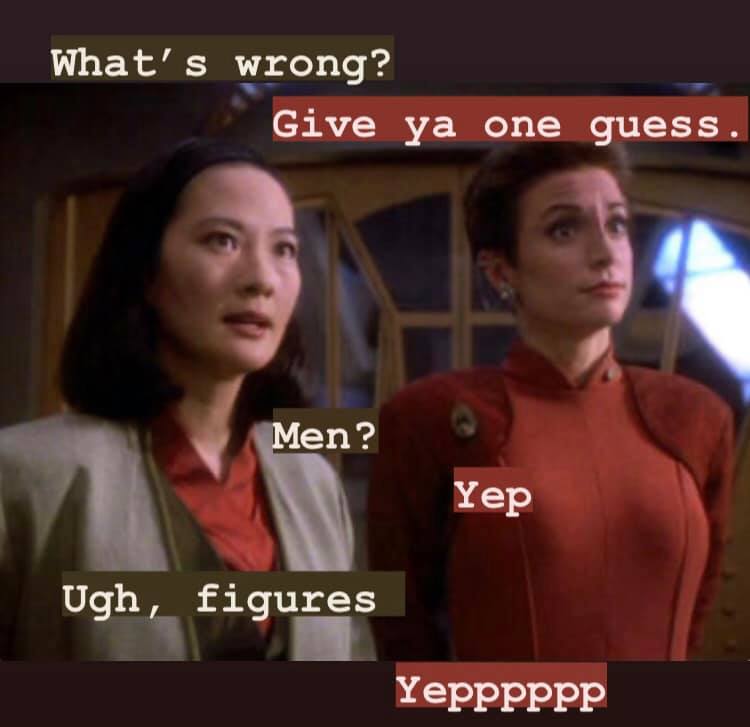
The image appears to be a screencap from a science fiction television show, likely Star Trek: Voyager, featuring the characters of B’Elanna Torres and Tuvok. The framing is a medium shot, focusing on the faces of the two characters. Torres looks exasperated, while Tuvok appears comparatively impassive, though slightly amused. Overlaid on the image are a series of text bubbles/lines, representing dialogue or internal monologue. The text bubbles are casually positioned, adding to the meme’s informal, ironic aesthetic. The progression of text is "What’s wrong?", "Give ya one guess," "Men?", "Ugh, figures," "Yep," and finally a playfully stretched "Yeeeepppp". The color scheme is somewhat muted, dominated by blues and reds. It appears to be an example of internet humor/meme culture.
Foucauldian Genealogical Discourse Analysis
This meme lends itself well to a Foucauldian analysis. The "problem" being discussed – the seemingly constant, underlying, or problematic presence of "men" – operates as a discourse. The meme doesn't explicitly state what is wrong with men; rather, it implies that the very question is almost self-evident within a certain shared understanding (a discourse) amongst its audience.
The genealogy would trace the historical development of this discourse. When did "men" become the default answer to what's wrong in a given situation? What power relations shaped this answer? This isn't simply about individual opinions; it's about how the category of "men" has been constructed historically through power dynamics, often as the source of various problems.
The meme acts as a site where this discourse is enacted and reinforced. The exasperated tone suggests a weariness with the repetition of this answer, while the quick affirmation ("Yep") suggests a shared normalization of it. The stretching of the "Yep" emphasizes the presumed universal truth of the statement. This meme functions to circulate and solidify this discourse through the mechanism of humor.
Critical Theory
From a Critical Theory perspective, the meme functions as a critique of patriarchal structures. The unstated "what's wrong" is often interpreted as pervasive systemic issues – harassment, violence, inequality, etc. – that are often, rightly or wrongly, attributed to men or patriarchal systems. The ease with which “men” is offered as an answer underscores how deeply ingrained this association is within the collective consciousness.
The meme can be read as a form of negative dialectic. It doesn’t offer a solution but rather highlights the continuing problematic situation—the constant recurrence of issues linked to patriarchal power. It implies a frustration that simple identification isn't enough. The meme is not arguing that all men are problematic, but rather that the structures of patriarchy create a problematic situation that is easily attributed to "men."
Queer Feminist Intersectional Analysis
From this lens, the meme highlights the ways in which patriarchal issues intersect with other forms of oppression. The focus on "men" as the problem can erase the experiences of individuals within that category who are also marginalized by race, class, sexuality, or other factors. It assumes a monolithic understanding of “men” that disregards internal diversity.
Furthermore, a queer feminist reading might point to how the meme reinforces a binary opposition: "men" as the problem, implying that not-men are the solution. This can be a limiting and exclusionary framework.
The meme subtly reinforces the notion that identifying the “problem” is enough. A more nuanced approach would acknowledge the complexities of power, intersectionality, and the need for systemic change that goes beyond simply naming "men" as the source of all issues. The implied frustration with the single-answer response can be seen as a rejection of simplistic analyses of complex social problems.
It’s important to note that the meaning of this meme is context-dependent and subjective. These analyses offer potential interpretations, but the actual meaning will vary depending on the individual viewer and the broader context in which the meme is shared.
simple-description (llama3.2-vision)
This meme is a still image from the TV show "Star Trek: The Next Generation" featuring a scene where two characters, Deanna Troi and Beverly Crusher, are looking confused. The text overlayed on the image reads "In 2-3 sentences, describe this meme for someone who cannot see it. Include any text that appears in the image." which is a self-referential joke, poking fun at the idea of describing a meme that is visually driven.
tesseract-ocr
What’s wrong? 7 Give ya one guess. Py f Cy eleg Ugh, figures a Yepppppp