First Seen
2023-05-10T21:03:41+00:00
simple-description (llama3.2-vision_11b)
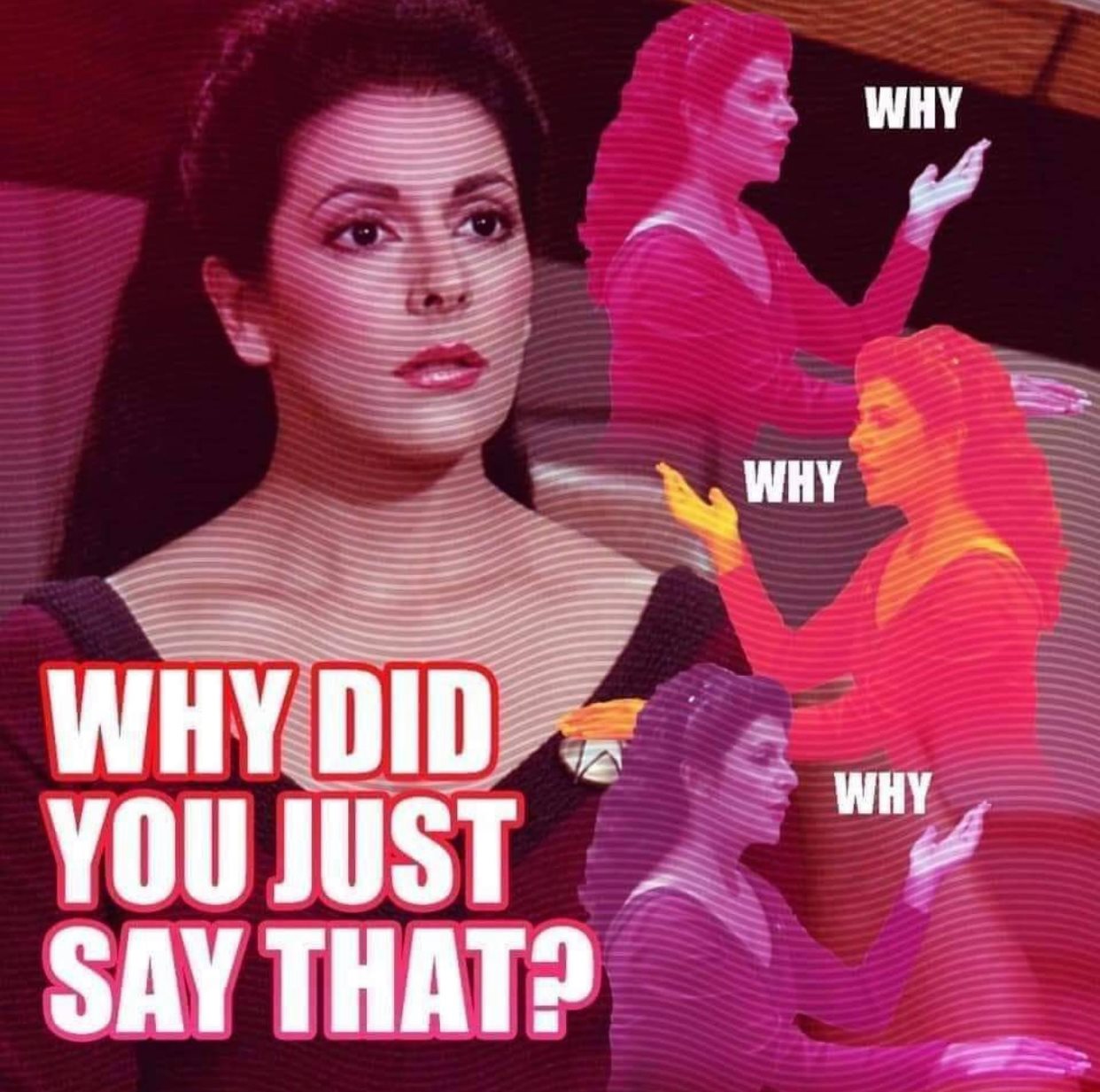
The meme is a screenshot from the Star Trek: The Next Generation episode "The Outcast" where a character's emotional outburst is met with a dry, sarcastic response from another character. The meme is captioned "When someone explains why they're upset but you still don't care" and features the character's response: "Because I said so. That is what I said."
detailed-analysis (gemma3-27b-vision)
Okay, let's break down this image using the requested theoretical lenses.
Visual Description
The image is a digitally altered still from the reality television show Real Housewives of Atlanta. It features Nene Leakes front and center, in a close-up with a visibly shocked and questioning expression. She's wearing dark clothing. The background is filled with blurred, repeating images of other women (presumably other housewives) in various poses, seemingly engaged in dramatic interaction. Overlaid on the image are repeating instances of the word "WHY" in white lettering, placed strategically around the blurred figures. The entire image is overlaid with horizontal lines reminiscent of a glitch effect or distorted signal, and dominated by red coloring. Text at the bottom reads "WHY DID YOU JUST SAY THAT?" in large white letters. The overall aesthetic suggests a high level of emotional intensity, confusion, and possibly even confrontation.
Foucauldian Genealogical Discourse Analysis
This image operates as a visual discourse reflecting the power dynamics inherent in reality television, particularly within the "Real Housewives" franchise. The phrase "Why did you just say that?" isn’t merely a question, but a discursive act designed to challenge, police, and control what is considered acceptable within the social field of the show (and by extension, within the discourses surrounding women and social behavior).
- Genealogy: Tracing the "why" as a form of interrogation reveals a history of policing speech, particularly that of women. The expectation that women’s statements need justification, defense, or explanation is deeply ingrained in patriarchal structures. The repeated "WHY" suggests an incessant questioning of female voices.
- Power/Knowledge: Nene Leakes, as a central figure on the show, embodies a specific type of power. She wields it through the act of questioning, establishing herself as the arbiter of what is “acceptable” speech. This is not about truth-seeking, but about creating a dynamic of dominance and submission.
- Discourse: The image constructs a discourse of performative outrage and interpersonal conflict. It contributes to the normalization of public shaming and the constant negotiation of social status among women.
Critical Theory
From a critical theory perspective, this image is a microcosm of broader societal issues regarding spectacle, female representation, and the commodification of conflict.
- Culture Industry: The image is a product of the culture industry (referencing Adorno and Horkheimer), designed to create and sustain a constant flow of entertainment based on interpersonal drama. The 'shocked' expression and repetition of 'why' encourage viewership and engagement.
- Spectacle: The image embodies the concept of the spectacle (Debord). It's not about genuine conflict or understanding, but about presenting a representation of conflict for consumption. The blurred background figures symbolize the audience's position as passive observers.
- Hegemony: The show, and images like this, contribute to the normalization of certain behaviors and attitudes, subtly reinforcing dominant ideologies about gender, class, and social interaction. The framing of women as inherently dramatic or confrontational subtly reinforces patriarchal expectations.
Marxist Conflict Theory
Though seemingly focused on interpersonal drama, this image hints at underlying conflicts rooted in class and status.
- Competition for Status: The Real Housewives franchise is, at its core, a competition for social status and economic gain. The confrontation implied in the image (“Why did you just say that?”) is not merely personal, but a struggle for dominance within a limited social field.
- Commodification of Relationships: The relationships between the housewives are, in a sense, commodified. Their conflicts and dramas are turned into entertainment, generating profit for the network and creating a form of spectacle.
- Ideology and Distraction: The focus on interpersonal conflicts distracts from larger systemic issues (economic inequality, structural sexism). The image is a form of ideological work, diverting attention from more substantive social problems.
Postmodernism
The image embraces postmodern characteristics through its fractured aesthetic and embrace of simulation.
- Simulacra and Simulation: The image is a simulation of a real interaction, divorced from any grounding in genuine emotion or meaning. The blurred background and repetitive text create a sense of hyperreality, where the image is more "real" than the reality it supposedly depicts.
- Deconstruction of Meaning: The relentless questioning ("Why?") undermines any stable meaning. It suggests a skepticism towards truth and a recognition that all interpretations are subjective and contingent.
- Fragmentation: The distorted aesthetic and fractured composition reflect the postmodern emphasis on fragmentation and the breakdown of traditional narratives.
Queer Feminist Intersectional Analysis
This is where the analysis can get really nuanced.
- Performance of Femininity: The image highlights the performative aspects of femininity. The housewives are constantly 'performing' for the cameras, enacting specific roles and tropes of femininity (e.g., drama, emotionality, cattiness).
- Intersectional Dynamics: Within the cast, there are likely intersecting identities (race, class, sexuality) that shape the dynamics of power and conflict. The image, while not explicitly depicting this, operates within a context where these intersections are crucial.
- Policing of Black Women's Speech: Given Nene Leakes is a Black woman, the questioning ("Why did you just say that?") can be interpreted as a subtle form of silencing or policing of her speech. Black women are often subjected to heightened scrutiny and are often expected to justify their opinions or actions more than their white counterparts.
- Deconstruction of "Catty" Narratives: The image challenges the trope of “catty” women, highlighting how it’s often used to dismiss or delegitimize female conflict. It forces us to examine the ways in which women’s expressions of anger or disagreement are often pathologized.
Hopefully, this detailed breakdown using various theoretical frameworks provides a comprehensive understanding of the image! Let me know if you'd like me to elaborate on any specific aspect.
simple-description (llama3.2-vision)
The meme is a screenshot of Deanna Troi, a character from the TV show Star Trek: The Next Generation, looking shocked and confused. The text "Why did you just say that?" is written below her image, implying that she's asking for an explanation for something she just heard. The meme is likely being used to express confusion or surprise at a statement or situation.
tesseract-ocr
= == — WHY = ZA < - “8 Fa 2 ] a —— ae = - = = eS eS =e AA = — = a = = — —_ ae — — SS — 7 = TT FF st YOUJUST - ™: NN A ASS a SEU E nt