First Seen
2023-05-10T21:03:41+00:00
simple-description (llama3.2-vision_11b)
The meme is a screenshot from the Star Trek: The Next Generation episode "The Outcast," where Commander Riker's friend and colleague, Commander Riker, is struggling with his own identity. The text "I'm... I'm... I don't know what I am" is spoken by Commander Riker as he is trying to understand and come to terms with his own identity. This scene is often referenced in memes as a way to poke fun at the struggles of identity and self-discovery.
detailed-analysis (gemma3-27b-vision)
Here's an analysis of the image, broken down into the requested theoretical sections. Note that not every theory is fully applicable, and the depth of analysis will vary depending on the theoretical lens.
Visual Description
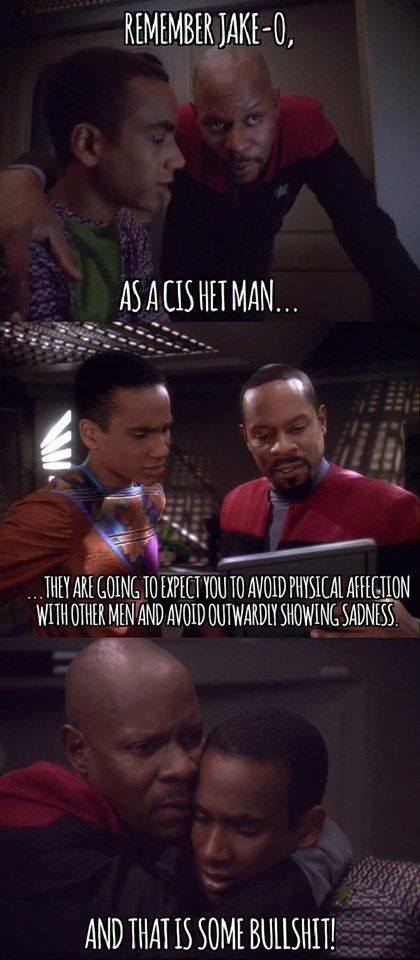
The image is a series of screenshots from a science fiction television series (likely Star Trek: Lower Decks given the animation style). It depicts a conversation between two characters. The top panel shows a character with green skin looking concerned or apprehensive. The central panels depict a character, Marvin, delivering a solemn or forewarning message to the other. The final panel shows the recipient character, Rutherford, reacting with strong disapproval and anger, emphasized by the caption "AND THAT IS SOME BULLSHIT!" The setting appears to be within a spaceship's bridge or a technologically advanced setting. The lighting is dramatic, with a focus on the characters' faces.
Foucauldian Genealogical Discourse Analysis
This image is ripe for a Foucauldian analysis. The conversation directly addresses the discourse surrounding masculinity—specifically, the "rules" governing how men are expected to behave.
- Power/Knowledge: Marvin's message highlights the ways in which power operates through the normalization of specific behaviors. The expectation for men to avoid physical affection with other men and suppress displays of sadness isn’t a natural state, but a construction produced by power. This isn’t about “truth” but about what has become accepted as “normal” through a history of social practices and enforcement.
- Genealogy: A genealogical investigation would trace the history of these expectations. How did these “rules” about men and affection/sadness emerge? What institutions (family, education, religion, media) have historically reinforced these expectations? What specific practices have contributed to their development? The genealogy would likely reveal how these rules are linked to control, dominance, and the maintenance of hierarchical social structures.
- Discipline: The expectation functions as a disciplinary mechanism. Men who deviate from these norms might face social ostracism, accusations of being "unmanly," or even violence. This self-regulation, combined with external enforcement, keeps men “in line” with societal expectations.
Critical Theory
The image powerfully illustrates core tenets of Critical Theory, particularly as it relates to the social construction of gender and the critique of dominant ideologies.
- Ideology: Marvin’s message reveals an ideology that underpins societal expectations of masculinity. This ideology presents a specific way of being a man as “natural” or “normal,” masking the fact that it is a social construct designed to serve particular interests.
- Hegemony: The expectation for men to repress affection and sadness represents a form of hegemony. It is a dominant worldview that is accepted as common sense, even though it disadvantages those who don't conform.
- Emancipation: Rutherford’s defiant response – “AND THAT IS SOME BULLSHIT!” – represents a potential for emancipation. He rejects the imposed norms and challenges the ideology that seeks to control his behavior. This act of resistance is critical for dismantling oppressive structures.
Queer Feminist Intersectional Analysis
This image is intensely relevant to Queer Feminist thought.
- Gender Performativity: The conversation highlights how gender isn’t inherent, but performed. Men are expected to act in certain ways to prove their masculinity. This performance is based on societal expectations, not biological reality.
- Toxic Masculinity: The expectations of suppressing affection and sadness are hallmarks of toxic masculinity. This set of harmful norms negatively impacts not only those who are marginalized but also men themselves. It limits their emotional expression and reinforces harmful power dynamics.
- Intersectionality: The fact that Rutherford is identified as "cis" (meaning his gender identity aligns with his sex assigned at birth) is important. The image demonstrates how even within a privileged gender identity, individuals can be harmed by restrictive norms. However, it’s also important to recognize that marginalized genders and sexualities experience these restrictions far more acutely.
- Queer Resistance: Rutherford’s rejection of the norms can be seen as an act of queer resistance—challenging the heteronormative expectations of masculinity.
Marxist Conflict Theory
While less directly applicable than other theories, a Marxist lens can still illuminate aspects of the image.
- Power Dynamics: The expectations surrounding masculinity reinforce existing power dynamics. The suppression of emotion and the emphasis on dominance contribute to a hierarchical social structure.
- Ideological Control: The normalization of these expectations serves the interests of those in power. A population that conforms to these norms is easier to control and exploit.
- Class & Masculinity: Historically, certain performances of masculinity have been associated with class privilege. This is not directly shown in the image, but the expectation for men to be “strong” and “unemotional” often reinforces existing class divisions.
In conclusion, the image is a potent depiction of the social construction of gender and the harmful effects of restrictive norms. It provides a rich starting point for analysis through various critical theoretical frameworks, revealing how power operates, ideologies are maintained, and resistance can emerge.
simple-description (llama3.2-vision)
The meme is a screenshot from the TV show Star Trek: Deep Space Nine, featuring a character named Worf and a character named Kira, who are having a conversation. The text in the image reads: "Remember, Worf: 'The needs of the many outweigh the needs of the few... and the one.' But in this case, the needs of the one outweigh the needs of the many." However, the actual text being referenced is from a different Star Trek series, Star Trek II: The Wrath of Khan, and is spoken by Mr. Spock, not Worf.
tesseract-ocr
REMEMBER JAKE-0, a AYN ae <a She! . ~ fai) ES A. r —— __ THEY AREGOINGTO EXPECT YOUTO AVOID PRYSICAL AMEGTION NOUN A) ANOLD OUTWARDLY STG WI) nl . o ow AND TMATISSOMEBULSHITE