First Seen
2023-05-10T21:03:41+00:00
simple-description (llama3.2-vision_11b)
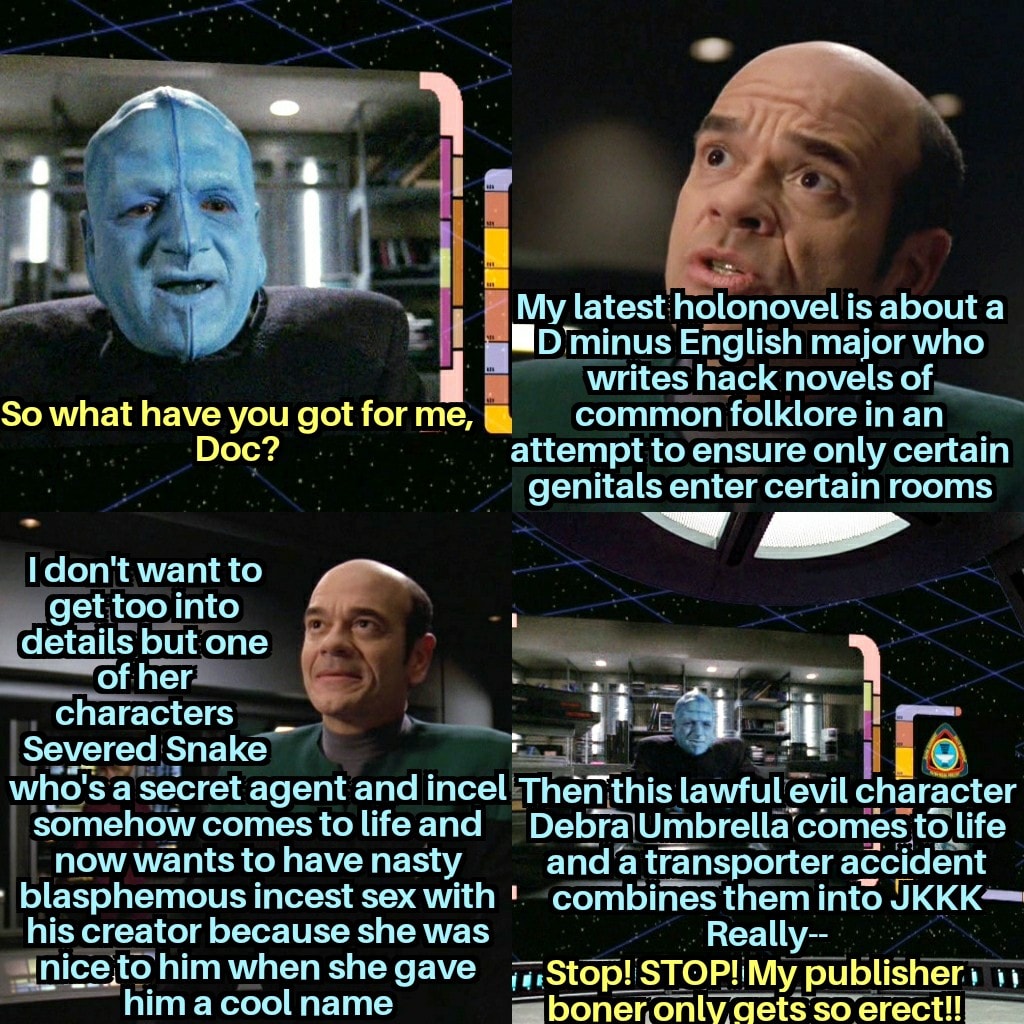
The meme is a screenshot from the Star Trek: The Next Generation episode "The Outcast," where Commander Riker is discussing his past with a holodeck program of a woman. The meme juxtaposes this scene with a quote from a book about a character named "Riker" who is a woman, implying that the character's past is being discussed in a way that is not typical for a male character in Star Trek.
detailed-analysis (gemma3-27b-vision)
Okay, this is... a lot. Here's a breakdown of the image, focusing on the aspects where the requested analytical lenses apply. It's important to note this is a highly interpretive exercise, given the bizarre, meme-like nature of the content. I will indicate where a section is not applicable.
1. Visual Description
The image is a collage of screenshots primarily from Star Trek: Voyager episodes. The main figures present are:
- The Doctor (Holodeck Character): Featured prominently twice, once in a close-up with a contemplative expression and again in conversation with another character.
- Captain Kathryn Janeway: Appears once.
- Seven of Nine: Also appears once.
- A Transporter Pad: Featured prominently, with a chaotic distortion effect around it.
- Text Overlays: The image is saturated with bizarre text snippets, acting as dialogue or internal monologue. The text describes a deeply unsettling and graphically suggestive novel-in-progress involving incest, power dynamics, and explicit sexual content, presented with a nonsensical and unsettling tone.
The overall aesthetic is a chaotic, low-resolution collage, typical of internet meme culture. The juxtaposition of dignified Star Trek imagery with the hypersexualized and disturbing text creates a jarring and unsettling effect.
2. Foucauldian Genealogical Discourse Analysis
This is very applicable due to the themes of power, knowledge, and the body.
- Power/Knowledge: The "novel" as described embodies the fusion of power and knowledge that Foucault discussed. The author holds the power of creation and narrative, and this novel aims to control access to space based on genitalia. This is an assertion of power through defining and controlling bodies.
- Discourse and Regulation: The novel's premise (controlling room access based on genitals) represents a discourse that seeks to regulate bodies and sexuality. This aligns with Foucault's idea that discourse creates norms and categorizes individuals. It’s an extreme example, but it highlights how seemingly abstract ideas can be used to control lived experiences.
- Genealogy of Norms: One could argue that the novel attempts to create a genealogy of norms around access and sexuality. It's attempting to establish a 'natural' order based on biological characteristics, ignoring the social construction of these categories. The absurdity of the premise reveals the arbitrary nature of such norms.
- The Panopticon: The attempt to control access based on genitals could be a warped metaphor for the Panopticon, where bodies are constantly monitored and regulated, even if there is no physical surveillance.
3. Critical Theory
This applies strongly, specifically focusing on deconstruction and challenging established norms.
- Deconstruction: The juxtaposition of the dignified Star Trek universe with the graphic and perverse content of the novel inherently deconstructs the idealized image of the show. It subverts the expectations associated with the series and reveals its underlying power dynamics (though in a distorted manner).
- Challenging Grand Narratives: Star Trek often presents a utopian vision of the future. This image/text collage actively dismantles that narrative, replacing it with a narrative of control, desire, and potential violence. It’s a nihilistic counter-narrative.
- Power Dynamics: The novel's premise (genital-based access control) highlights the problematic power dynamics inherent in defining who belongs and who is excluded. This is a critique of social structures that privilege certain bodies over others.
4. Marxist Conflict Theory
While less prominent than other approaches, conflict theory can be applied.
- Class and Access: The novel’s premise could be interpreted as a symbolic representation of class-based access. The “certain genitals” could represent a privileged group who control access to resources (rooms in this case), while others are excluded.
- Ideology and Control: The attempt to control access based on genitalia can be seen as an ideological construct used to maintain power imbalances. The novel perpetuates a system of control by defining who is worthy and who is not.
- Alienation: The bizarre and disturbing nature of the novel's premise contributes to a sense of alienation and disconnect from the idealized world of Star Trek.
5. Postmodernism
This is highly applicable.
- Pastiche and Intertextuality: The collage nature of the image combines elements from different sources (Star Trek and the author’s writing) to create a new, fragmented whole. This is a characteristic of postmodern pastiche.
- Irony and Parody: The juxtaposition of the dignified Star Trek imagery with the disturbing text creates a strong sense of irony and parody. It mocks the conventions of both the show and the traditional novel.
- Deconstruction of Meaning: The fragmented and nonsensical nature of the text challenges the idea of fixed meaning. It suggests that meaning is fluid, subjective, and open to interpretation.
- Meta-narrative: The text itself comments on the process of writing and creation, blurring the line between reality and fiction.
6. Queer Feminist Intersectional Analysis
This is very applicable, given the explicit focus on bodies, sexuality, and power.
- Sexualization and Objectification: The novel’s premise is inherently sexualizing and objectifying, reducing bodies to their genitalia. This perpetuates harmful stereotypes and reinforces patriarchal power structures.
- Power Imbalance: The control of access based on genitalia is a clear example of power imbalance, reinforcing the dominance of one group over another.
- Incest and Exploitation: The reference to incest is deeply problematic and highlights the potential for exploitation and abuse.
- Intersectional Oppression: The novel intersects with multiple forms of oppression, including sexism, heteronormativity, and ableism (potentially, depending on how “certain genitals” are defined).
- Subversion and Resistance: It could be argued that the sheer absurdity of the text is a form of subversive resistance against dominant norms and expectations. But that reading is heavily dependent on interpreting the intent behind the collage, which is uncertain.
Important Disclaimer: This analysis is based on the content of the image and text as presented. It’s important to acknowledge the disturbing nature of the content and to approach it with critical sensitivity. The analysis does not endorse or condone the problematic themes depicted.
Let me know if you’d like me to elaborate on any specific point or analytical lens!
simple-description (llama3.2-vision)
This meme is a screenshot of a character from the TV show "Star Trek: Deep Space Nine" (Quark) being asked to identify a character from a book. The character, Quark, is confused and provides a humorous and inaccurate description of the book's protagonist, "In a Sunburned Country" by Bill Bryson, which is actually a travel book, not a romance novel with a character named "In a Sunburned Country" is actually a travel book, not a romance novel.
tesseract-ocr
: on on ~ a : aa he, Pe . = % a ia ra Swe it A eee) Oe | q tA ix =e = ro ee Wh sei My latest holonovel is about a || a English major who | ‘al writes hack novels of So what have you got forme, @ = common folklore in an Doc? attempt to ensure only certain ; ; - genitals enter certain rooms _ ~T - | don't want to | ; : getitoo into £ 4 § ne gas . ‘Chas but one \ ae ; prmmren(LLT=Toee € be ate a 6 a | . ,. characters); i i Ries Ef i ; Severed Snake) po ia ae | [oe Meee terial lela Mea Ree a eear lela somehow comes to lifeand ~Debra\Umbrella’comes tollife now wants to have nasty and‘a transporter accident - blasphemous incest sex with ' «combines them into JKKK= his creator because she was Really-- @iniceto him when she gave ;;,Stop!'STOP!/My publisher 1 hima cool name me boner only acets'so erect!! im