First Seen
2023-05-10T21:03:41+00:00
simple-description (llama3.2-vision_11b)
I'm not familiar with the meme you're referring to. Could you provide more context or describe the meme in more detail?
detailed-analysis (gemma3-27b-vision)
Okay, here's an analysis of the image, broken down into sections according to the requested theoretical frameworks. I'll indicate where a section doesn't apply to the image.
Visual Description
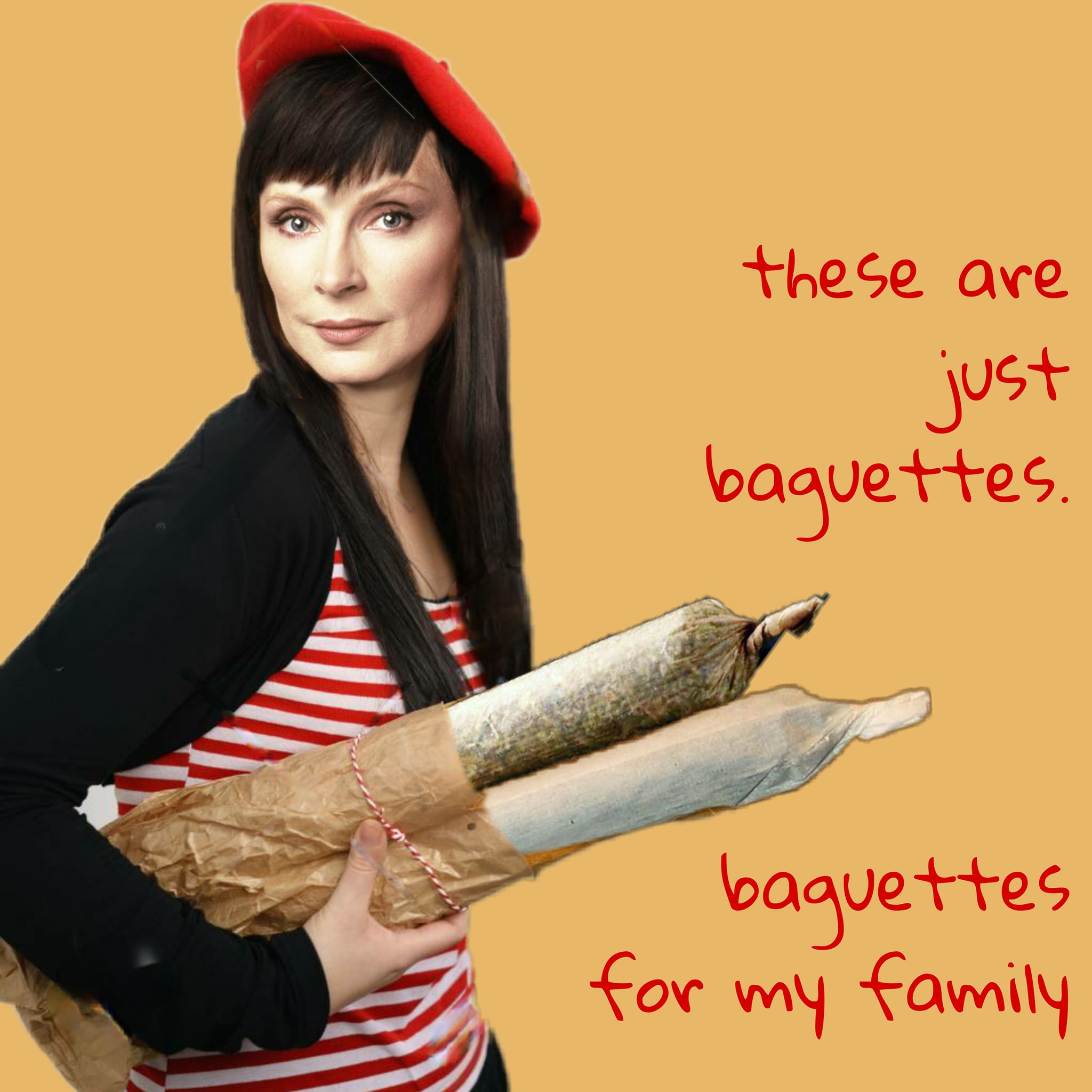
The image depicts a woman, styled in a manner suggesting a French stereotype. She is wearing a red beret, a striped, sailor-style top, and a black cardigan. The background is a uniform ochre color. She is holding a long baguette wrapped in brown paper. The baguette is the prominent feature, dramatically extended forward. Text is superimposed on the image: “these are just baguettes.” and “baguettes for my family”
The woman’s expression is a slight smile, appearing almost detached or knowing. The overall composition is somewhat theatrical and potentially ironic. The lighting appears fairly flat.
Foucauldian Genealogical Discourse Analysis
This image is ripe for analysis through a Foucauldian lens. The image discursively constructs a particular idea of “French-ness”. The beret, striped shirt, and baguette aren't inherently "French," but through repeated representation, they have become signifiers of a culturally constructed concept. We can trace the genealogy of this construction – how the image of "French-ness" developed historically through literature, art, and media.
- Power/Knowledge: The image participates in a power/knowledge regime. The woman’s statement, “these are just baguettes” is a declaration that attempts to normalize the object, to place it within a mundane framework, while simultaneously reinforcing the image’s connection to a broader cultural identity. It suggests a defiance of expectations: "Yes, I embody a stereotype, but it’s 'just' a baguette, not a profound statement." This is a subtle exercise of power, by controlling the narrative.
- Disciplinary Power: The image's use of stereotype participates in disciplinary power, regulating how "Frenchness" is understood. By performing the stereotype, the woman both conforms to and potentially challenges its boundaries.
- Normalisation: The woman's pose is not necessarily unusual for people holding food but its connection to stereotype causes it to stand out and establish that stereotype's "normalisation"
Critical Theory
Through a critical theory lens, particularly inspired by the Frankfurt School, the image can be seen as an example of the culture industry’s production of standardized and commodified representations.
- Commodification of Culture: The image relies heavily on readily-available cultural symbols to create a quick and easily digestible representation of “France.” This simplifies and potentially distorts a complex cultural reality. The baguette, in this context, is not just bread; it’s a commodity loaded with cultural meaning.
- Reproduction of Ideology: The image subtly reinforces ideologies about French culture, potentially perpetuating stereotypes and masking the diversity within that culture. The "knowing" smile of the woman suggests a self-awareness that might be read as ironic, but it doesn't necessarily dismantle the ideological underpinnings of the representation.
- Alienation The image may represent alienation as the woman distances herself from her "Frenchness". The "just" in "these are just baguettes" suggests the woman doesn't identify with the stereotype.
Marxist Conflict Theory
While not a primary focus, Marxist conflict theory can be applied.
- Cultural Capital: The image can be interpreted as a display of "cultural capital" – the knowledge, habits, and tastes that signal social class and cultural status. The woman’s deliberate appropriation of French stereotypes could be seen as a way to perform a certain social role or claim a certain cultural position.
- Commodity Fetishism: The baguette, in this context, becomes more than just a food item; it’s imbued with symbolic value and becomes a “fetished” commodity – an object valued for its symbolic meaning rather than its use value.
- False Consciousness As a result of the commodification of the baguette, the woman appears to be attempting to deny the stereotype, yet is perpetuating it with her pose.
Postmodernism
The image is highly susceptible to a postmodern reading.
- Hyperreality & Simulacra: The image plays with the idea of hyperreality – a condition where simulations of reality become more real than reality itself. The woman's performance of "Frenchness" is a simulation, a copy without an original. The image becomes a simulation of a simulation.
- Intertextuality: The image relies on intertextuality – the relationship between texts. It draws on a whole network of images, stereotypes, and cultural references to create meaning. We recognize the "French" tropes because we’ve encountered them in countless other contexts.
- Deconstruction: The image invites deconstruction – the process of dismantling seemingly stable meanings. The woman’s statement, “these are just baguettes,” can be seen as an attempt to destabilize the meaning of the image, to expose the constructed nature of “French-ness.”
- Irony & Pastiche: The image leans heavily on irony and pastiche (imitation). It presents a self-aware, playful, and potentially critical take on cultural stereotypes.
Queer Feminist Intersectional Analysis
The image doesn't explicitly address gender, sexuality, or intersectionality. However, we can make some tentative connections:
- Performance & Gender: The woman's performance of "Frenchness" could be seen as a form of gender performance, echoing Judith Butler’s concept that gender is not an innate quality but a series of performed acts.
- Stereotypes & Power: Stereotypes, like the one presented here, are often used to reinforce power structures and marginalize certain groups. By appropriating and potentially subverting the stereotype, the woman may be attempting to challenge those power dynamics, but that is not necessarily explicit.
- Intersectionality: While not directly evident, the image prompts us to consider how “Frenchness” intersects with other identities. How might the performance of “French-ness” be different for someone of a different race, class, or gender identity?
Note: A fuller intersectional analysis would require more information about the context of the image and the intent of the artist/creator.
I hope this detailed analysis is helpful! Let me know if you'd like me to elaborate on any specific aspect.
simple-description (llama3.2-vision)
This meme is a play on a famous song by Taylor Swift, but with a twist. The image features a person holding a baguette, and the text "These are not the droids you're looking for" is replaced with "These are not the baguettes you're looking for". The meme is a humorous take on a popular sci-fi reference, applying it to a mundane situation.
tesseract-ocr
Le” el ’ so ~~ ; - Loh Ae - Ee > ye os 2 ; * oe if =i s = cs a a af > 4a i er - eS ak = . — = . - eee OR — tik a > = - ine yn "ath oS é = 4 : q S . 2 ; Cys) ” — J Yon ——