First Seen
2023-05-10T21:03:41+00:00
simple-description (llama3.2-vision_11b)
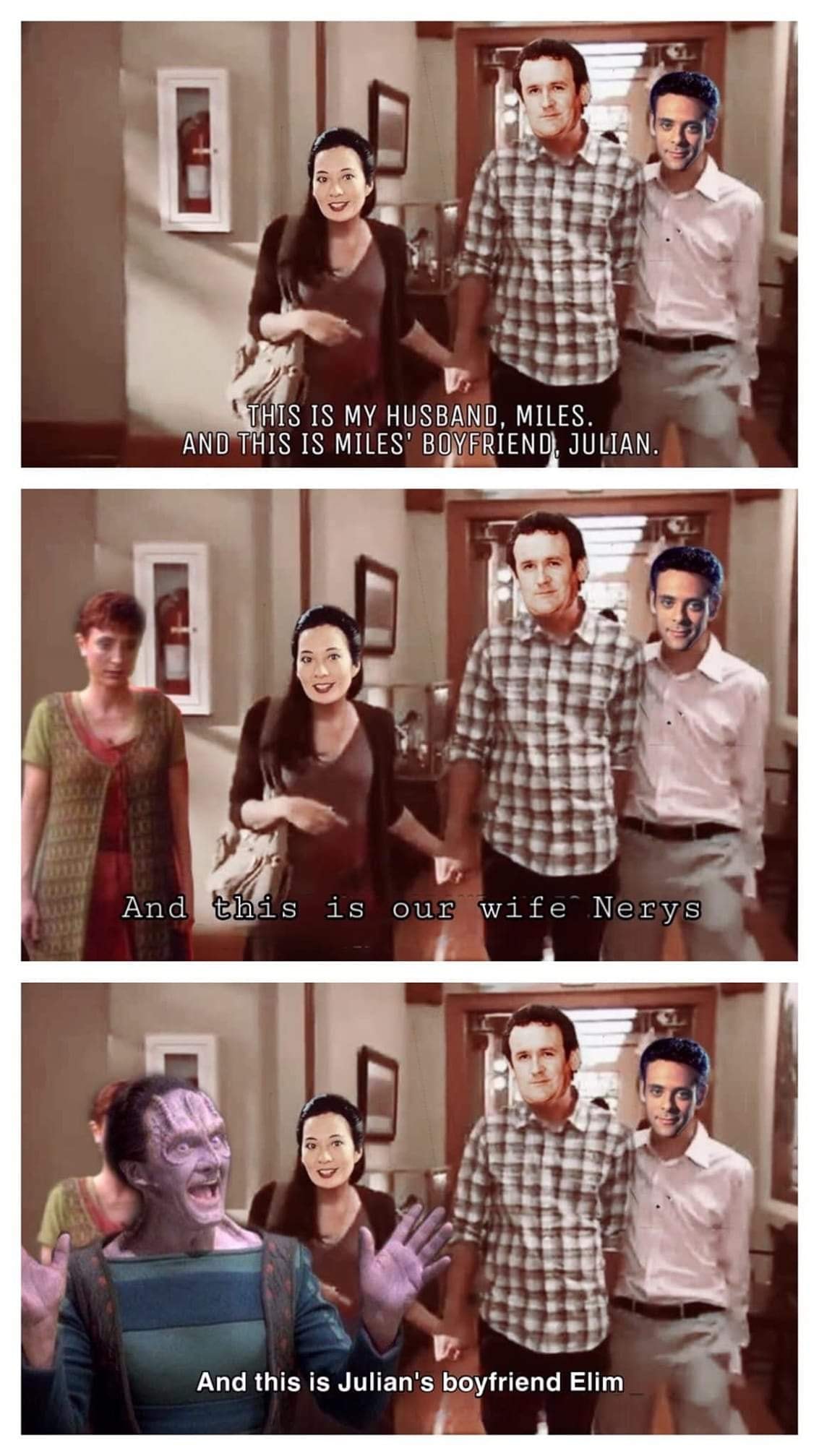
The meme is a screenshot from the TV show Star Trek: The Next Generation, with the character Data (played by Brent Spiner) standing in front of a group of people. The meme is captioned with a quote from the show, but the words are altered to make it sound like a character from the Star Trek franchise is making a comment about the TV show "Star Trek: The Next Generation" being a show about a group of people. The quote is: "I'm a Star Trek fan, and I love watching the show, but I have to say, I'm not a fan of the show."
detailed-analysis (gemma3-27b-vision)
Okay, here's an analysis of the provided image series, broken down into relevant sections. The image presents a progressively revealing introduction of a polyamorous relationship, so several lenses are highly applicable.
Visual Description
The image is a series of four screenshots, likely from a television show (potentially You're the Worst). Each frame shows a woman (identified as Nerys) introducing a series of partners to an unseen audience (we infer this from her gestures and direct address).
- Frame 1: Nerys stands between two men, Miles and Julian, and declares “This is my husband, Miles, and this is Miles’ boyfriend, Julian.” The background appears to be a simple living room.
- Frame 2: She adds “And this is our wife, Nerys.” An additional woman is introduced into the grouping.
- Frame 3: Nerys continues, introducing "And this is Julian’s boyfriend, Elim.” Another man joins the group.
- Framing & Composition: The visual composition is static; the individuals are generally lined up. The increasing number of people presented highlights the expanding relational network. There is a casual, slightly awkward, and understated quality to the whole scene.
Queer Feminist Intersectional Analysis
This image is strongly relevant to a Queer Feminist Intersectional lens. Here's how:
- Subversion of Normative Relationships: The most obvious aspect is the outright rejection of the monogamous, heterosexual relationship as the "default." It presents a polyamorous relationship as matter-of-fact. This directly challenges the heteronormative assumption that relationships must be dyadic (two-person) and exclusive.
- Deconstruction of Gender Roles: The introduction of a wife and a husband further destabilizes the traditional gendered expectations of marriage. It isn't about a man having a wife, but a collective "we" building a relational structure.
- Intersectionality: This scene isn’t just about challenging relationship norms. It implicitly acknowledges that identity is not monolithic. While the immediate focus is on relationships, it’s likely the characters also hold other intersecting identities (race, class, ability, etc.). These identities will inevitably shape their experiences within the polyamorous network.
- Power Dynamics: Polyamory, while potentially egalitarian, can replicate or exacerbate power imbalances if not carefully navigated. This scene doesn’t reveal power dynamics, but a critical analysis would ask: Who holds more social capital? Who is benefiting most from this relationship structure? Are all voices heard equally?
- Visibility and Representation: The representation of a polyamorous relationship on television, even in a comedic or dramatized context, increases visibility for a marginalized relationship orientation. This can contribute to increased acceptance and understanding.
Postmodernism
Postmodernism offers a strong interpretive framework:
- Rejection of Grand Narratives: This scene actively rejects the "grand narrative" of monogamous, heterosexual love as the only valid way to form meaningful connections. It deconstructs the idea of a single, "correct" way to live and love.
- Fluidity and Deconstruction of Identity: The scene showcases fluidity – not just in relationships, but potentially in identities. The labels ("husband," "wife," "boyfriend") are used, but the structure itself is complex, challenging easy categorization.
- Simulation & Hyperreality: A postmodern reading could argue that the presentation of the relationships is a performance—a constructed reality for the audience (both within the show and the actual viewers). The individuals are presenting themselves in a particular way, and the “truth” of their relationships is filtered through performance.
- Irony & Parody: The understated delivery and the sheer number of people introduced could be interpreted as ironic or a parody of traditional relationship introductions.
Foucauldian Genealogical Discourse Analysis
This scene is ripe for Foucauldian analysis, focusing on how power operates through discourse:
- Discursive Formation of "Relationships": The very language we use to talk about relationships (“husband,” “wife,” “boyfriend”) is not neutral. It's historically constructed and reinforces certain norms. This scene deliberately challenges those norms by extending the terminology to a non-traditional structure.
- Power/Knowledge: Foucault argues that power and knowledge are inextricably linked. The societal “knowledge” about relationships historically has been defined by those in power (e.g., patriarchal institutions, religious organizations). This scene attempts to create a new discourse of relationships, challenging the established power dynamics.
- Genealogy of Monogamy: A genealogical analysis would trace the historical development of monogamy as a social institution, revealing how it emerged through specific power dynamics and social conditions. The polyamorous structure presented here represents a disruption of that historical trajectory.
- Panopticism & Surveillance: While not immediately visible in the image, a Foucauldian lens might consider how the characters are implicitly being "surveilled" by societal expectations and judgments. Their relationships are subject to external scrutiny, even if not explicitly depicted.
Marxist Conflict Theory (Less Directly Applicable, but Possible)
This lens is less central but still relevant, though requires some stretching:
- Challenge to Bourgeois Family Structure: The traditional nuclear family (man, woman, children) is often seen as a cornerstone of capitalist society. This polyamorous structure challenges that traditional model, potentially representing a rejection of bourgeois norms.
- Resource Distribution & Conflict: A Marxist analysis could consider how resources (emotional, financial, time) are distributed within the polyamorous network. Potential conflicts could arise from unequal distribution or differing needs.
- Alienation & Commodification of Love: Some Marxist thinkers argue that capitalism commodifies even intimate relationships. A polyamorous structure could be seen as a resistance to that commodification, emphasizing connection and emotional fulfillment over economic or social pressures.
Let me know if you'd like me to elaborate on any of these points or explore other theoretical frameworks!
simple-description (llama3.2-vision)
This meme is a screenshot from the TV show "How I Met Your Mother" with a caption that replaces the characters' names with those from the Star Wars franchise. The caption reads: "This is my husband, my wife, and my friend. This is my husband, my wife, and my friend. This is my husband, my wife, Nerys, and my friend."
tesseract-ocr
—_—" Fl i an ~ C , ay . ies , ; Te! shad te } “| a, iS ¥ * ' N793 3 yz ’ ~~ os Ba fy ig S25 ra - ‘@ IS MY HUSBAND, MILES. AND'THIS IS MILES" BOWERIEND), JULIAN. ‘ — az © Leis. eg PO Entei f %, A “' a ¢ ~ - re fe % : ae . ; “ etd= j a]. P : / Vv. Kees And@ehis is our wife en aaa eH © D , a fp ia a , ~G i a ieee yy . e 2 e Ot ta , Ss, =i WER Ht i — a ya 1s93. » iS oe i "SS ee Pio R IMM Lo coh Ata tare aL Ut) f