First Seen
2023-05-10T21:03:41+00:00
simple-description (llama3.2-vision_11b)
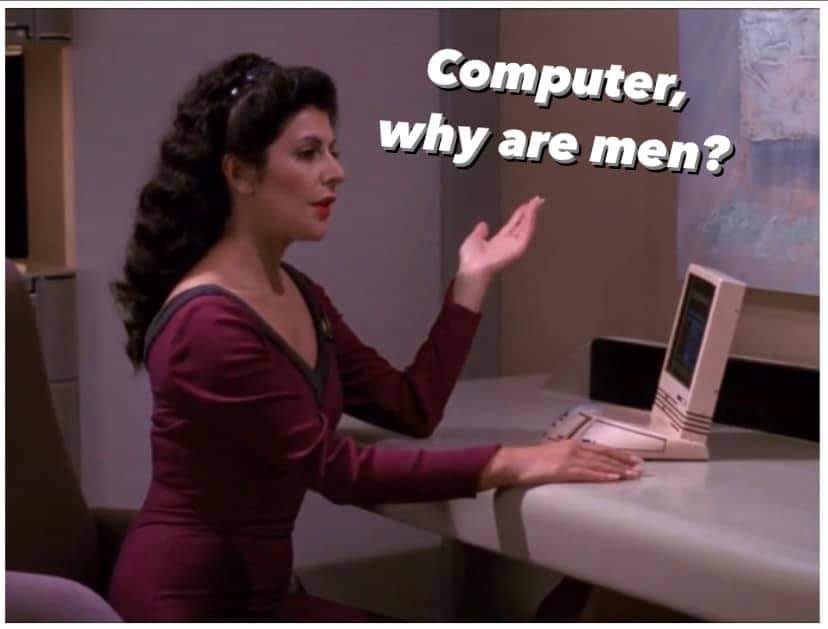
This meme is from the Star Trek franchise and is a reference to a classic episode where a character, Lieutenant Commander Data, is trying to understand human nature and asks "Computer, why are humans so emotional?" The meme takes this question and replaces "emotional" with "queer", implying that Data's question is now about the LGBTQ+ community. The image is likely a screenshot of Data from the show, with the caption "Computer, why are humans so queer?"
detailed-analysis (gemma3-27b-vision)
Okay, let's break down this image, which is a still from Star Trek: The Next Generation with a humorous overlay of text, through the lens of various theoretical frameworks.
Visual Description
The image depicts Deanna Troi (Marina Sirtis) in her standard counselor's uniform, a fitted burgundy dress. She is seated at a workstation common to the setting of Star Trek: The Next Generation, and appears to be addressing a beige computer terminal. Her body language is demonstrative, with one hand raised in a questioning gesture and a slightly perplexed expression. Overlaid on the image is the text "Computer, why are men?". The context is humorous, playing on the typical phrasing used to ask questions of the ship's computer. The aesthetic is late 80s/early 90s sci-fi.
Foucauldian Genealogical Discourse Analysis
This image, through the overlaid text, opens a discourse around the very construction of "man" itself. A Foucauldian analysis wouldn't seek a reason why men exist, but rather how the category of "man" has been produced through historical power dynamics.
- Discourse & Power: The question invites an examination of the discourses that define masculinity. What historical forces, institutions, and social practices have shaped the definition of “man”? The question challenges the assumed naturalness of this category.
- Genealogy: Tracing the historical genealogy of “man” would reveal how it isn't a stable, universal concept. The image subtly suggests the constructed nature of gendered identity. We could examine how the concept of "man" has shifted over time and across cultures.
- Power/Knowledge: The question, even in its humorous form, points to the ways knowledge about gender is always linked to power. Who defines what it means to be a man? What are the consequences of falling outside that definition?
- Subjectivation: The question implies that 'men' are a subject created through discourse, not a pre-existing category. Troi, in a sense, is asking the computer to uncover the processes through which individuals are constituted as “men”.
Critical Theory
This image offers a fertile ground for a critical theoretical reading, particularly using elements of the Frankfurt School.
- Ideology Critique: The question implicitly challenges the dominant ideology surrounding gender. The image questions the naturalization of patriarchy, suggesting that the category of 'men' isn't simply a biological given, but a socially constructed one sustained by ideology.
- Reason and Enlightenment: The question is posed to a computer, a symbol of rationality and technological progress. This juxtaposition is interesting. Is Troi suggesting that even logic and technology are implicated in perpetuating traditional gender roles? Does she expect a rational, algorithmic explanation for the construction of men?
- Domination & Control: The question implies a potential for domination and control inherent in the category of "man". It begs the question of how this category has been used to justify power imbalances and social hierarchies. The question can be read as an attempt to deconstruct the foundations of patriarchal power.
Queer Feminist Intersectional Analysis
This image offers a rich opportunity for an intersectional queer-feminist reading.
- Deconstruction of Gender: The question immediately challenges the binary of gender. The very phrasing suggests the constructed nature of “man” and “woman” – the question is not what are men, but why are they? It implies that there is nothing inherently natural or inevitable about their existence.
- Intersectional Perspective: The question is a starting point for considering how gender intersects with other forms of identity and power, such as race, class, sexuality, and species. The question can open discussion on the ways in which masculinity is constructed differently across various social groups and cultures.
- Challenging the Universal Subject: The image challenges the notion of a universal "man." It acknowledges that masculinity is not monolithic, but is shaped by a complex interplay of factors.
- Subversion and Humor: The humorous nature of the image is a form of subversion. It uses irony to question the taken-for-granted assumptions about gender and power. The humor can be a tactic to disrupt dominant narratives and open up space for alternative ways of thinking.
Let me know if you'd like any of these analyses expanded, or if you'd like me to try a different theoretical lens!
simple-description (llama3.2-vision)
The meme is a humorous image featuring a character from the TV show Star Trek: The Next Generation, Deanna Troi, sitting at a computer. The image is captioned "Computer, why are men?" implying that Deanna is asking the computer to explain the nature of men, but the response is not provided, leaving the question unanswered. The meme is likely intended to be humorous and ironic, poking fun at the idea that men are somehow mysterious or inexplicable.
tesseract-ocr
! A Computer, | pas a IC 12 | pe fs