First Seen
2023-05-10T21:03:41+00:00
simple-description (llama3.2-vision_11b)
This meme is a screenshot of a Twitter post from a Star Trek fan account, referencing the show's character Captain Jean-Luc Picard. The post says "Make it so" which is a famous quote from the show, but in this context, it's being used to express a desire to "make it so" that the show's character, Jean-Luc Picard, is queer.
detailed-analysis (gemma3-27b-vision)
Okay, here's an analysis of the screenshot of the Twitter/X thread, broken down into the requested theoretical frameworks. Please note, this is based solely on the limited visual information provided and relies heavily on inference. The context of "dukat" is not clear, making a fully fleshed-out analysis challenging. I will indicate areas where assumptions are being made.
Visual Description
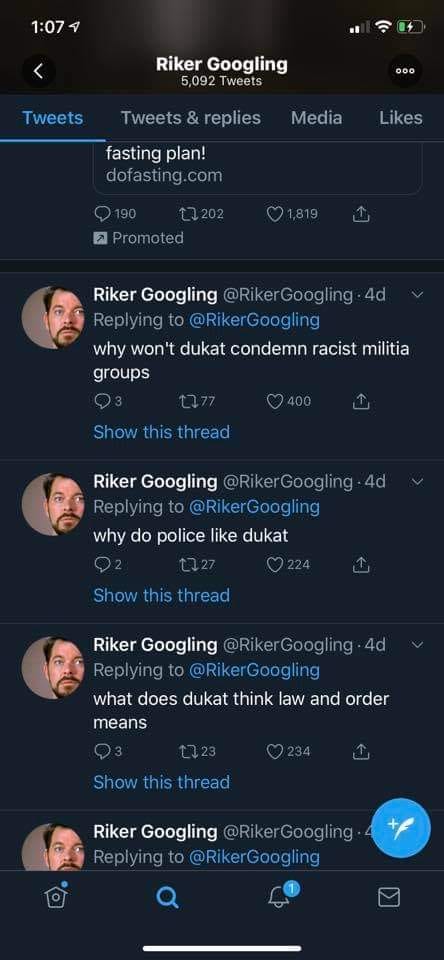
The screenshot shows a portion of a Twitter/X feed from a user named "Riker Googling." There are four visible tweets in a thread, all replies to the same user (@RikerGoogling). Each tweet displays the user's profile picture (a person with a mustache), timestamp (4 days ago), engagement metrics (number of views, replies, likes, and re-posts) and a "Show this thread" link. A promoted advertisement for "dofasting.com" sits at the top. The tweets pose questions:
- "why won't dukat condemn racist militia groups"
- "why do police like dukat"
- "what does dukat think law and order means"
The content is text-based, with a clean and standard social media layout. The layout is very standard of the X platform.
Foucauldian Genealogical Discourse Analysis
This thread offers fertile ground for a Foucauldian analysis. "Dukat" is posited as a figure around which discourses about power, legitimacy, and potentially, the exercise of control are circulating. The questions aren't about Dukat's personal feelings, but about the relationship between Dukat, institutions (police), and societal forces (racist militias).
- Discourse & Power/Knowledge: The thread is an attempt to dissect the power/knowledge relationship associated with "Dukat". The questions seek to reveal how Dukat constructs meaning around concepts like law and order, and what this construction allows or prohibits. The silence of Dukat (not condemning militias) becomes a site of power – what is not said is just as telling as what is.
- Genealogy: A genealogical investigation would trace the historical conditions that have led to this current moment of questioning Dukat. What historical formations, social practices, and power dynamics have positioned Dukat as a potentially complicit figure? The questions suggest a history of problematic alignment or silence.
- Panopticism/Governmentality: Depending on what "dukat" represents, it's possible to read these questions through the lens of governmentality. Is "Dukat" an institution, an ideology, or a personification of certain ways of governing? The questions could imply an attempt to expose the underlying mechanisms of control exerted by "Dukat".
Critical Theory
The thread displays elements that align with some of the core tenets of Critical Theory.
- Ideology Critique: The questions are seeking to unpack the potential ideological underpinnings of Dukat’s actions or beliefs. The linking of Dukat to police and racist militias suggests a critique of how power structures reinforce one another. What seemingly neutral principles or values (law and order) might actually serve to legitimize oppression?
- Domination and Emancipation: The questions implicitly point to a concern about domination. The questioning of Dukat suggests a desire to uncover complicity in systems of power and potentially to challenge and dismantle them. The thread could be read as a small attempt to empower those who might be marginalized or oppressed by the structures "Dukat" represents.
- Hegemony: If "Dukat" is a figure who has gained cultural or political prominence, the questions might be challenging their hegemonic status – attempting to disrupt the naturalized acceptance of their worldview.
Marxist Conflict Theory
While the screenshot alone doesn't explicitly scream "class struggle", it can be read through a Marxist lens, albeit speculatively.
- Power Dynamics: The questions reveal a focus on power imbalances. The association of Dukat with police (often seen as agents of the state maintaining the status quo) and racist militias suggests a power dynamic where certain groups are protected and others are oppressed.
- Ideological Control: If "dukat" represents an ideology or a class interest, the questions about law and order could be interpreted as a challenge to how that ideology is used to justify exploitation or maintain class divisions.
- False Consciousness: The questions could be interpreted as an attempt to expose a "false consciousness" – a situation where individuals unknowingly support systems that are detrimental to their own interests.
Postmodernism
The thread lends itself to a Postmodern reading through its deconstruction of meaning and questioning of authority.
- Deconstruction: The questions actively deconstruct the assumed meanings of concepts like "law and order." By asking what dukat thinks these terms mean, the thread challenges the idea that these concepts have a fixed or universal meaning.
- Skepticism of Grand Narratives: The thread implicitly rejects the idea of a single, overarching truth or moral framework. The questions suggest that Dukat’s worldview might be self-serving or based on biased assumptions.
- Relativity of Truth: The thread implies that truth is not objective, but is constructed through power relations. What dukat deems lawful or orderly may differ from other perspectives, and these differences reflect underlying power dynamics.
Queer Feminist Intersectional Analysis
This is the most speculative, given the lack of specific information. However, if "Dukat" represents a figure embodying traditional power structures, the thread could be read through an intersectional lens.
- Power & Oppression: If Dukat aligns with patriarchal, white supremacist, or heteronormative structures, the questions could be seen as a challenge to these systems of oppression. The association with racist militias strengthens this reading.
- Interlocking Systems of Power: The questions imply that power operates through multiple, interlocking systems. The thread suggests that policing, racism, and a particular interpretation of "law and order" are all connected and reinforce one another.
- Marginalized Voices: While the thread itself doesn't directly represent marginalized voices, it could be interpreted as an attempt to create space for them by challenging the authority of a powerful figure.
Important Note: Without further context about "Dukat," these analyses are necessarily speculative. The power of this thread lies in its open-endedness and its invitation to question established norms and power dynamics.
simple-description (llama3.2-vision)
The meme is a screenshot of a Twitter thread where someone named "Riker" (not "Riker" but "Riker" is not the name of the person in the original post) is responding to a tweet about a joke about a "Duck, Duck, Goose" game, but instead of "Duck, Duck, Goose" it says "Duck, Duck, Liar". The text of the tweet is "Duck, Duck, Liar".
tesseract-ocr
aie eae Pom Can ra erry re) coy Xm ies Bac Tweets & replies Media er fasting plan! dofasting.com Os Ee OL Lo Tale Riker Googling @RikerGoogling-4d ~ Replying to @RikerGoogling why won't dukat condemn racist militia groups ox} pez bees & ERR Ue) Riker Googling @RikerGoogling-4d_ v Replying to @RikerGoogling why do police like dukat oy) cee O24 a STROM Cle) Riker Googling @RikerGoogling-4d Replying to @RikerGoogling Parle leet 1M LaMar Rolke m Cary Q3 Gare) (ore a Seem 18) Riker Googling @RikerGoogling - ® Replying to @RikerGaogling 5G icy Q [a