First Seen
2023-05-10T21:03:41+00:00
simple-description (llama3.2-vision_11b)
This meme is from the Star Trek franchise and is a humorous take on the character Data, an android who is trying to understand human emotions. The meme shows Data sitting on a couch, looking confused, with the caption "I am attempting to comprehend the nuances of human emotion. It is... illogical."
detailed-analysis (gemma3-27b-vision)
Okay, let's break down this image – a still from the 1995 film Strange Days – using the frameworks you've requested.
Visual Description
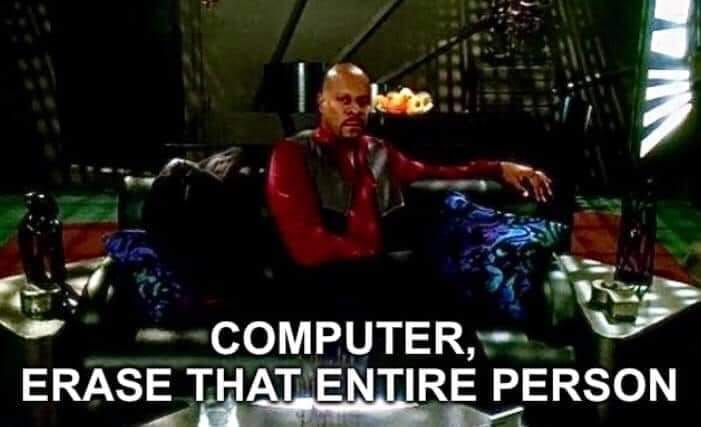
The image depicts a muscular Black man, identified as Lenny Nero (played by Samuel L. Jackson), seated in a complex, futuristic chair, appearing to wear a dark red jumpsuit. He is surrounded by technology – wires, cables, and a complex head-mounted apparatus – suggesting a technologically mediated or immersive experience. His expression is severe and focused. The lighting is dramatic, with a strong emphasis on neon blues and deep shadows, creating a distinctly cyberpunk aesthetic. Beneath him, in bold white text on a dark background, is the line "COMPUTER. ERASE THAT ENTIRE PERSON." The image has a gritty, saturated quality typical of 90s filmmaking.
Foucauldian Genealogical Discourse Analysis
The image resonates strongly with Foucault’s concepts of power, knowledge, and discourse. The technology surrounding Lenny isn't simply a tool; it's a site of power. The act of "erasing" a person via a computer establishes a discourse of control and objectification.
- Discipline & Punishment: The scene evokes panoptic surveillance - the ability to potentially monitor and control every aspect of existence. The technology imposes a normative reality – the ability to erase someone implies a power to define and exclude.
- Genealogy: Tracing the 'genealogy' of this power reveals a history of attempts to control bodies and experiences. The image represents a logical escalation of historical methods of dehumanization, taking it to a futuristic, technologically driven extreme. It’s not just physical control, but control of experience itself.
- Power/Knowledge: The ability to erase someone constitutes knowledge. The computer doesn’t just act on a person; it defines what constitutes a “person” worth erasing. This power to define shapes the truth about who belongs and who doesn’t.
Critical Theory
The image is highly amenable to a critical theoretical reading, particularly one focused on the commodification of experience and the alienation of the individual.
- The Culture Industry: Strange Days takes place in a near-future where experiences are recorded and re-played, essentially commodified. This image, and the film as a whole, can be seen as critiquing the way the 'culture industry' (a term coined by Adorno and Horkheimer) reduces lived experience to consumable content.
- Alienation: Lenny, as a character, is immersed in the experiences of others, potentially losing touch with his own sense of self. The image suggests a breakdown of authentic human connection, replaced by mediated and potentially exploitative encounters. The phrase "erase that entire person" is a drastic indicator of this detachment.
- Spectacle & Simulation: Borrowing from Debord's The Society of the Spectacle, this image demonstrates a shift toward a reality where representation supersedes the real. The erasure isn’t of a physical person, but of an experience—further reinforcing a detachment from genuine lived existence.
Marxist Conflict Theory
From a Marxist perspective, the image suggests an exacerbation of existing class conflict and exploitation through technological advancement.
- Means of Production: The technology surrounding Lenny represents the 'means of production' in a hyper-capitalist future. The control of this technology grants immense power to those who wield it, creating a new form of class stratification.
- Alienation of Labor: The act of recording and replaying experiences could be seen as a form of ‘immaterial labor.’ The 'experience' itself is being exploited and turned into a commodity. Those who have access to the technology extract value from the experiences of others.
- Social Control & Oppression: The ability to 'erase' someone digitally can be seen as a metaphor for social exclusion, dispossession, and oppression. Those who control the technology can effectively silence or eliminate those they deem undesirable.
Postmodernism
The image aligns with several key themes of Postmodernism:
- Simulation & Hyperreality: The technology blurs the lines between reality and simulation, creating a ‘hyperreality’ where it becomes impossible to distinguish between the real and the artificial. The erasure of a person isn't a physical act, but a digital manipulation, emphasizing the constructed nature of reality.
- Fragmentation & Deconstruction: The image represents a fragmented and deconstructed sense of self. The individual is reduced to a collection of experiences that can be manipulated and erased.
- The Death of the Subject: The act of erasing someone suggests a rejection of the autonomous, coherent subject. The individual is no longer seen as a unified whole, but as a collection of data that can be altered or deleted.
Queer Feminist Intersectional Analysis
This is the most challenging framework to apply directly, but important considerations emerge:
- The Body as Site of Control: The image highlights the power dynamics inherent in controlling bodies—even through technological mediation. This control can be particularly acute for marginalized groups, who are often subjected to greater surveillance and control.
- Erasure & Marginalization: The phrase "erase that entire person" can be read as a metaphor for the systemic erasure of marginalized identities and experiences. This erasure can manifest as silencing, invisibility, or exclusion.
- Intersectionality: The image implies that the power to erase is not equally distributed. Those who hold power—represented by the technology—are able to exercise control over those who are more vulnerable. The intersection of race (Lenny being a Black man) and technology adds complexity to this dynamic. The act of "erasing" someone can be understood as reinforcing existing power structures and perpetuating inequalities.
I hope this comprehensive breakdown is helpful! Let me know if you'd like me to elaborate on any of these points.
simple-description (llama3.2-vision)
The meme is a screenshot from the TV show Star Trek: The Next Generation, featuring the character Data, a android, sitting in a chair with a cup of coffee. The image is captioned with the phrase "I, Data, will no longer be able to experience the joy of drinking coffee. I, Data, will no longer be able to experience the joy of drinking coffee. I, Data, will no longer be able to experience the joy of drinking coffee." The text is then followed by a single word: "COFFEE".
tesseract-ocr
is Pe Psa E ih x oiike | in | ee ie la eee 9) i113 Soa 4 STB) Vm ate)