First Seen
2023-05-10T21:03:41+00:00
simple-description (llama3.2-vision_11b)
The meme is a screenshot from the Star Trek: The Next Generation episode "The Outcast," where the character K'Ela, a Betazan, is being tortured by the villain K'Ela's emotions are being suppressed, and she is forced to confront her own emotions. The text overlayed on the image reads, "I am K'Ela, and I am not K'Ela." This meme is a commentary on the struggles of being a queer person in a world where your emotions are constantly being suppressed, and you are forced to conform to societal norms.
detailed-analysis (gemma3-27b-vision)
Okay, let's analyze the image using the requested theoretical frameworks.
Visual Description
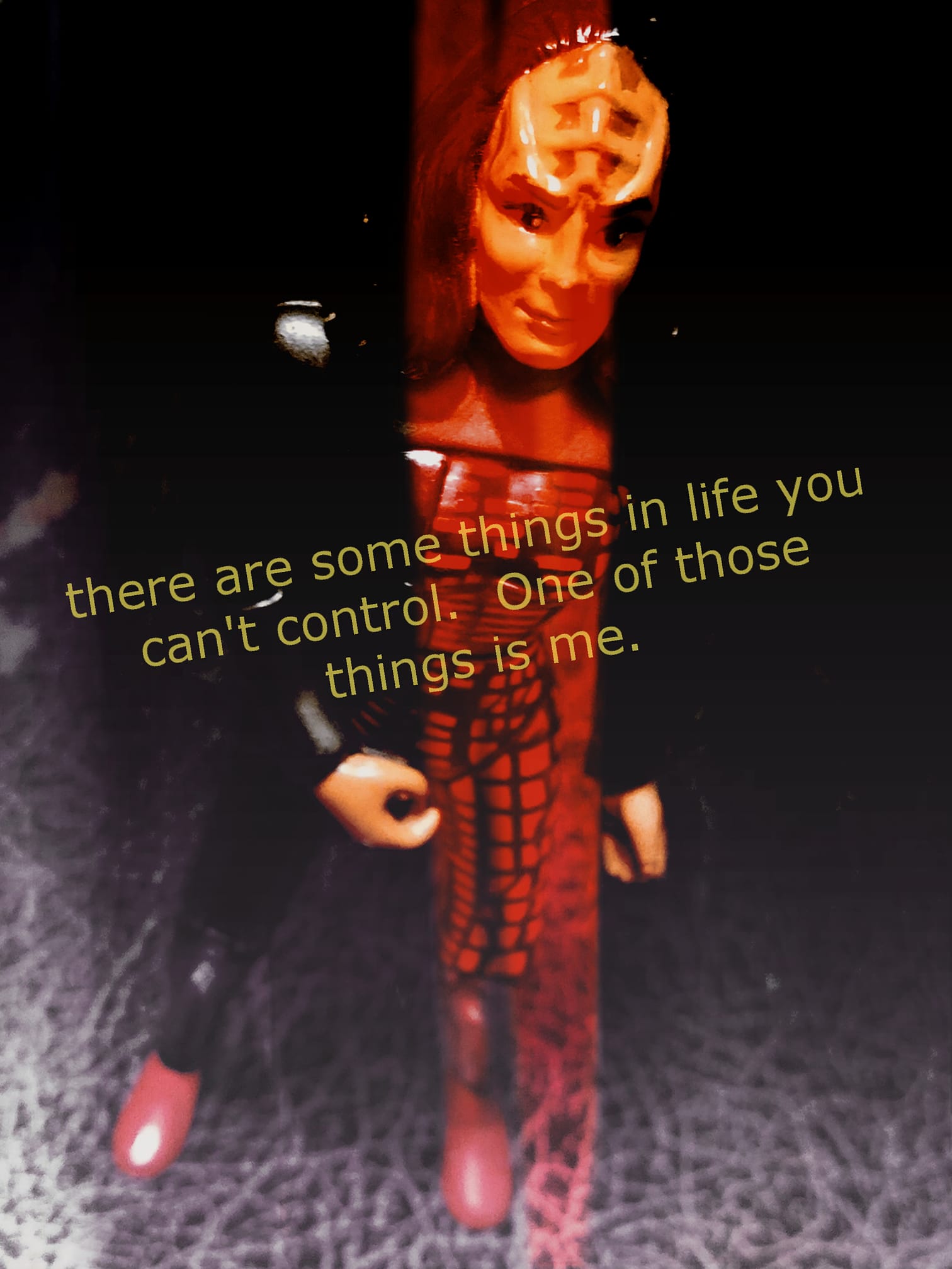
The image is a close-up, low-resolution, and somewhat distorted photograph of a Barbie doll. The doll is positioned in the foreground, slightly off-center. Its skin tone is reddish, giving it a somewhat unsettling or damaged appearance. The doll's facial expression is somewhat obscured, with the eyes appearing shadowed. The doll is wearing what appears to be a one-piece outfit in a similar reddish tone, and a chain or necklace. The background is blurry and dark, providing a low-contrast environment. There's a suggestion of a textured surface, possibly fabric or a textured wall. Overlaid onto the image in white script is the text: “there are some things in life you can't control. One of those things is me.” The overall aesthetic is unsettling, and the image has a retro, almost analogue quality.
Foucauldian Genealogical Discourse Analysis
The image, especially with the accompanying text, is ripe for Foucauldian analysis. The doll, as a cultural artifact, is a site where discourses about femininity, beauty, childhood, and consumerism converge.
- Discourse & Power: The Barbie doll itself is a product of discourses around what it means to be a “desirable” woman, and how childhood should be constructed. These discourses are not neutral; they are interwoven with power dynamics. The doll's idealized body shape, appearance, and lifestyle contribute to normalizing certain standards that can be oppressive.
- Genealogy of "Control": The text directly engages with the concept of control. A genealogical approach would trace the historical emergence of the idea of "control" itself. How have societal norms around gender and appearance historically sought to control women's bodies and expressions? How does the doll both embody and reinforce this control?
- Panopticism/Self-Surveillance: The doll can be seen as a vehicle for self-surveillance. Girls playing with Barbie are encouraged to internalize specific beauty standards and perform femininity in a particular way, constantly measuring themselves against the doll.
- "One of those things is me": This assertion is crucial. It can be read as a resistance to control, a reclamation of agency. It suggests that the doll, while a product of controlling discourses, also embodies a force that cannot be fully contained or regulated. The "me" can be read as a subversive force, a rejection of prescribed roles, and a demand for self-definition.
Critical Theory
The image can be critically examined through a broader lens of Critical Theory, particularly regarding the Frankfurt School’s concerns about the culture industry.
- Commodification of Identity: The Barbie doll exemplifies the commodification of identity. It offers a pre-packaged "self" to be consumed and emulated. This creates a superficial understanding of identity, based on external appearance rather than authentic experience.
- False Consciousness: The doll can be viewed as contributing to “false consciousness”. Girls playing with Barbie may internalize unrealistic expectations and believe that their self-worth is tied to their appearance, distracting them from larger systemic inequalities.
- Ideology: The doll’s representation of femininity and consumerism can be seen as ideological. It reinforces capitalist values and traditional gender roles, presenting them as natural and inevitable.
- The Image as Critique: However, the somewhat distorted and unsettling nature of the image, coupled with the text, introduces a critical edge. It suggests a questioning of the idealized representation of the doll and its underlying ideologies. The image doesn't simply reproduce the dominant ideology, but also seems to deconstruct it.
Queer Feminist Intersectional Analysis
This framework provides a particularly nuanced way of understanding the image.
- Deconstructing Gender Norms: The doll is inherently linked to conventional gender norms (heteronormative femininity). However, the image challenges those norms. The altered image can be read as a queer act of re-appropriation. The doll is no longer simply a symbol of traditional femininity, but a site of disruption and questioning.
- Intersectional Critique: The image can be understood through an intersectional lens by considering how race, class, and other social categories intersect with gender. The standard Barbie doll is overwhelmingly white and middle-class. This image disrupts this by taking a common object and recontextualizing it.
- Reclaiming Agency: The text "One of those things is me” can be interpreted as a declaration of self-determination, especially from a queer feminist perspective. It’s a rejection of societal control and an assertion of the right to define oneself outside of normative expectations.
- Subversion of the Gaze: The somewhat unsettling quality of the image may subvert the male gaze (often associated with the objectification of women). It challenges the viewer to confront their own assumptions and expectations about femininity and beauty.
Please note: This is an interpretation, and other readings are possible. The strength of these analyses lies in the ability to read the image as a complex cultural artifact that embodies and challenges various social and political forces. The somewhat blurry, low-resolution nature of the image actually adds to its interpretative potential. It resists easy categorization and invites deeper consideration.
simple-description (llama3.2-vision)
The meme is a picture of a Star Trek character, Data, with a caption that reads: "There are four things you can't change: the past, the truth, the facts, and the law." However, the text is actually a misquote and says: "There are four things you can't change: the past, the truth, the facts, and the law. The law is constantly changing."
tesseract-ocr
et = { ’ = wie 4 ar , aKa Yolaahe Tella aoe \ife YOU s rechas Ayako’ ore een d. things !$ anor a 4 % i ? ' a * ef * on 9 a ~— eed : = ete: ae