First Seen
2023-05-10T21:03:41+00:00
simple-description (llama3.2-vision_11b)
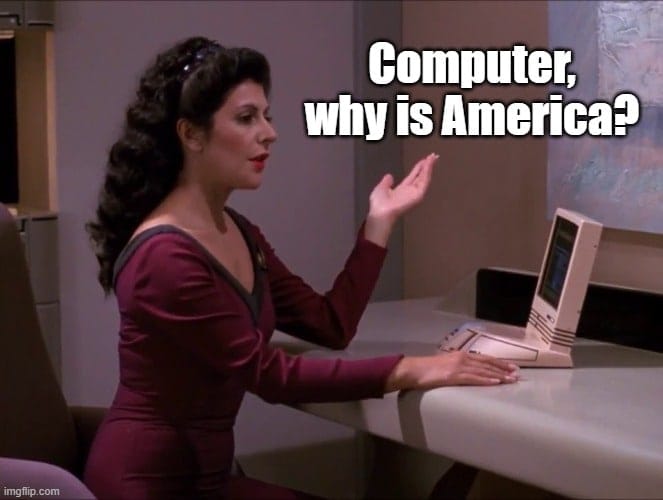
The meme is a screenshot from the TV show Star Trek: The Next Generation, featuring Captain Jean-Luc Picard and his android friend Data. The image shows Data asking "Computer, how do humans reproduce?" and the computer responding with a long, dry explanation. The meme is often used to poke fun at the idea that humans are complex and mysterious, and that even a highly advanced android like Data can't understand the basics of human biology.
detailed-analysis (gemma3-27b-vision)
Okay, let's break down this image of Commander Riker from Star Trek: The Next Generation and analyze it through various theoretical lenses, as requested.
Visual Description
The image is a still frame from an episode of Star Trek: The Next Generation. Commander William Riker, a tall man with dark, curly hair, is seen seated at a futuristic computer console. He's wearing a maroon, long-sleeved uniform, typical for Starfleet officers. Riker is facing the computer screen with a gesture that conveys both frustration and inquiry. He is gesticulating with one hand, palm up, in a questioning manner. The computer itself is a beige-colored, boxy Macintosh, rather dated even for the time the show aired. Above the image is a text bubble reading, "Computer, why is America?" The setting appears to be a section of the USS Enterprise bridge or a similar vessel compartment, characterized by a muted color palette and metallic surfaces. The overall aesthetic suggests a futuristic but somewhat primitive technological environment.
Foucauldian Genealogical Discourse Analysis
The image, juxtaposed with the question "Computer, why is America?", immediately evokes the search for origins – the 'why' of a nation’s construction. A Foucauldian approach wouldn't be interested in a single, truthful "why," but rather in the discourses that have historically constituted "America."
- Power/Knowledge: The "computer" here acts as a repository of knowledge, but its knowledge is constructed through the power dynamics of whoever programmed it, and the societal structures that shaped that programming. What knowledge does the computer hold about America? Is it simply patriotic narratives, or does it contain conflicting histories, the narratives of colonized peoples, or the realities of systemic oppression? The question challenges the very foundation of this knowledge.
- Genealogy: To perform a genealogical analysis, one would trace the historical development of the idea of "America." How did the concept emerge? What power relations and social forces shaped its definition over time? We’d look at the changing meanings of “America” – from colonial aspirations to Manifest Destiny to the contemporary understanding of a superpower – and the exclusions inherent in each iteration.
- Discursive Formation: The question hints at the lack of a stable, coherent meaning of "America." The computer’s inability to give a simple answer suggests that the very question is flawed. “America” isn’t a fixed entity but is constantly being constructed (and contested) through language, institutions, and practices.
Critical Theory
Applying Critical Theory, particularly in the tradition of the Frankfurt School, the image can be interpreted as a commentary on the relationship between technology, ideology, and social control.
- Instrumental Reason: The computer represents the pinnacle of instrumental reason – technology as a tool to achieve specific ends. But the question reveals a gap: technology can process information, but it cannot provide meaning or moral justification. "Why is America?" implies a search for ethical foundations, something technology alone cannot provide.
- Culture Industry: One could view the "America" presented by the computer as a product of the culture industry—a manufactured narrative designed to reinforce existing power structures. The computer, in this context, is not a neutral source of information but a vehicle for propagating dominant ideology.
- Critique of Enlightenment: The question echoes a broader critique of the Enlightenment's emphasis on reason and progress. The computer, as a symbol of these values, is revealed to be incapable of answering fundamental questions about meaning and purpose.
Marxist Conflict Theory
From a Marxist perspective, the image underscores the inherent contradictions within American society and the role of technology in perpetuating them.
- Base and Superstructure: "America" represents the "superstructure" (ideology, culture, political systems) built upon the "base" (economic relations and class struggles). The question challenges the legitimacy of this superstructure. Is the "America" presented by the computer a reflection of the interests of the ruling class, obscuring the exploitation and inequality that underpins the system?
- Ideology and False Consciousness: The computer's potential response would likely be a sanitized version of American history, glossing over the struggles of marginalized groups and promoting a nationalistic narrative. This represents ideology – a set of beliefs that serves to legitimize the existing power structures. The question challenges this manufactured consensus.
- Alienation: The reliance on the computer to answer a fundamental question about national identity suggests a sense of alienation – a disconnection from meaningful social relationships and a dependence on technological solutions to existential problems.
Postmodernism
The image aligns perfectly with many themes within Postmodern thought.
- Deconstruction of Grand Narratives: The question, "Computer, why is America?" fundamentally challenges the idea of a singular, coherent national identity. Postmodernism rejects "grand narratives"—overarching stories that claim to explain history or meaning. The question implies that there is no single answer to “why America,” but rather a multiplicity of fragmented and conflicting perspectives.
- Simulacra and Simulation: The computer itself could be seen as a simulacrum—a copy without an original. The “America” it presents is a mediated representation, a simulation of reality that bears little resemblance to the lived experiences of many.
- Fragmentation and Relativism: The image suggests a world where meaning is not fixed but is constantly being constructed and deconstructed. The question acknowledges the subjectivity of interpretation and the impossibility of objective truth.
Queer Feminist Intersectional Analysis
From this perspective, the image and question highlight the exclusion of marginalized voices within the dominant narrative of “America.”
- Intersectionality: The question "Computer, why is America?" implicitly asks for a history that includes the experiences of women, people of color, LGBTQ+ individuals, and other marginalized groups—groups whose stories are often erased or misrepresented in mainstream narratives. The computer, as a product of a patriarchal and white-dominated society, is unlikely to provide a truly inclusive answer.
- Deconstruction of Binary Oppositions: The question challenges the traditional (and often exclusionary) definitions of “Americanness.” It invites us to question who is included in the category of “American” and who is excluded.
- Critique of Power Structures: The reliance on a technological system to define national identity reinforces the power of those who control the technology and the information it contains. This perpetuates systemic inequalities and marginalizes voices that challenge the status quo.
I hope this detailed breakdown, utilizing multiple theoretical lenses, provides a nuanced understanding of the image and its potential meanings! Let me know if you'd like me to elaborate on any of these interpretations.
simple-description (llama3.2-vision)
This meme is a humorous image of a Star Trek character, Deanna Troi, sitting at a computer with a puzzled expression. The text "Computer, why is America..." is typed into the screen, but it cuts off abruptly, implying that the computer is not responding to the question. The implication is that the computer is either not working properly or is not capable of answering the question, leading to a humorous and ironic situation.
tesseract-ocr
| | a Pe eer ANF ara | : .