First Seen
2023-05-10T21:03:41+00:00
simple-description (llama3.2-vision_11b)
The meme is a screenshot from the Star Trek: The Next Generation episode "The Outcast," where the character of Lieutenant Worf is struggling to understand his own identity and emotions. The image shows Worf's face with a caption that reads "I am Lieutenant Worf. I am Klingon. I am gay." The meme is a humorous take on the character's struggle to come to terms with his own identity, and the caption is a clever play on words that references the character's Klingon heritage and his own personal struggles with his identity.
detailed-analysis (gemma3-27b-vision)
Okay, let's break down this meme using the requested theoretical frameworks. This is a playful, yet potentially provocative image, so a multifaceted approach is appropriate.
Visual Description
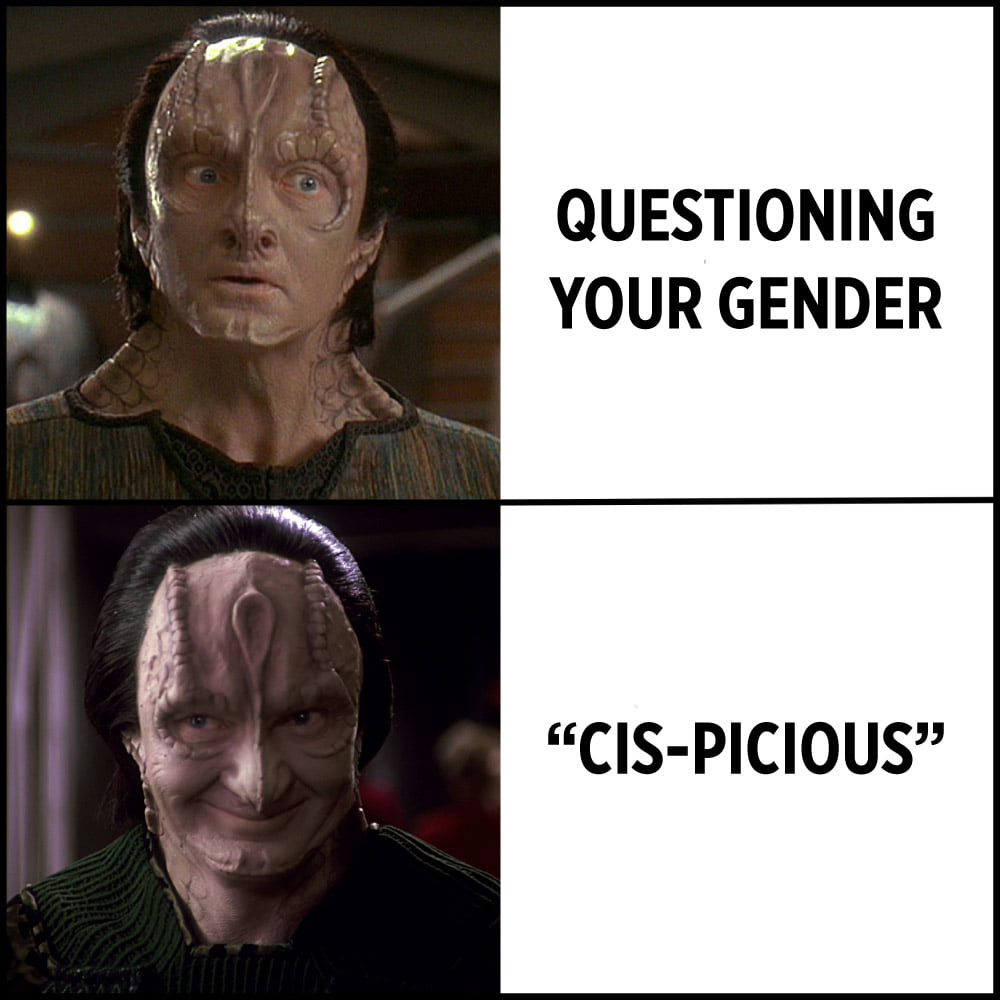
The meme features two images of the character Gul Dukat from Star Trek: Deep Space Nine. Dukat is a Cardassian, a humanoid species with distinct physical features.
- Top Image: Dukat appears somber, contemplative, and somewhat brooding. The lighting emphasizes his ridges and the sculpted quality of his forehead. His expression seems to be one of internal questioning or moral conflict.
- Bottom Image: Dukat is smiling, a knowing, slightly predatory smile. The lighting gives him a more imposing and confident look.
Text overlays accompany each image:
* "Questioning Your Gender" is above the top image.
* "Cis-Picious" (a portmanteau of "cisgender" and "suspicious") is above the bottom image.
Foucauldian Genealogical Discourse Analysis
Michel Foucault’s work focuses on how power operates through discourse (language, systems of thought). A Foucauldian analysis can be applied as follows:
- Discursive Formation: The meme engages with the discourse surrounding gender identity, particularly the growing vocabulary and awareness of transgender and non-binary experiences. It presupposes an understanding of "cisgender" as a specific identity category.
- Power/Knowledge: The meme plays with the power dynamics inherent in questioning identity. The top image suggests that vulnerability and introspection around gender can be prompted by an external (or internal) force. The 'Cis-Picious' bottom image inverts this power dynamic. It suggests that those who identify as cisgender may be perceived as potentially hiding something. This is particularly impactful because traditionally, cisgender identity was assumed rather than explicitly stated.
- Genealogy: The meme traces a shift in discourse. Previously, questioning gender was largely directed at those who deviated from traditional binary norms. Here, the questioning is directed at those who identify within those norms. This demonstrates the evolution of these discourses.
- Subjectivation: Gul Dukat as a character is often defined by performativity, by presenting different facets of himself to manipulate those around him. The meme implies a parallel: that even in stating a seemingly firm identity, one is performing it, and therefore open to scrutiny.
Queer Feminist Intersectional Analysis
This meme opens itself to a Queer Feminist lens due to the exploration of gender, power, and societal norms.
- Deconstruction of Binary: Though not explicit, the meme subtly challenges the fixed understanding of gender. The "questioning" suggests that identity is not inherently static or self-evident.
- Performativity: As mentioned in the Foucauldian section, Dukat's character embodies performativity. This is key to queer theory, which argues that gender is not an internal essence but a series of performances constructed through social norms. The meme implies that even those who identify as cisgender are performing their gender.
- Intersectionality: Intersectionality would consider the power dynamics at play. Who is the “questioner” and who is the “questioned”? What assumptions are being made about cisgender people? The meme can be seen as a playful critique of the dominance of the cisgender perspective in society. The "suspicion" implied is based on a power differential.
- Subversion: The meme subverts the expectation that questioning gender is usually directed at those who don't fit within traditional binaries.
Critical Theory
The meme engages with the broader project of Critical Theory, which seeks to expose power structures and challenge dominant ideologies.
- Ideology Critique: The meme critiques the implicit assumption that cisgender identity is natural and unquestionable. It exposes how this assumption has historically shaped societal norms and power relations.
- Hegemony: The meme highlights the hegemonic position of cisgender identity—the idea that it is the default, the normal, the unquestioned standard. It asks viewers to consider how this dominance operates.
- Reflexivity: The meme encourages reflexivity. It asks the viewer to examine their own assumptions about gender and identity, and to consider how those assumptions may be shaped by societal forces.
In conclusion: This meme, though seemingly lighthearted, is surprisingly rich in theoretical implications. It plays with current conversations about gender, identity, and power dynamics, inviting viewers to critically examine their own assumptions and to consider the constructed nature of identity. It's a playful yet thought-provoking commentary on the shifting landscape of gender discourse.
Let me know if you'd like me to elaborate on any particular aspect!
simple-description (llama3.2-vision)
The meme features a split-screen image of the character K'Ela from the Star Trek: The Next Generation episode "The Child," with a puzzled expression on her face. The left side of the image shows her looking confused, while the right side shows her with a more confident and assertive expression. The text "I'm not arguing, I'm just explaining why I'm right" appears above the split-screen image, but the meme itself is actually a joke about a character's response to being asked to identify as something other than their assigned gender at birth.
tesseract-ocr
7 he QUESTIONING - YOUR GENDER ? “CIS-PICIOUS”