First Seen
2023-05-10T21:03:41+00:00
simple-description (llama3.2-vision_11b)
This meme is from the Star Trek franchise and is a play on a famous line from the TV show. The image shows a character, Data, who is known for his dry wit and literal interpretations of human phrases. The meme is a humorous take on the character's literal interpretation of the phrase "I'm dying up here in the mountains," which is a common idiomatic expression. The text overlayed on the image reads "I'm dying up here in the mountains" and "I'm dying," which is a play on words referencing the phrase's literal meaning.
detailed-analysis (gemma3-27b-vision)
Okay, let's break down this image—a meme featuring a scene from Star Trek: The Next Generation—through the lens of various theoretical frameworks. It's a surprisingly rich image for this type of analysis!
Visual Description
The image features a screenshot from the television series Star Trek: The Next Generation. It's composed of two distinct character portraits placed above and below a text overlay.
- Top Portrait: Captain Jean-Luc Picard (played by Patrick Stewart) is depicted in a moment of apparent frustration or desperation. He’s in his Starfleet uniform and looks down, with a furrowed brow. The lighting is dramatic, creating shadows that accentuate his expression.
- Bottom Portrait: Commander Data (played by Brent Spiner) appears stoic and flat-faced, arms crossed. He is looking out of frame. His expression is impassive, seemingly devoid of emotion.
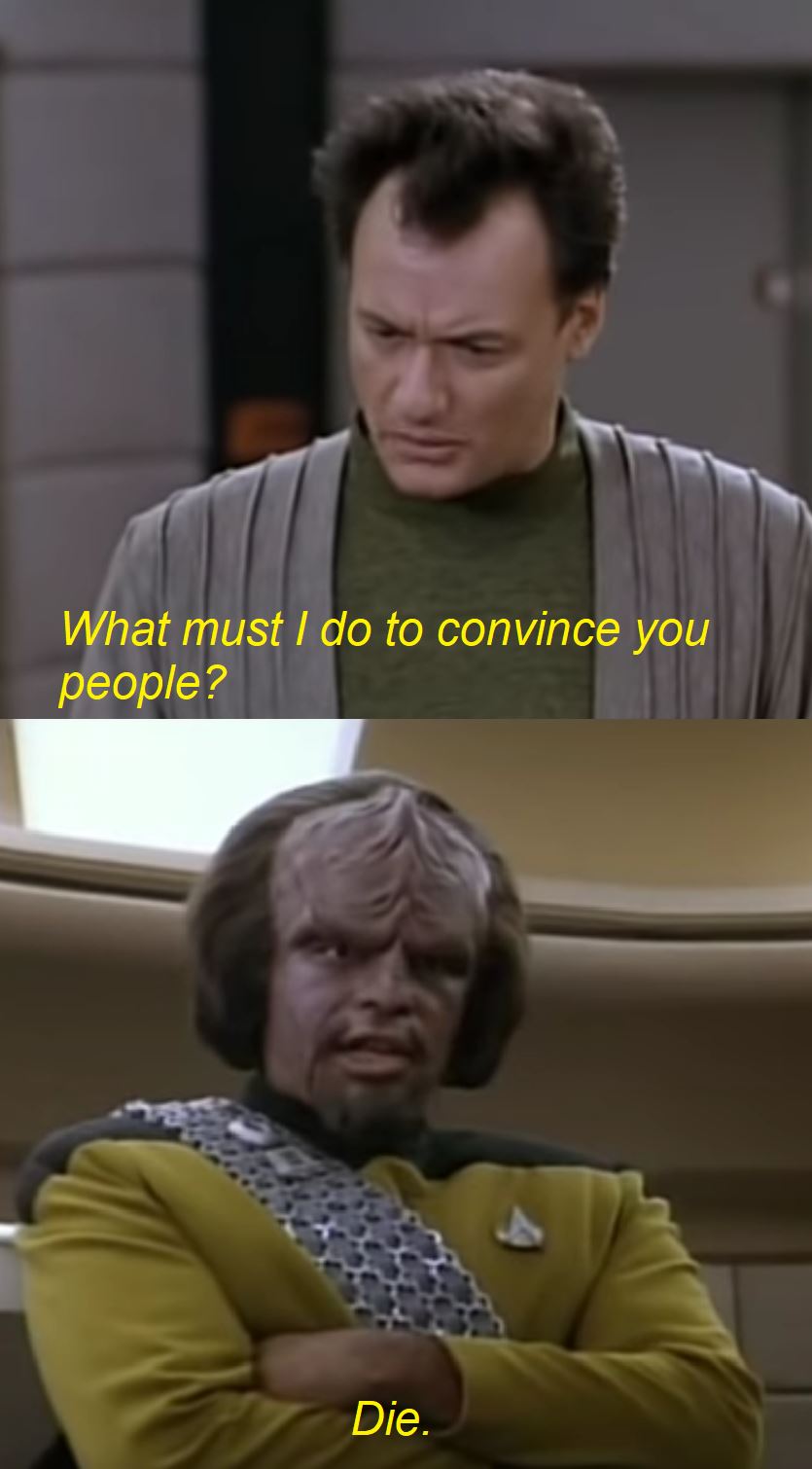
- Text Overlay: “What must I do to convince you people?” is written in white text above Data’s portrait, and “Die.” appears in white text below his portrait. This creates an absurdly direct and dark contrast between Picard’s plea for understanding and Data’s blunt, robotic response.
- Setting: The background indicates the bridge of the USS Enterprise, implying a setting of authority, command, and crisis.
Foucauldian Genealogical Discourse Analysis
This image can be analyzed through a Foucauldian lens as a microcosm of power dynamics and the construction of "truth."
- Discourse: The dialogue represents a discourse of power—Picard, as captain, seeks to convince his crew of something. However, the inherent power imbalance is subverted. The question assumes a need to persuade, implying a lack of inherent authority. Picard feels compelled to justify his position.
- Data as a Disruptor: Data, as an android, is particularly interesting. He is outside of the typical social norms and power structures that dictate persuasion. He lacks the emotional and social programming that would lead him to offer reassurance or negotiation. His response is purely logical, stripped of the customary rituals of maintaining social order.
- Genealogy of the "Convince": The meme highlights the history of discourse surrounding persuasion. What does it mean to "convince" someone? The image suggests that the ultimate method of conviction is to eliminate the objector—a dark and potentially violent origin of authority. It forces a consideration of the underlying, often unspoken, methods used to establish dominance in a dialogue.
Critical Theory
From a Critical Theory perspective, the meme challenges the presumed rationalities and assumptions of power structures.
- Deconstruction of Authority: Picard, as a figure of authority, is reduced to begging for acceptance. His plea reveals the instability of his power. He’s not simply giving orders; he’s asking for them to be followed.
- Exposure of Violence: Data’s response, while delivered in a deadpan manner, exposes the inherent violence within systems of power. The implication is that those who don’t comply will be eliminated. This is not necessarily physical violence, but also the silencing or marginalization of dissenting voices.
- Critique of Communication: The image subtly critiques the idea of meaningful communication within hierarchical structures. Picard is attempting to engage in a rational dialogue, but Data simply offers a negation. It suggests that true communication may be impossible when there is a significant power imbalance.
Marxist Conflict Theory
From a Marxist perspective, the image represents a conflict between different ideological positions, as well as a power dynamic within a social structure.
- Power Imbalance: Picard represents the ruling class (the Captain of the Starship) and is seeking to maintain control. Data's response is a blunt assertion of control – a dismissal of the need to appease or negotiate.
- Suppression of Dissent: The “Die.” response can be interpreted as a symbolic representation of the suppression of dissent by those in power. Those who challenge the established order will be eliminated.
- Critique of Authority: The image challenges the legitimacy of authority. Picard's plea suggests that he is not inherently entitled to obedience.
Postmodernism
The image is deeply aligned with postmodern themes of irony, fragmentation, and the deconstruction of grand narratives.
- Irony and Absurdity: The humor comes from the juxtaposition of Picard’s earnest (though desperate) question and Data’s bluntly nihilistic answer. The absurdity breaks down conventional expectations of dialogue.
- Deconstruction of Narrative: The typical Star Trek narrative often involves resolving conflict through diplomacy and understanding. This meme subverts that expectation.
- Loss of Meaning: The meme’s power lies in its open-endedness. The "something" Picard needs to convince people of remains unclear, contributing to a sense of fragmentation and the erosion of meaning.
Queer Feminist Intersectional Analysis
This framework allows for a more nuanced understanding of power, subjugation, and resistance.
- Deconstruction of Masculinity: Picard is portrayed as vulnerable and desperate, challenging traditional notions of masculine authority and control.
- Data as “Other”: As an android, Data occupies a position of “otherness” and marginalization. His response can be interpreted as a rejection of the norms and expectations imposed upon him by the dominant culture.
- Rejection of Compromise: Data’s response is a refusal to engage in the compromises and negotiations often expected of those who are marginalized. It is a blunt assertion of agency and a rejection of the demand to appease those in power.
- The Power of Silence: Data’s brevity and lack of explanation are powerful. Sometimes, a refusal to engage is a statement, a form of resistance against being forced to justify one's existence within oppressive systems.
Let me know if you'd like me to elaborate on any of these analyses or explore other theoretical frameworks!
simple-description (llama3.2-vision)
This meme features a quote from the TV show Star Trek: The Next Generation, spoken by the character Worf. The quote is "Today is a good day to die." However, the meme replaces the word "good" with a more... let's say, "colorful" alternative. The text "What do you people want? When I came in here I didn't hear you knocking, and if you had, you would have been knocking on something, not hearing something, so you would have had to ask yourself, what do you people want? When I came in here I didn't hear you knocking, and if you had, you would have been knocking on something, not hearing something, so you would have had to ask yourself, what do you people want? When I came in here I didn't hear you knocking, and if you had, you would have been knocking on something, not hearing something, so you would have had to ask yourself, what do you people want?"
tesseract-ocr
ee > ' “* | a ' uh, ‘ lat must I do to convince you oye) (-¥a . _ ON eu rs We. 9: — naan rE aaa eS | Ch ey