First Seen
2023-05-10T21:03:41+00:00
simple-description (llama3.2-vision_11b)
The meme is an image of a character from the Star Trek franchise, likely a scientist or engineer, with a puzzled expression. The text overlay reads "Computer, why are you so... human?" and is meant to poke fun at the idea that a computer, a highly advanced artificial intelligence, would have a human-like personality.
detailed-analysis (gemma3-27b-vision)
Okay, let's break down this image from the movie Event Horizon, focusing on the requested theoretical frameworks. It's a rich image, especially when considering the film's context.
Visual Description
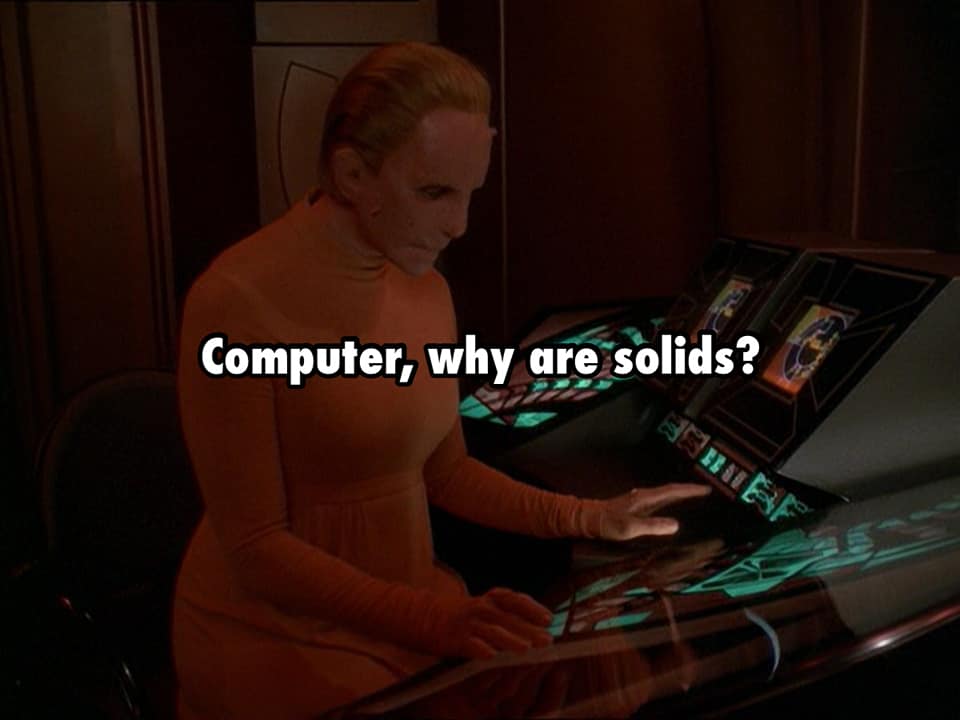
The image depicts a man operating a complex control panel bathed in a deep, ominous red light. The setting is clearly the interior of a spaceship or similar technologically advanced vessel. The man is pale, with a severe haircut and appears to be intensely focused on the controls. The panel itself is composed of glowing green lights, forming an intricate pattern, which contrast with the surrounding redness. The image is heavily shadowed, adding to the sense of claustrophobia and dread. The caption reads "Computer, why are solids?".
Foucauldian Genealogical Discourse Analysis
The question “Computer, why are solids?” is not merely a scientific inquiry. From a Foucauldian perspective, it is a challenge to the very discourse of reality as constructed through power/knowledge regimes. The Event Horizon spaceship, and the technology it represents, produces a certain understanding of the universe. This ship isn’t just traveling through space; it’s a site where the boundaries of our understanding of physics and reality are questioned and potentially broken.
The question itself is unsettling because it points to the limitations of our categories of understanding. “Solid” is a category we use to make sense of the world, but the ship has travelled to a realm where those categories may not apply. The question implies that the ship’s technology (and the ‘force’ it encountered) has deconstructed the stable meaning of ‘solidity.’
Furthermore, the man asking the computer reveals a power dynamic: a desire to extract knowledge from the machine. However, the ship, and the force within, might not be amenable to rational questioning. The question is a desperate attempt to impose an order and meaning on something that has fundamentally shattered it. The discourse of ‘solidity’ is not innate, but constructed, and the Event Horizon demonstrates the fragility of that construction.
Critical Theory
From a Critical Theory perspective, this image is deeply concerned with the themes of technology, reason, and domination. The ship, and its technology, represent the pinnacle of instrumental reason – a relentless pursuit of efficiency and control. However, the red lighting and the man's intense focus suggest that this control is illusory, or that it has come at a terrible cost. The "Computer, why are solids?" question hints at a loss of rationality, a descent into the irrational, where scientific understanding fails.
The very attempt to ask the computer questions is an expression of the Enlightenment's faith in reason as a means of understanding the universe. However, the film suggests that there are limits to reason, and that pushing beyond those limits can unleash forces that are destructive and uncontrollable. The ship, therefore, becomes a critique of the uncritical embrace of technology and the belief that reason can solve all problems. It highlights the dangers of a technological logic that is divorced from ethical considerations.
Postmodernism
The image strongly resonates with postmodern themes. The question itself challenges the notion of objective reality and stable meaning. "Why are solids?" implies that the very foundation of our understanding of the physical world is uncertain. The intense red lighting and the unsettling technological environment contribute to a sense of alienation and disorientation. This challenges the modernist belief in a coherent, ordered universe.
The image embodies the postmodern suspicion of grand narratives and universal truths. The film rejects the idea of progress and suggests that technological advancement can lead to chaos and destruction rather than enlightenment. There is a blurring of the lines between reality and illusion, sanity and madness, and the human and the technological, which is a hallmark of postmodern thought.
Queer Feminist Intersectional Analysis
While the image doesn't directly present gender or sexuality, a queer feminist intersectional reading can focus on the ship itself as a metaphor for penetration and the transgression of boundaries. The ship has entered a realm beyond human understanding, a ‘dark’ space that represents the ‘other’ – the repressed, the abject. The red lighting, often associated with danger and passion, can also be interpreted as symbolizing the disruption of established norms and the challenging of power structures.
The man's desperation and questioning of the ship’s computer can be seen as a symbolic representation of the silencing of marginalized voices. The ship’s refusal to provide a rational answer suggests a resistance to dominant modes of knowledge production. This resistance can be interpreted as a metaphor for the challenges faced by those who seek to disrupt oppressive systems of power.
In a wider sense, the ship's voyage into the unknown, and its subsequent descent into madness, can be seen as a metaphor for the challenges faced by those who dare to transgress societal norms and explore the boundaries of human experience. The image, therefore, can be interpreted as a powerful critique of the patriarchal structures that seek to control and suppress those who deviate from the norm.
Disclaimer: These are interpretations, and the beauty of art (and film) is that it can be understood in multiple ways. The richness of Event Horizon allows for diverse readings through different theoretical lenses.
simple-description (llama3.2-vision)
The meme is a screenshot from the Star Trek: The Next Generation episode "The Outcast" where the character Lieutenant Worf is struggling to understand a human concept. The image shows Worf looking puzzled and the text "Computer, what is love?" is displayed on the screen. The meme is a play on this scene, replacing "what is love" with "what is a computer" and referencing the 2015 song "What Is Love" by Haddaway.
tesseract-ocr
Computer, why are solids? es 7 by AG rd