First Seen
2023-05-10T21:03:41+00:00
simple-description (llama3.2-vision_11b)
This meme is a screenshot from the Star Trek: Discovery episode "If Memory Beta", featuring a character saying "I'm... I'm... I'm... I'm... I don't have words" in response to a provocative comment. The meme juxtaposes this quote with a caption that reads "When you're trying to explain why you hate [insert topic here] but the words just won't come".
detailed-analysis (gemma3-27b-vision)
Okay, let's break down this image/meme using the requested theoretical frameworks. It's a bit of a complex image loaded with internet culture, so we'll try to cover the relevant points.
Visual Description
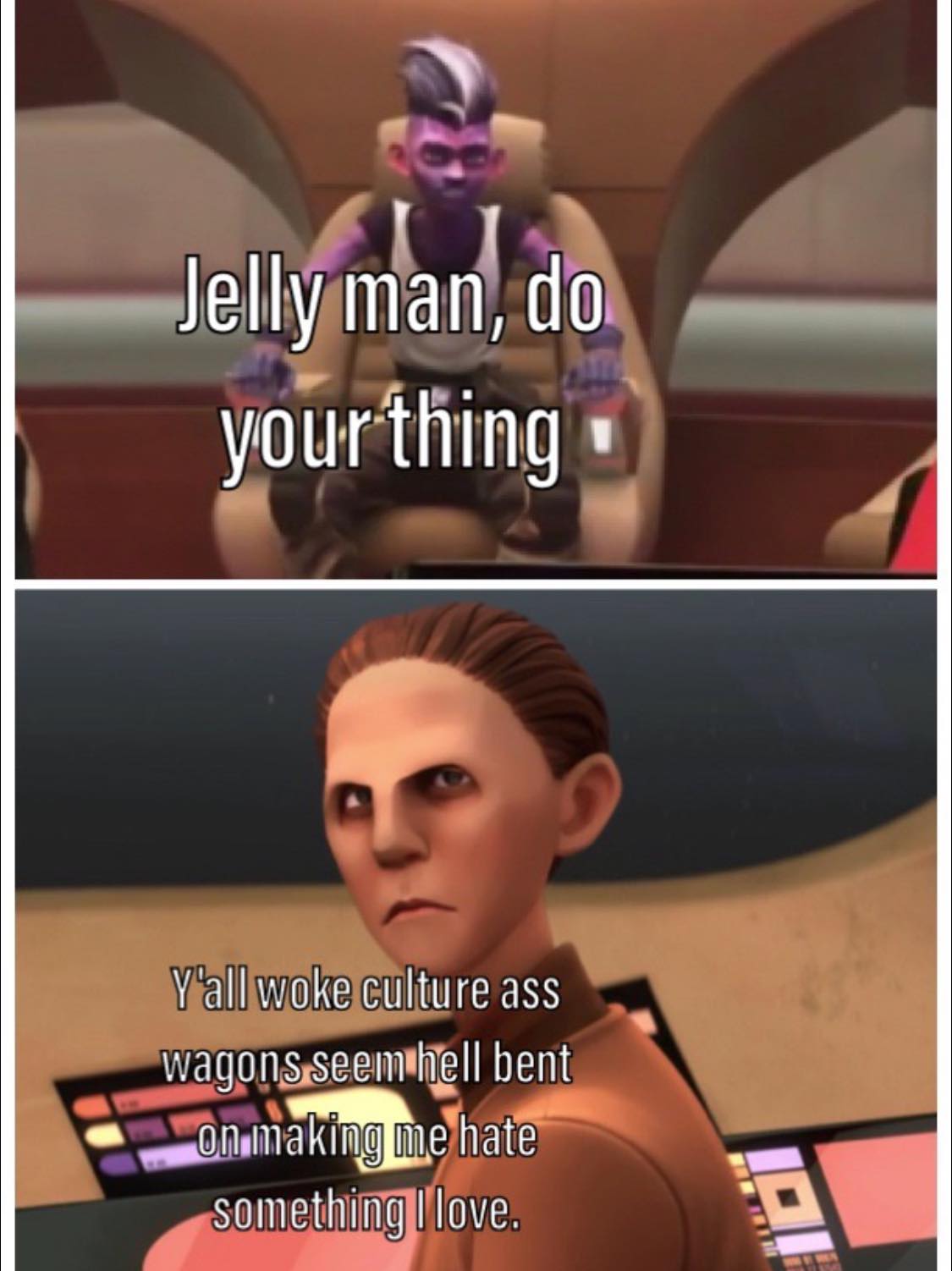
The image is a two-panel meme constructed using screenshots from the video game Mass Effect 3.
- Panel 1: Features a purple-skinned alien character (a Turian named Garrus Vakarian) looking downward with a slight smirk. The text overlaid reads, "Jelly man, do your thing."
- Panel 2: Depicts a human male character (Commander Shepard, customizable, shown here with a specific aesthetic) looking intensely with a scowling expression. Text overlaid reads, "Y'all woke culture ass wagons seem hell bent on making me hate something I love."
- Background: Both panels take place in a dimly lit, futuristic interior, likely a spaceship or station within the Mass Effect universe.
- Additional elements: In the bottom panel a colorful rainbow box can be seen.
Foucauldian Genealogical Discourse Analysis
This meme functions as a micro-discourse regarding the evolution of cultural norms and power dynamics.
- Discourse and Power: The text “Y’all woke culture ass wagons seem hell bent on making me hate something I love.” reveals a power struggle. The speaker frames "woke culture" as an external force actively changing their emotional response to something they previously enjoyed. This represents an attempt to define and contain a discourse. It's not a neutral statement; it positions "woke culture" as an antagonistic force.
- Genealogy of “Wokeness”: The phrase "woke culture" itself has a genealogy. It originates in African American Vernacular English (AAVE) as a call to awareness of social injustice, but has been adopted and redefined (and often weaponized) within online spaces. The meme relies on that evolution and the baggage attached to the term.
- Subjectivation: The speaker positions themselves as a subject affected by this discourse. They’re not simply objecting to ideas, but claiming their emotional experience is being manipulated.
- Garrus Vakarian’s Role: Garrus’s text is significant. He is telling the speaker to “do your thing” which is to voice their opinion.
Critical Theory
The meme speaks to the central tenets of Critical Theory, particularly the critique of culture and the concept of ideology.
- Culture Industry: The meme engages with the “culture industry” by commenting on current cultural trends and anxieties around online discourse. It's a meta-commentary about the way we talk about culture.
- False Consciousness: The speaker implicitly suggests that "woke culture" is imposing a "false consciousness" – altering their genuine enjoyment of something. This suggests a belief that genuine experience is being corrupted.
- Ideology: The meme expresses a particular ideology – a resistance to perceived changes in cultural norms. The speaker views these changes as a threat to their enjoyment and expresses resentment towards the forces driving them.
- Commodification of Culture: The meme can be seen as critiquing how culture is increasingly viewed through the lens of identity politics and social justice, potentially overshadowing inherent artistic or entertainment value.
Marxist Conflict Theory
While not a direct application of Marxist theory, elements of conflict are apparent:
- Class Conflict (Metaphorical): The meme frames a conflict between the speaker (representing a certain traditional way of experiencing culture) and "woke culture" (representing a perceived challenging force). This isn't necessarily about economic class, but a clash of cultural values and ideologies.
- Hegemony: The speaker sees "woke culture" as attempting to establish cultural hegemony—dominating the way people think and feel. They perceive a threat to their established ways of enjoying things.
- Alienation: The phrase “making me hate something I love” suggests alienation from a previously enjoyed experience. This alienation is being caused, in the speaker’s view, by an external force.
Postmodernism
The meme embodies several postmodern characteristics:
- Meta-Commentary: It’s a statement about statements. It’s not directly arguing a point, but commenting on the discourse itself.
- Irony and Parody: There’s a strong element of irony—using a character and setting from a science fiction video game to comment on modern cultural anxieties.
- Deconstruction of Meaning: The meme challenges a singular, fixed meaning of enjoyment. It suggests that emotional responses are not inherently "pure" but are shaped by social and cultural forces.
- Simulation/Hyperreality: The use of video game characters and settings creates a simulation of a real-world conversation. It emphasizes the increasing blending of reality and representation in the digital age.
Queer Feminist Intersectional Analysis
This is the most complex area for application, as it requires some inference.
- Resistance to Progressive Movements: The meme can be read as a resistance to progressive movements that aim to address issues of social justice and representation. The term "woke culture," when used in this way, is often a backlash against these efforts.
- Intersectionality (Negatively): The speaker seems to view intersectionality (the understanding that different forms of discrimination intersect) as a threat to their ability to enjoy something without feeling pressured to conform to certain political expectations.
- Backlash Against Representation: It’s possible the “something I love” refers to a piece of media that is being re-evaluated through a more critical lens, and the speaker is reacting negatively to that re-evaluation.
- The role of Garrus Vakarian: The role of Garrus Vakarian is noteworthy, as he is supporting the speaker and their opinion. This is important because he is a character that is viewed favorably in feminist and queer communities, but is supporting an opinion that opposes those communities.
Important Note: These are interpretations. The meme is intentionally open to interpretation, and its meaning will depend on the individual viewer’s own background and perspective.
simple-description (llama3.2-vision)
The meme features a screenshot from the 2021 film "Space Jam: A New Legacy" where the character of LeBron James' AI robot, "The Bot," says "I am LeBron when you're not looking" before suddenly shouting "I am LeBron when you're not looking" and then "I am LeBron when you're not looking" again, with a third and final "I am LeBron when you're not looking" after that.
tesseract-ocr
‘y ~~ a yy ae {0 yourthing * Ygalliwokeyeulture ass ELTON TSN ] Sirens hate — something)l|love. a