First Seen
2023-05-10T21:03:41+00:00
simple-description (llama3.2-vision_11b)
This meme features a screenshot of a Star Trek character, likely Captain Jean-Luc Picard, but with a queer twist. The image is captioned "When you finally understand the true meaning of 'make it so'" and features a cheeky, knowing expression on the character's face. The meme is likely referencing the character's iconic line "Make it so" and implying that the character has finally understood the true nature of queer identity and is embracing it.
detailed-analysis (gemma3-27b-vision)
Okay, here's an analysis of the image, broken down into sections addressing the requested theoretical frameworks. Given the nature of the image (a digital illustration appearing to depict a character from a sci-fi setting) some analyses will be more fitting/applicable than others.
Please Note: Interpretation is subjective, and this analysis leans into possibilities suggested by the visual cues.
1. Visual Description
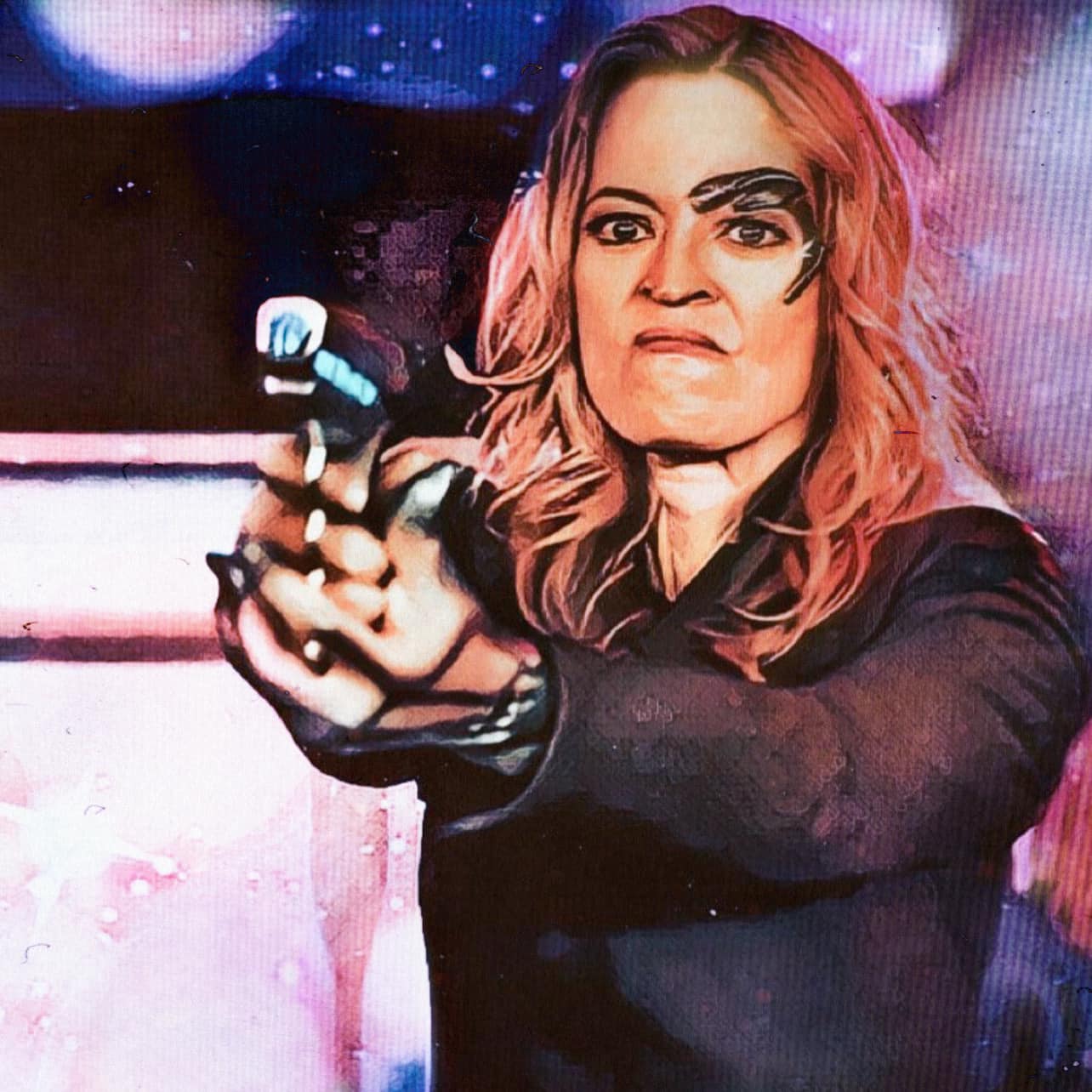
The image is a digital illustration of a woman, seemingly mid-action, wielding a futuristic-looking ray gun. She's positioned centrally, in a dramatic pose of aiming. Her expression is serious, perhaps even fierce.
- Appearance: The woman has fair skin, reddish-blonde hair styled in layers, and striking makeup, including dramatic dark eye shadow and what appears to be painted markings on her forehead/temples. She is wearing dark clothing, likely a uniform of some sort, suggesting a role in a structured, possibly military or security-based setting.
- Composition: The composition is focused on her face and the ray gun, drawing the viewer’s attention to her agency and potential for action. The background is blurred and suggests a futuristic interior – metallic surfaces, possibly corridors or a ship's interior – illuminated with pink and purple light.
- Style: The illustration style is somewhat painterly, with visible brushstrokes or digital equivalents that create a textured look. There is a slight surreal quality to the lighting and composition.
2. Foucauldian Genealogical Discourse Analysis
Foucault's work emphasizes the relationship between power, knowledge, and discourse. Analyzing the image through this lens:
- Discourses of Power: The image actively taps into established discourses surrounding power. The presence of the weapon, her confident stance, and the uniform all indicate authority and the right to exert force. We can ask how these elements are constructed through discourse. The image doesn't simply show power, it performs it.
- Genealogy of the ‘Action Hero’: The image can be seen as a point in the genealogy of the “action hero” archetype, particularly a female action hero. We can trace how representations of powerful, armed women have evolved over time, and what social and political forces have shaped those representations. Is this image a disruption of or a continuation of existing tropes?
- Surveillance & Discipline: Depending on the context of this character (if we know more about the story), the setting and the technology (the ray gun) might suggest systems of surveillance and control. Even without this context, the fact that she wields that technology implies she participates in those systems, potentially normalizing them.
- Knowledge/Power Relationship: The character's ability to operate the weapon suggests specialized knowledge. This knowledge isn’t neutral; it is tied to power, enabling her to control and potentially dominate others.
3. Critical Theory
Applying a broader Critical Theory lens (drawing from thinkers like Adorno, Horkheimer, Marcuse):
- Culture Industry & Spectacle: The image could be viewed as a product of the “culture industry,” designed to reinforce existing power structures and distract from real social problems. While not inherently negative, it becomes problematic if it glorifies violence or simplifies complex issues.
- Ideology: The image subtly communicates an ideology – a set of beliefs about how the world should be. This might involve notions of heroism, security, or the justification of force. The representation of a strong, armed woman could be interpreted as a challenge to traditional gender roles, or as a reinforcement of patriarchal ideas about what constitutes power.
- Alienation: Depending on the larger narrative, this character might be portrayed as alienated from society, acting as a lone enforcer or vigilante. This alienation could reflect broader societal anxieties.
4. Marxist Conflict Theory
From a Marxist perspective, conflict arises from the struggle over resources and power.
- Class Struggle: If the narrative establishes a social hierarchy, this character’s role could be seen as enforcing that hierarchy, protecting the interests of the ruling class. She may be a tool of oppression, even if she doesn't consciously intend to be.
- Means of Production: The ray gun can be seen as a “means of production” in a futuristic context – a tool used to control and exploit others. Who owns and controls this technology is crucial to understanding the power dynamics at play.
- Ideological State Apparatus: The image itself can be seen as an “ideological state apparatus” – a tool used to legitimize the existing social order and maintain the status quo. By presenting a heroic figure wielding a weapon, it potentially normalizes violence and control.
5. Postmodernism
Postmodern thought challenges grand narratives and emphasizes fragmentation, simulation, and the constructed nature of reality.
- Hyperreality & Simulation: The image, as a digital creation, exists within a realm of simulation. It's not a "real" person or situation, but a constructed representation. This raises questions about authenticity and the relationship between image and reality.
- Deconstruction of Archetypes: While potentially drawing on existing archetypes (the warrior, the hero), the image could also be seen as subtly deconstructing those archetypes. Perhaps the character isn't a traditional "hero" in the conventional sense, or her motivations are ambiguous.
- Loss of Meaning & Grand Narratives: The fragmented, stylized nature of the illustration could reflect a broader postmodern sense of fragmentation and the loss of traditional values or beliefs.
6. Queer Feminist Intersectional Analysis
This requires a complex approach considering the intersection of gender, sexuality, and other forms of power.
- Challenging Gender Roles: The image offers a potentially subversive portrayal of a woman in a traditionally masculine role. However, it's important to examine how her femininity is depicted (or suppressed) and whether the image reinforces or challenges patriarchal expectations.
- Commodification of Female Strength: Is her strength presented as empowering, or is it used to sexualize or objectify her? Is her agency genuine, or is it controlled by external forces?
- Intersectionality & Other Identities: Without knowing more about the character, we can’t assess how her other identities (race, class, sexuality, etc.) intersect with her gender and affect her experiences. If she's a woman of color, for example, her experience of power and authority will be different than a white woman's.
- Disrupting the Male Gaze: Does this image present a vision of female power that is genuinely free from the male gaze, or is it still designed to appeal to a predominantly male audience?
Disclaimer: These analyses are interpretations based on the visual information available. A deeper understanding would require knowing the context of the image – the story it’s part of, the artist’s intent, and the target audience.
simple-description (llama3.2-vision)
The meme features a screenshot of Captain Marvel (played by Brie Larson) from the 2019 Marvel movie of the same name. The image shows her holding a gun and giving a stern expression. The text "I'm not crying, I'm just... actually, I am crying" is often added to the meme, referencing the character's emotional moments in the film.
tesseract-ocr
t As ise tl We Te | Nam AN aay aN x ms | ) A y \ | A Bee 4 : Wor led —_ & oat i “ i wht f ' baile