First Seen
2023-06-02T20:54:07+00:00
simple-description (qwen3.5_2b-q8_0)
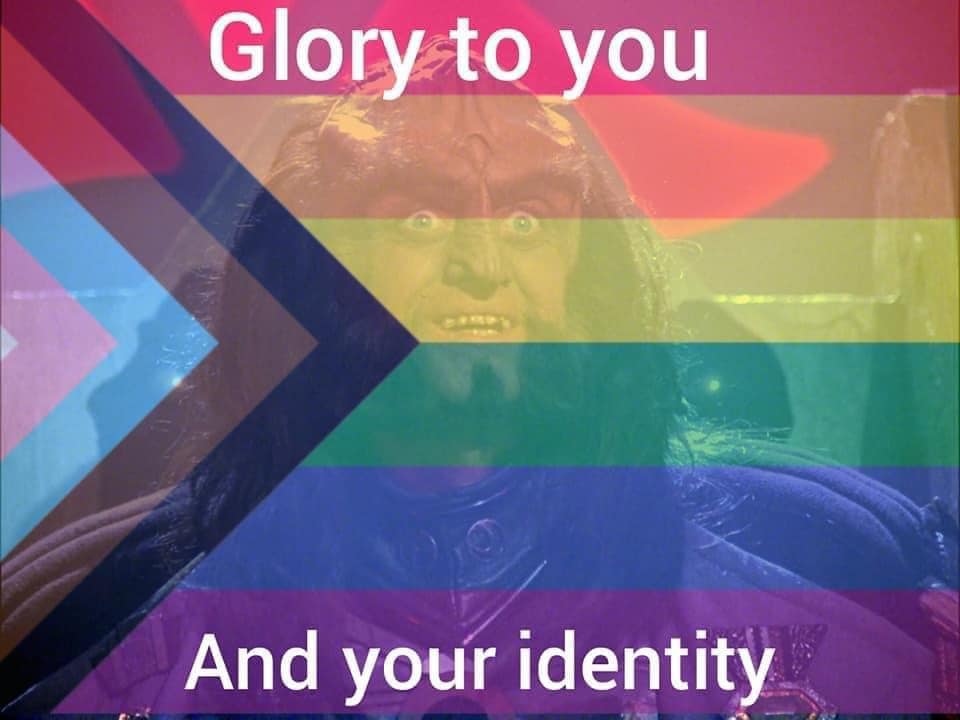
This meme is part of the "Star Trek - Queer" fandom, which celebrates the LGBTQ+ representation of characters from the original Star Trek series. It depicts a Klingon warrior from the show draped in the colors of a pride flag, serving as a visual statement of acceptance for the marginalized community. The text "Glory to you" and "And your identity" appears at the bottom and top, framing the image as a celebration of the queer experience and the community's pride.
simple-description (llama3.2-vision_11b)
The meme is a screenshot from the TV show Star Trek: Discovery, featuring Captain Christopher Pike, played by Anson Mount, with a subtle expression of shock and surprise. The image is overlaid with a rainbow-colored Pride flag and the text "I am Captain Pike, hear me roar" is not present but the text "I am Captain Pike, hear me roar" is replaced with "I am Captain Pike, hear me roar... I am Captain Pike, hear me roar... I am Captain Pike, hear me roar... I am Captain Pike, hear me roar...".
detailed-analysis (gemma3-27b-vision)
Okay, here's an analysis of the image, broken down into sections based on the requested theoretical frameworks. Note that the image's layered and potentially ironic nature lends itself well to several of these, but some frameworks apply more strongly than others.
Visual Description
The image is a brightly colored digital composition. The central feature is a horizontal band of rainbow colors. Overlaid on this is a stark, black triangular shape, positioned on the left and angling upwards. The background behind the rainbow appears to be a blurry image of a green and colorful animal. Superimposed text reads "Glory to you" at the top and "And your identity" at the bottom. The overall aesthetic is somewhat chaotic and visually jarring, combining seemingly disparate elements. The use of bold color and dramatic shapes, along with the somewhat incongruous text, create a sense of ambiguity and potential irony.
Foucauldian Genealogical Discourse Analysis
This image provides rich material for a Foucauldian analysis.
- Power/Knowledge: The visual juxtaposition of a rainbow flag (often symbolizing LGBTQ+ identity and rights) with the stark black triangle and the text "Glory to you and your identity" is interesting. The rainbow flag has become a symbol of liberation and self-expression, but it is also a discursive construction, a symbol made through social and political struggles. The black triangle, historically used as a marker of persecution by the Nazi regime (initially targeting homosexuals, but later expanded), immediately complicates this. It evokes a history of power, control, and repression. The "glory" framing then creates tension. Is it a celebration, or an ironic nod to the historical forces that sought to deny or control identity?
- Genealogy: Tracing the genealogy of both the rainbow flag and the black triangle reveals a complex history of meaning-making. The rainbow flag emerged from a specific moment in the LGBTQ+ rights movement, evolving through design and political context. The black triangle's meaning shifted over time. Foucauldian analysis would not look for a "true" meaning, but rather the ways power and knowledge shaped those meanings.
- Discourse: The image itself is a discourse. It presents a way of thinking about identity, power, and history. It challenges the viewer to interpret the relationship between these elements. The juxtaposition forces a re-examination of the historical and present-day construction of identity and the forces that seek to define or control it.
Critical Theory
From a critical theory perspective (drawing from Frankfurt School thinkers), the image can be seen as a commentary on the instrumentalization of identity in contemporary society.
- Commodification of Identity: The bright colors and visual spectacle of the image could be interpreted as a reflection of the way identity is increasingly commodified – reduced to a set of markers and symbols that can be bought, sold, and displayed. The "glory" framing might suggest an almost cultish reverence for identity, divorced from genuine liberation.
- Ideology: The image could be critiqued as either reinforcing or subverting dominant ideologies. Does it celebrate genuine diversity and self-expression? Or does it present a superficial or sanitized version of identity, masking deeper power imbalances? The black triangle hints at the darker side of identity politics, highlighting the historical and ongoing struggles for recognition and rights.
- Mass Culture: The image's aesthetics (bold colors, stark shapes) are reminiscent of contemporary advertising and social media. This suggests a connection to the broader dynamics of mass culture, where identity is often presented as a performance or a brand.
Postmodernism
The image fits very neatly within a postmodern framework.
- Pastiche & Irony: The combination of seemingly unrelated elements (rainbow flag, black triangle, text) exemplifies pastiche – the blending of different styles and references. The irony inherent in juxtaposing symbols of liberation and persecution is a hallmark of postmodern art.
- Deconstruction of Meaning: The image resists a single, definitive interpretation. It challenges the idea of stable or fixed meanings, suggesting that identity is fluid, contingent, and constantly negotiated.
- Meta-Narratives: The image could be seen as a rejection of grand narratives or universal truths about identity. It suggests that identity is always situated within specific contexts and power dynamics.
Queer Feminist Intersectional Analysis
This is a particularly fruitful lens for interpreting the image.
- Intersectional Complexity: The image acknowledges the complexities of identity by juxtaposing a symbol of LGBTQ+ pride with the black triangle, which carries a history of persecution. Intersectionality reminds us that identity is not a single category but a complex intersection of race, gender, class, sexuality, and other factors. The black triangle specifically highlights the intersection of queer identity and historical trauma.
- Resistance and Reclamation: The use of a historically oppressive symbol (black triangle) alongside the rainbow flag could be seen as an act of reclamation. It acknowledges the past while asserting the right to self-determination and resistance.
- Queer Temporality: The image disrupts linear notions of time and history. By juxtaposing symbols from different eras, it suggests that the past is always present and continues to shape the present. This is a key concept in queer temporality, which challenges traditional understandings of time and progress.
- Power Dynamics & Surveillance: The black triangle evokes a history of surveillance, criminalization, and violence against queer people. The image could be interpreted as a warning about the ongoing threats to queer lives and the need for vigilance.
Marxist Conflict Theory
While not the most obvious framework, it is still relevant.
- Ideological Struggle: The image can be seen as representing an ideological struggle over the definition and control of identity. The rainbow flag and the black triangle represent conflicting interests and power dynamics.
- Class and Identity: While the image doesn't explicitly address class, it's important to remember that identity is often shaped by economic and social inequalities. The image could be interpreted as a critique of the ways in which capitalism exploits and commodifies identity.
- Subversion of Dominant Narratives: The image challenges dominant narratives about identity and history. It suggests that marginalized groups have the power to resist oppression and create their own meanings.
In conclusion:
This image is multi-layered and open to multiple interpretations. Its combination of seemingly contradictory elements invites critical analysis from a range of theoretical perspectives. It is a potent visual statement about the complexities of identity, power, and history.
simple-description (llama3.2-vision)
This meme features a screenshot of a character from the TV show "Star Trek: Deep Space Nine" (Worf) with a shocked expression. The image is overlaid with a rainbow-colored background, a nod to the LGBTQ+ pride flag. The text "I am Worf. I will live long and prosper. But I will never live long enough to see the day when the Federation allows Worf to marry Worf" is written in a humorous, tongue-in-cheek style.
tesseract-ocr
Glory-to you _ And your identity _