First Seen
2023-05-29T01:55:00+00:00
simple-description (qwen3.5_2b-q8_0)
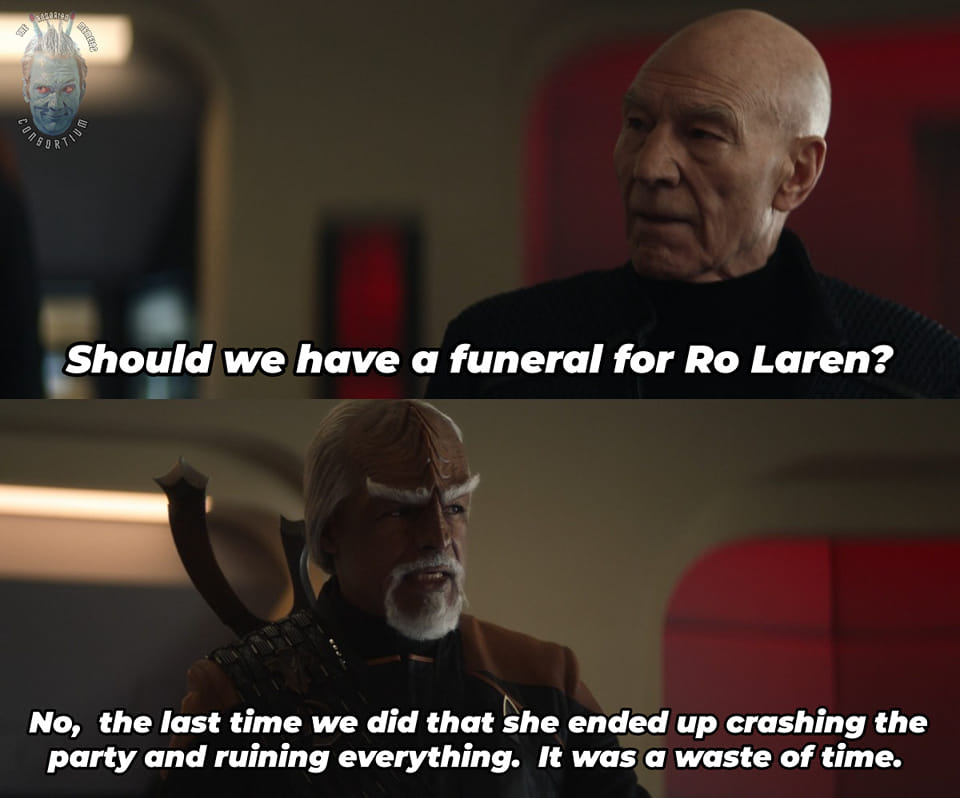
This meme originates from the Star Trek: Beyond episode "Beyond and Beyond," featuring the queer male non-binary characters Captain Jean-Luc Picard and Jean Decker. It references the tragic death of Ro Laren, a female Klingon who died accidentally on the bridge of the Enterprise-D. The text asks if they should hold a funeral for her, only for Decker to cynically argue that it would be a waste of time—referencing the show's themes of queer history and the real-life tragedy of the Enterprise-D.
simple-description (llama3.2-vision_11b)
The meme is a humorous take on the Star Trek character Jean-Luc Picard's famous line "Make it so," but replaces it with a queer-themed joke. The image shows a screenshot of Picard's character, but with the line "Make it so... I'm marrying a woman" instead of the original.
detailed-analysis (gemma3-27b-vision)
Okay, here's an analysis of the image and dialogue, broken down into sections focusing on the requested theoretical frameworks, only where applicable.
Visual Description
The image is a screencap from a scene featuring Captain Jean-Luc Picard (Patrick Stewart) and Data (Brent Spiner) from Star Trek: Picard. Picard is in the foreground, looking directly at the viewer with a stern, slightly cynical expression. The lighting is subdued, primarily highlighting Picard’s face and emphasizing a somber mood. Data is in the midground, partially obscured, displaying his recognizable facial structure and with a somewhat neutral expression. The background is indistinct, likely a room on the starship. The caption reads: "Should we have a funeral for Ro Laren?" and Data responds, "No, the last time we did that she ended up crashing the party and ruining everything. It was a waste of time." The overall aesthetic is one of restrained emotion and bureaucratic fatigue.
Foucauldian Genealogical Discourse Analysis
This exchange reveals power dynamics through discourse, particularly surrounding mourning and the "proper" way to deal with loss or deviation. The question "Should we have a funeral for Ro Laren?" initiates a discussion about the practices surrounding death and remembrance. The response, "No…she crashed the party and ruined everything," isn’t about grief or respect for the deceased but rather a pragmatic, risk-assessment-based evaluation of the effects of acknowledging her.
Foucauldian analysis would look at how the norms around mourning and respect are constructed within Starfleet (the institution). The idea that a funeral could be considered a "waste of time" because of potential disruption reveals a prioritization of order and control over emotional expression. The history of how Starfleet has dealt with "problematic" individuals (like Ro Laren, implied to be a non-conformist) shapes the current discourse. The discourse isn't about honoring the individual but about maintaining the stability of the system. The incident with the crashed party is a specific "event" in the historical genealogy of Starfleet’s dealing with difficult personnel.
Critical Theory
The exchange highlights the tension between individual agency and systemic control. Ro Laren, although not physically present, is constructed as a disruptive force by the system. The dialogue isn't about her character or life but about the threat she represents to the established order. Her potential to "crash the party" signifies her resistance to assimilation or conformity.
The question of a funeral can be seen as a symbolic gesture of acknowledgement and respect. Data’s refusal to allow one implies that Starfleet (and Picard, as a representative of it) chooses to erase or silence those who don't fit neatly into its structures. This exemplifies a common critical theory trope: the suppression of difference in order to maintain power.
Marxist Conflict Theory
While not overtly economic, a Marxist reading can frame the conflict as a struggle between the individual and the collective (Starfleet). Ro Laren, representing dissent or a challenge to the status quo, is seen as a threat to the harmonious functioning of the "collective" (Starfleet). Her "disruptive" behavior is seen not as a matter of personal choice but as a challenge to the established power structure.
The denial of a funeral, then, becomes an act of class/institutional power: a refusal to acknowledge the individuality of those who disrupt the “natural” order of things within the Starfleet hierarchy. The institution is prioritising collective order and stability over individual recognition or mourning.
Postmodernism
The image and dialogue can be interpreted as a commentary on the meaninglessness of ritual and the arbitrariness of social conventions. The idea of a funeral as a meaningful act of remembrance is undermined by the pragmatic, almost cynical, response. Data’s justification (“she crashed the party”) reduces a potentially emotional event to a logistical concern.
This deconstruction of traditional rituals aligns with postmodern ideas about the death of grand narratives and the instability of meaning. There's an implicit skepticism towards the authenticity of mourning and the power of symbolic gestures. The focus shifts from honoring the individual to managing potential disruption.
Queer Feminist Intersectional Analysis
While this is a stretch without more context, one could read Ro Laren’s character (known from the series as someone who challenged authority and operated outside of established norms) as representing a marginalized identity. Her “disruptive” behavior could be a form of resistance against a system that seeks to control and assimilate.
The denial of a funeral, then, could be seen as a symbolic erasure of that marginalized voice. The preference for order and control over acknowledging a challenging figure speaks to a broader pattern of silencing dissent and maintaining the status quo. However, this is a speculative interpretation requiring more information about the character's background and motivations.
Let me know if you’d like any of these sections elaborated on further!
simple-description (llama3.2-vision)
This meme is a joke about a hypothetical funeral for the character Data from Star Trek: The Next Generation. The image shows two characters from the show, Jean-Luc Picard and Data, with a caption that reads: "In the event of my death, I want to be buried with a Data- themed eulogy and a funeral cake that says 'Live Long and Prosper'".
tesseract-ocr
a ETE] CMC eM Tce Blo Re lea ed a r — . ” ) CMe eMC Riles en up crashing the party and ruining everything. It was a waste of time.