First Seen
2023-06-08T19:24:14+00:00
simple-description (qwen3.5_2b-q8_0)
The top image displays the Star Trek: Voyager Enterprise, a starship from the late 1990s series. The bottom image features mannequins dressed in the traditional "Ensign" uniforms. One mannequin is wearing the green uniform (female style), and the other is wearing the red uniform (male style). Interestingly, the word "Tosk" appears on the red uniform, referencing the famous line from the 1979 movie Stargate where Kirk says "Tosk!" when Worf asks about a man's anatomy. The meme plays on the franchise's history of subverting gender norms, often highlighted in the Star Trek universe.
simple-description (llama3.2-vision_11b)
The meme is a screenshot from the Star Trek: The Next Generation episode "The Outcast," where Counselor Deanna Troi's Betazoid senses are overwhelmed by the emotions of the crew. The image shows Deanna Troi, played by Marina Sirtis, with a shocked expression.
detailed-analysis (gemma3-27b-vision)
Okay, here's an analysis of the image, broken down into sections as requested. It’s important to note that applying theoretical lenses can be somewhat interpretive, and I'll highlight where I'm leaning into specific readings.
Visual Description
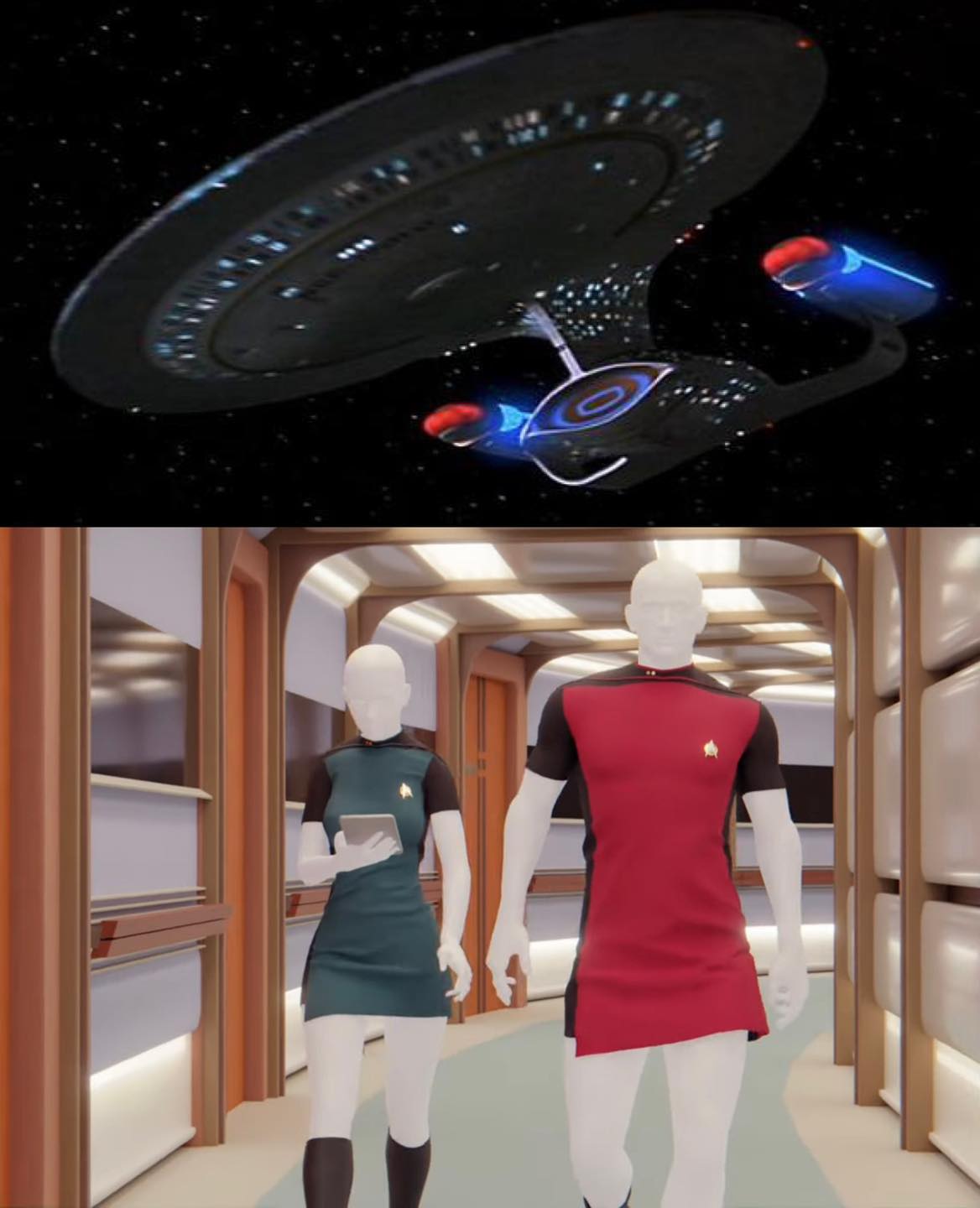
The image is a composite of two distinct scenes. The top half showcases a highly detailed rendering of the USS Enterprise-D from Star Trek: The Next Generation. It's depicted in space, with a starfield backdrop and glowing warp nacelles (the blue cylinders). The lighting suggests a dynamic, fast-paced journey.
The bottom half depicts a corridor within the Enterprise-D. Two female mannequin figures, dressed in different colored uniform dresses, stand along the hallway. The color of the dresses are a Teal/green and Red. The corridor is well-lit, and has a classic 1980s/90s sci-fi aesthetic with wood paneling and neutral color schemes. The overall impression is a simulation or rendering, likely generated through digital art or 3D modeling.
Foucauldian Genealogical Discourse Analysis
This image can be explored through a Foucauldian lens by looking at how Star Trek constructs, and then normalizes, power relations. The Enterprise-D itself is a vessel of power, representing a system of control (Starfleet) that seeks to explore and potentially regulate the galaxy.
The uniforms are central to understanding this. The color-coding of the uniforms (red – Operations/Security, teal/green – Science/Medical, yellow - Engineering) constitutes a disciplinary regime. The colors aren't arbitrary; they are part of a system that defines roles, expectations, and limits on behavior. They produce the identities of those who wear them, linking appearance to function within the ship’s hierarchical structure.
The mannequins, representing the bodies subject to these uniform codes, are interesting. They are empty of agency, representing the subject as a function of the power structure. The focus isn’t on who wears the uniform, but the uniform itself as a carrier of authority. We can examine how Star Trek establishes a genealogy of "acceptable" command, competence, and control by regulating (through dress) bodies within its universe.
Critical Theory
This image is ripe for a Critical Theory analysis focusing on the relationship between technology, representation, and social control. Star Trek presents a utopian vision of the future, but this image subtly reveals the underlying mechanisms of control that maintain that utopia.
The Enterprise-D is a technologically advanced machine. However, it is not neutral. It embodies the values and beliefs of Starfleet, and its technology is deployed to maintain a specific order. The corridor and uniforms represent the internal structures of that order.
The mannequins, as representations of the crew, are de-individualized. They highlight the potential of technology to normalize and standardize bodies, leading to a loss of autonomy. This can be tied into broader critical discussions about the impact of technology on subjectivity and the dangers of a technologically mediated "rational" society that can suppress individuality.
Marxist Conflict Theory
While not explicitly depicted in the image, a Marxist reading can focus on the inherent contradictions within the Star Trek universe. The Federation, despite its claims of equality, still operates within a hierarchical structure.
The Enterprise-D and its crew represent the means of production – the technological and organizational infrastructure used to explore and control resources. The uniforms, while not explicitly representing class, mark different roles within this production process. The color-coding subtly reinforces the division of labor, with certain roles (Operations/Security – red) potentially holding more power.
The mannequins can be interpreted as representing the proletariat – the bodies who perform the labor that sustains the Federation. Their facelessness and passivity suggest a lack of agency and an emphasis on function over individual expression. This is a subtle critique of systems that prioritize efficiency and control over human needs.
Postmodernism
A Postmodern reading focuses on the image’s blurring of reality and simulation. The Enterprise-D is a fictional construct, and the corridor and mannequins appear to be digitally rendered. This challenges the notion of an “original” reality.
The image can be seen as a hyperreality – a simulation that has become more real than the real thing. The emphasis on visual spectacle (the detailed ship, the polished corridor) obscures the underlying power dynamics.
The mannequins, as copies without originals, further destabilize the concept of authenticity. They represent a fragmentation of identity, where bodies are reduced to mere surfaces and their roles are defined by external codes.
Queer Feminist Intersectional Analysis
This is where the image gets particularly interesting. While Star Trek: The Next Generation was groundbreaking in its representation of women in leadership roles, the image reveals underlying issues.
The mannequins present a particular standard of femininity. They are slender, and the uniforms, while functional, are form-fitting. This reinforces a certain body type as ideal, excluding those who do not conform.
The color-coding of the uniforms can also be analyzed through an intersectional lens. While the colors aren't directly tied to gender, they can reinforce existing gender roles. The red uniform, often associated with security and leadership, has historically been a male-dominated field. The teal uniform being assigned to a female model, subtly reinforces the historic trope of women being nurses or scientists.
Furthermore, the lack of diversity in body type and presentation on the mannequins highlights the limitations of even progressive media in fully embracing intersectionality. It is important to note that this is not to criticize the TV show itself, but to highlight how images such as these may still perpetuate harmful stereotypes and limit possibilities for diverse representation.
Disclaimer: These analyses are interpretive and open to debate. The goal is to illustrate how different theoretical frameworks can be applied to understand the meaning and implications of a seemingly simple image.
simple-description (llama3.2-vision)
The meme is a humorous comparison between the original Star Trek TV series and the more recent Star Trek movies. It shows a side-by-side image of the original USS Enterprise spaceship from the 1960s, with its saucer-shaped design, and the new USS Enterprise spaceship from the 2010s, which is much larger and more angular. The text overlay reads "The original Enterprise was a spaceship. The new Enterprise is a space station with a spaceship attached to it."
tesseract-ocr
Ta et) All