First Seen
2024-02-07T22:47:05.499032+00:00
simple-description (qwen3.5_2b-q8_0)
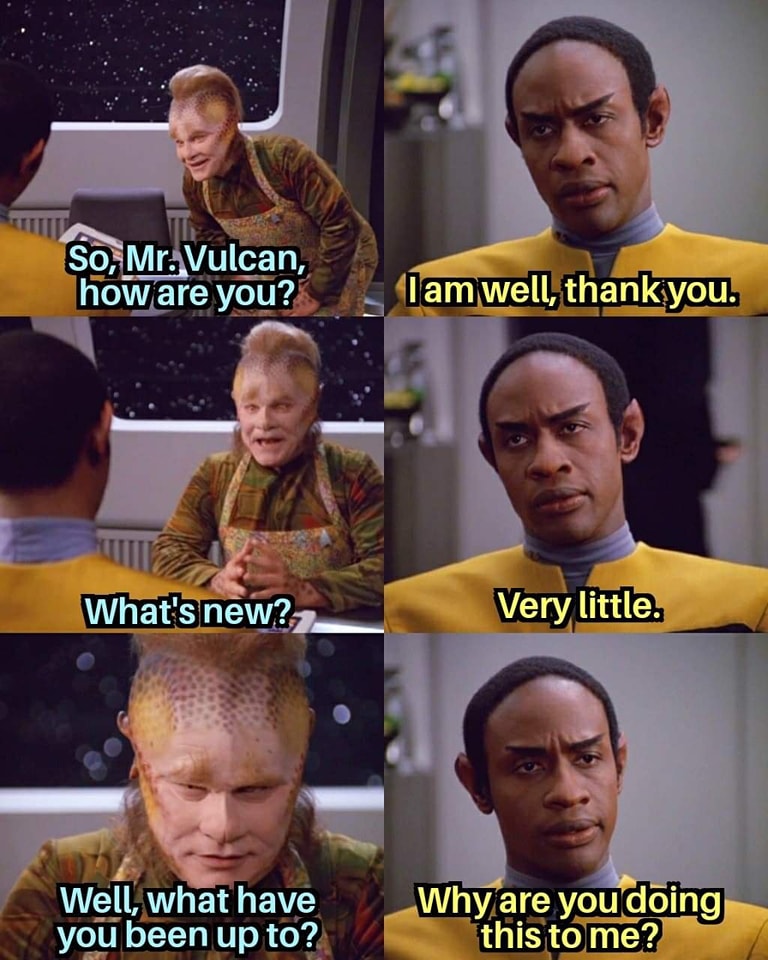
This meme is a play on the "Star Trek" lore regarding the genderless Vulcan species. By captioning the female Vulcan character as "Mr. Vulcan," it humorously references the trope that the species is often treated as having a single gender or being "Mr. [Species]" (like Mr. Universe) rather than having a traditional binary gender. The punchline comes from the final line, "Why are you doing this to me?", implying the Vulcan is being weird or offending the human. Since Vulcans are emotionless, they cannot answer this question with a personal reaction; instead, they can only say "No, I am not doing that" in a human way, or simply respond "No, I am doing that" to refer to their own neutrality.
simple-description (llama3.2-vision_11b)
This meme is a humorous exchange between two characters from the Star Trek franchise, where a Vulcan is trying to explain a complex concept to a human, but the human is not understanding it. The meme shows the Vulcan's frustration and the human's confusion, with the Vulcan saying "Fascinating. I am trying to explain it to you. Please, do not try to think about it. You will only get confused. And you will die."
The text "I am trying to explain it to you. Please, do not try to think about it. You will only get confused. And you will die." is not present in the original image.
detailed-analysis (gemma3-27b-vision)
Okay, let's break down this scene from Star Trek: Deep Space Nine using the requested theoretical lenses. It's a deceptively complex exchange, highlighting power dynamics and social interaction.
Visual Description
The image is a four-panel screencap from a Star Trek: Deep Space Nine scene. In each frame, we see two characters: Miles O'Brien, a human Starfleet engineer with reddish hair, and Worf, a Klingon/human security officer. The setting is a hallway or corridor on the space station Deep Space Nine. O'Brien is actively engaging Worf in conversation, asking him questions with apparent affability. Worf, in contrast, maintains a stoic, almost pained expression throughout the exchange. His body language is closed, and his gaze is direct and unyielding. The backgrounds appear utilitarian and somewhat sterile, common for the station setting. The visual contrast between O'Brien's enthusiastic, animated demeanor and Worf's impassivity immediately signals a power imbalance or discomfort.
Foucauldian Genealogical Discourse Analysis
This scene provides a perfect illustration of how power operates through discourse, as analyzed by Michel Foucault. O’Brien’s relentless questioning is not simply polite conversation; it's an exercise of power. He expects Worf to answer, to perform a role of conversational participant. The increasingly desperate tone of Worf’s responses ("Very little," and finally, "Why are you doing this to me?") reveals the disciplinary aspect of this interaction.
- Genealogy: We can trace the "genealogy" of this interaction to societal norms around politeness and social interaction, particularly Western norms. O’Brien expects Worf to conform to these norms, regardless of Worf’s cultural background (Klingon culture values strength and directness and discourages excessive small talk). The expectation of continuous reciprocal exchange forms a disciplinary regime.
- Discourse & Power: O’Brien's questioning establishes a discourse where Worf's silence or terse responses are seen as deviations requiring correction. The expectation of self-disclosure within the discourse is a tool for controlling and understanding the other. Worf’s discomfort illustrates the effect of this power dynamic.
- Panopticism: In a broader sense, the expectation of conformity to social norms can be seen as a micro-level example of panoptic power, where the feeling of being observed and judged shapes behavior. Worf anticipates O'Brien’s dissatisfaction and attempts to meet his expectations, illustrating self-regulation.
Critical Theory
This exchange is a strong example of how ostensibly benign interactions can reinforce asymmetrical power relations. Viewing the scene through a Critical Theory lens (drawing on thinkers like the Frankfurt School), we can see how O’Brien’s seemingly innocent curiosity is part of a broader system of control.
- Dominant Ideology: O'Brien's expectation of personal disclosure reinforces a dominant cultural ideology that values openness and communication. This ideology implicitly frames Worf's reserved nature as 'abnormal' or ‘problematic’.
- Instrumental Reason: O’Brien’s questioning, while presented as friendly, can be seen as an exercise of instrumental reason – seeking to understand and categorize Worf for his own purposes. Worf is treated as an object of knowledge rather than a subject with agency.
- The Colonization of the Self: Worf’s increasing distress points to a subtle form of colonization of the self. He’s compelled to participate in a social ritual that doesn't align with his cultural identity, causing internal conflict and discomfort.
Marxist Conflict Theory
While subtle, a Marxist reading can illuminate the underlying power dynamics.
- Class/Status Inequality: Although set in a futuristic society, we can interpret Worf's position as a “professional” (security officer) and O'Brien's as a “worker” (engineer). Though both are Starfleet officers, Worf’s role as a security officer gives him a degree of authority. However, O'Brien is subtly asserting his social dominance through this interrogation.
- Ideological Hegemony: The expectation of social exchange is a form of ideological hegemony—an idea is so pervasive it becomes accepted as “normal.” O'Brien, benefiting from this dominant ideology, implicitly demands that Worf conform, solidifying the existing social order.
- Exploitation of Labor/Social Interaction: While not material exploitation, O’Brien is “extracting” social labor from Worf – demanding his emotional and conversational energy. Worf's discomfort demonstrates the cost of participating in this unequal exchange.
Postmodernism
A postmodern lens challenges the notion of a single, fixed meaning in this exchange.
- Deconstruction of Politeness: The scene deconstructs the idea of “politeness” as a neutral social practice. It reveals how politeness can be used as a tool for asserting power and control.
- Simulacra and Simulation: The entire interaction can be seen as a simulacrum – a copy without an original. O’Brien’s questions are not genuinely motivated by concern for Worf’s well-being; they are a performance of social etiquette. Worf’s responses are similarly a performance – attempts to satisfy O’Brien and end the interrogation.
- Fragmentation of Meaning: The scene lacks a clear resolution. Worf's final question, “Why are you doing this to me?” is left unanswered, highlighting the fragmentation of meaning and the ambiguity of social interaction.
Queer Feminist Intersectional Analysis
This is more nuanced, but still applicable.
- Deviance from Normative Script: Worf’s refusal to participate in the expected social script can be read as a rejection of normative expectations of emotional expression. This can be linked to queer readings of refusing to perform heteronormative emotional labor.
- Intersection of Cultural Identity: Worf’s experience is shaped by the intersection of his Klingon heritage, his human upbringing, and his position within Starfleet. His silence and discomfort are a result of navigating these multiple identities within a dominant Western cultural framework.
- Power Dynamics of Vulnerability: O’Brien's persistent questioning demands a degree of vulnerability from Worf. Worf's resistance can be seen as a refusal to perform vulnerability on O’Brien’s terms.
I hope this detailed breakdown, organized by theoretical lens, is helpful! Let me know if you'd like me to expand on any of these analyses.
simple-description (llama3.2-vision)
This meme is a screenshot from the TV show Star Trek: Deep Space Nine, featuring a character named Odo, a shapeshifter, responding to a question from Captain Sisko. The meme shows Odo's face with a confused expression, and the text "I... I... I do not understand the nature of this question" is overlaid on his face. The caption "I... I... I do not understand the nature of this question" is also included, implying that Odo is struggling to comprehend the question being asked.
tesseract-ocr
i 7 : fp. fe * A Rion ee ele? Sy Tam\well thankyou: cee 4 « See ; wr rN es M a TES ee, | AUT CJ " t ° rh ‘ * my S- | 4 iy \ - Well whathave —_.Why,are you'doing you been up to?, this tome?)