First Seen
2024-03-20T04:18:42.037926+00:00
simple-description (qwen3.5_2b-q8_0)
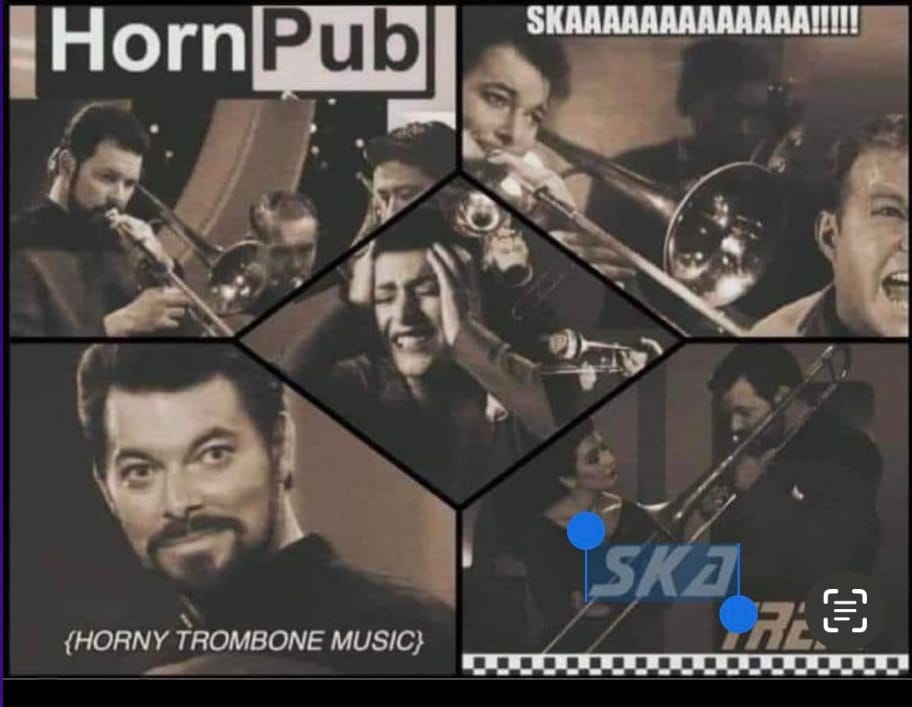
This meme, labeled "Star Trek - Queer", is a high-energy collage of musicians playing brass instruments and trombones, often associated with the "Star Trek" aesthetic's high energy or sci-fi music video culture.
It features text reading "Horn Pub" and "SKA AAAAA...", humorously suggesting a space opera setting filled with loud brass instruments that matches the category's theme.
The logo for "SKA" and the tagline "{HORNY TROMBONE MUSIC}" add a retro, punk-rock flair to the retro music scene.
simple-description (llama3.2-vision_11b)
This meme is a Star Trek-themed image featuring a character from the show, with the text "I'm reading a book on anti-gravity. It's impossible to put down." The image is likely a humorous take on the character's personality, as it pokes fun at the idea of a book about anti-gravity being impossible to put down. The meme is likely intended to be humorous and lighthearted, and is likely to appeal to fans of the Star Trek franchise.
detailed-analysis (gemma3-27b-vision)
Okay, here's an analysis of the image, broken down into sections relevant to the requested theoretical frameworks. Some sections will be shorter or non-existent, as not all theories neatly apply.
Visual Description
The image is a collage of what appear to be screenshots or stills from videos featuring men playing trombones. The overall aesthetic is high-energy and seemingly improvised or dynamic. The stills are presented in a grid-like arrangement with a high contrast, blue-tinted color scheme. The image is overlaid with text in different fonts and sizes. Prominent text elements include “HornPub”, and “SKAAAAAAA”. Also at the bottom is text that reads “{Horny Trombone Music}”. The composition evokes a sense of movement and excitement, almost a visual cacophony. The men shown are diverse in terms of race and age. The quality of the screenshots is relatively low, suggesting a raw or unfiltered aesthetic.
Foucauldian Genealogical Discourse Analysis
The image and the text surrounding it invites a Foucauldian reading. Consider “HornPub” and “{Horny Trombone Music}”. These terms, as they appear in this context, are not neutral. They're discursive formations constructing a particular link between musical performance, masculinity, and sexuality.
A genealogical approach would ask: How has this association – musical skill, masculine energy, and sexual suggestion – come to be understood in this way? What historical and social forces have contributed to this specific framing? The image itself could be seen as a site of power/knowledge. The performance of trombone music is not simply a neutral act. It is framed by these suggestive terms, creating a particular meaning.
The use of the fragmented, visually chaotic composition, might reflect the dispersed nature of power. Power isn't centralized in one place, but flows through the various elements of the image and their associations. The repetition and intensification of "SKA" could be analyzed as a process of normalization - the constant reiteration of this musical style and its associations to create a perceived naturalness of the connection.
Critical Theory
The image’s presentation prompts an examination through the lens of Critical Theory. The collage, with its fragmented imagery, suggests the fragmentation of modern life and the breakdown of traditional structures. The layering of text and images can be seen as an example of the culture industry at work – the mass production of images and sounds designed to shape public opinion and reinforce existing power structures.
The image plays with the trope of masculine performance. The trombone is traditionally associated with masculinity, and the text (“HornPub”, “{Horny Trombone Music}”) introduces a decidedly sexual dimension to that performance. This could be seen as a form of commodification of masculinity, where male bodies and performances are turned into objects of consumption.
The use of the word “SKAAAAAAA” could be seen as a form of distraction – a way to divert attention from more serious issues and to maintain the status quo. The raw, low-quality aesthetic of the image also contributes to this sense of alienation and fragmentation.
Marxist Conflict Theory
From a Marxist perspective, the image could be analyzed as a reflection of class conflict. The image doesn't explicitly address socioeconomic disparities, but the commodification of music and masculinity could be seen as a manifestation of capitalist exploitation. The musicians, even if seemingly autonomous, are participating in a system that profits from their labor and their image.
The image's hyper-stimulation and suggestive imagery can be read as a form of false consciousness – a way to distract the masses from their true material conditions and to keep them content with the existing order. The focus on individual performance and sexuality distracts from systemic issues of inequality and exploitation.
Postmodernism
The image embodies several key characteristics of Postmodernism. The fragmented composition, the mixing of different visual styles, and the self-referentiality (the image about an image of music) are all hallmarks of this aesthetic.
The image lacks a clear, unifying message or meaning. It's open to multiple interpretations, and its meaning is constructed by the viewer. This lack of fixed meaning is a key characteristic of Postmodern thought.
The use of irony and pastiche (the mixing of different styles) is also evident. The image doesn't take itself too seriously, and it seems to revel in its own absurdity. This self-awareness and playfulness are characteristic of Postmodern art.
Queer Feminist Intersectional Analysis
This is perhaps the most complex area to apply. While the image appears to focus on male performance and potentially objectifies male bodies, it does not necessarily offer a clear platform for Queer Feminist analysis. The hyper-masculine presentation could be interpreted as reinforcing dominant patriarchal norms. However, the playful and ironic tone of the image could also be seen as a subversion of those norms.
From an intersectional perspective, it's important to consider how race and other forms of identity intersect with gender in this image. The diversity of the musicians is a positive aspect, but it's important to consider whether their representation is authentic or merely tokenistic. The image doesn't explicitly address issues of gender equality or sexual liberation, but it does offer a space for questioning traditional notions of masculinity and sexuality.
It's crucial to note that the image's meaning is subjective and open to interpretation. A Queer Feminist analysis would require a more nuanced understanding of the context in which the image was created and consumed.
Disclaimer: This analysis is based on a visual interpretation of the image and relies on theoretical frameworks. Different interpretations are possible depending on individual perspectives and contexts.
simple-description (llama3.2-vision)
The meme is a screenshot of a YouTube video of a group of men playing a song on trombones, with the title "Horn" and the subtitle "(Horn) (Trombone) Music" displayed on the screen. The text "Horn" is likely a reference to the song's title, which is a play on words. The image is likely humorous because it's a clever and absurd title for a song about trombone music.
tesseract-ocr
f Horny r = eed i >a ai eB CEs i | ae x ee e.: t- -} Se | a iL 7 ee (HORNY TROMBONE MUSIC)