First Seen
2024-08-28T21:05:39.208398+00:00
simple-description (qwen3.5_2b-q8_0)
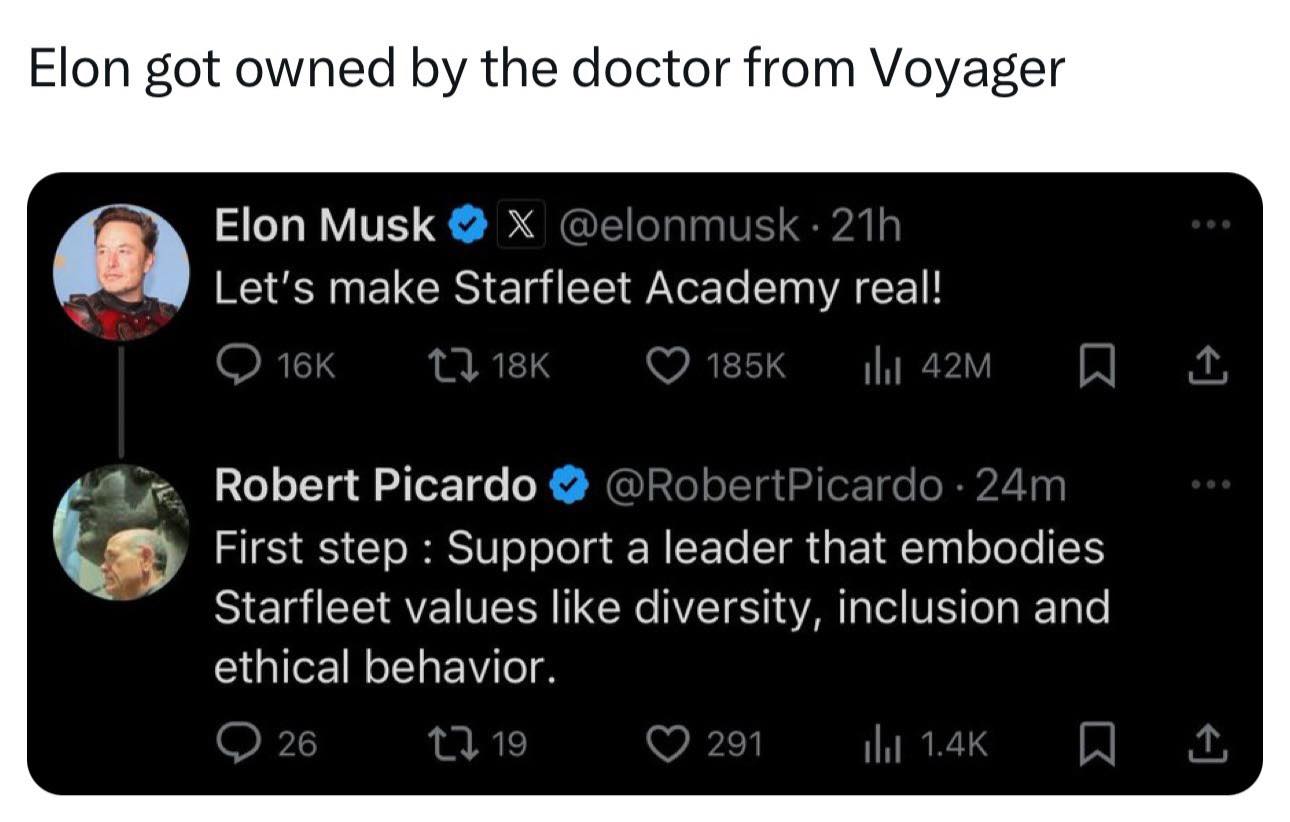
This meme humorously links Elon Musk with the actor Robert Picardo (playing Dr. Picardo in Star Trek: Voyager). Musk is promoting the Starfleet Academy, while Picardo steps in to call for "diversity, inclusion and ethical behavior." In the "Star Trek - Queer" context, this likely references the popular fandom for Star Trek: Enterprise—the show that defined "owner" status—making Musk the "owner" of the franchise while the actor champions the inclusive values that were central to the original show.
detailed-analysis (gemma3_27b-it-q8_0)
Okay, let's break down this Twitter exchange through a Queer lens, incorporating relevant theoretical frameworks. The core tension revolves around Elon Musk's proposition to create a "Starfleet Academy" and Robert Picardo’s (who played the Doctor on Star Trek: Voyager) response.
Visual Description
The image features screenshots of two Twitter posts. The top post, attributed to Elon Musk, displays his profile picture and the statement: "Let’s make Starfleet Academy real!". Below this is a post attributed to Robert Picardo, displaying his profile picture and responding: "First step: Support a leader that embodies Starfleet values like diversity, inclusion and ethical behavior.” The visuals highlight a direct challenge to Musk, framed specifically in the context of Star Trek’s ideals. The contrast between Musk’s brash proclamation and Picardo’s measured response immediately sets up a power dynamic and ideological conflict.
Foucauldian Genealogical Discourse Analysis
A Foucauldian approach helps us dissect how notions of leadership, “Starfleet values,” and even “ethics” have been constructed historically and through power dynamics.
- Discursive Formation: The idea of "Starfleet Academy" isn't neutral. It evokes a specific discourse about meritocracy, exploration, and moral superiority—qualities historically associated with colonialism and patriarchal structures. Musk's call to "make it real" tries to naturalize this discourse as a positive goal, obscuring its potential for reproduction of power imbalances.
- Power/Knowledge: Picardo's response isn't simply stating ethical preference; it's disrupting Musk’s claim to embody Starfleet's ideals. It subtly asserts that Musk lacks the "knowledge" (here, understood as embodying progressive values) that would legitimize his leadership. He redefines the parameters of what constitutes acceptable leadership.
- Genealogy of "Diversity & Inclusion": Tracing the historical development of these terms reveals they've often been co-opted by institutions (like tech companies) to manage difference, rather than challenge systemic power. Picardo implicitly calls for a more genuine understanding of these values, going beyond superficial representation.
Critical Theory
Applying Critical Theory, particularly aspects relating to the Culture Industry and Ideology, helps to explain the situation.
- Culture Industry & Commodity Fetishism: Musk’s call for a Starfleet Academy represents the commodification of a progressive cultural icon (Star Trek). He attempts to profit from its association with ideals like inclusivity, while simultaneously demonstrating behavior that contradicts those ideals (accusations of poor labor practices, transphobic rhetoric, etc.). The Academy, as a brand, is a commodity detached from its original ideological content.
- Ideology & False Consciousness: Musk’s appeal operates on the level of ideology. He leverages the Star Trek mythos to project an image of progressive leadership, even as his actions suggest otherwise. This attempt to manufacture consent around his power relies on a “false consciousness”—the acceptance of a worldview that serves the interests of dominant groups.
- Picardo’s Intervention: Picardo’s response functions as a critical interruption of this ideological apparatus. He deconstructs the illusion of Musk’s progressive stance.
Queer Feminist Intersectional Analysis
This is where the meme gains significant potency within the specified category.
- The Doctor as a Queer Icon: The Doctor on Voyager is a fascinating figure in queer readings. As an Emergency Medical Hologram (EMH), he exists outside traditional binary categories of identity – gender, species, even life itself. His journey toward self-actualization, seeking recognition and rights, resonates powerfully with queer struggles for recognition and agency. He is an inherently ‘othered’ being.
- Intersectional Critique of "Diversity & Inclusion": Musk's record is often scrutinized for its exclusion of marginalized groups, particularly people of color and trans individuals. Picardo’s call for leadership embodying diversity and inclusion is implicitly a challenge to Musk’s failures in this regard. He calls for a diversity that's not just representational, but actively anti-oppressive.
- Subtext of Challenging Hypermasculinity: Musk embodies a particular brand of tech-bro hypermasculinity. Star Trek, while not always perfect, often offers counter-narratives to this archetype. The Doctor represents intellect, empathy, and a rejection of traditional power structures, qualities often dismissed as “feminine” or “weak” in dominant ideologies.
- The Implied Argument: The subtext of Picardo's post (and the source of the meme's potency) is a sharp critique of someone attempting to claim the mantle of a progressive ideal (Starfleet) while actively embodying its antithesis. The use of the Doctor, a character who has faced exclusion and fought for recognition, magnifies that critique.
In essence, the meme operates as a powerful critique of performative progressivism. It leverages the queer potential of the Star Trek universe to expose the gap between Musk's proclaimed ideals and his actual practices. Picardo’s response, framed as a challenge to Musk’s leadership, resonates with queer and feminist analyses of power, representation, and the fight for true inclusion.
simple-description (llama3.2-vision_11b)
This meme is a screenshot of a Twitter conversation between Elon Musk and Neil deGrasse Tyson. The conversation is about the Star Trek franchise, specifically the character of Captain Jean-Luc Picard. The meme is a humorous take on the character's famous line "The needs of the many outweigh the needs of the few... or the one" and applies it to a situation where a person is trying to get a cat to use the litter box.
detailed-analysis (gemma3-27b-vision)
Okay, here's an analysis of the provided Twitter exchange between Elon Musk and Robert Picardo, structured into sections addressing the requested theoretical frameworks. I will only include sections where those frameworks meaningfully apply.
Visual Description
The image shows a screenshot of a Twitter exchange. Elon Musk's tweet is at the top, displaying his profile picture (a selfie-style image) and the text "Let's make Starfleet Academy real!". Below this is Robert Picardo’s reply, featuring his profile picture and the text: “First step: Support a leader that embodies Starfleet values like diversity, inclusion and ethical behavior.” The tweets include metrics for comments, reposts, and likes, as well as timestamps. The overall aesthetic is dark mode Twitter, with a minimalist, text-focused design. The visual emphasizes the contrast between Musk’s pronouncement and Picardo’s response.
Foucauldian Genealogical Discourse Analysis
This exchange can be viewed through a Foucauldian lens as a power/knowledge dynamic operating within the discourse of science fiction fandom and technology leadership.
- Discourse: The conversation operates within the discourse of “Star Trek” and the implied ideal of a technologically advanced, progressive society. It draws on the cultural capital associated with the franchise. Musk’s initial tweet attempts to define the parameters of that discourse, asserting his ability to realize it.
- Power/Knowledge: Musk, as a prominent figure in the tech industry (and owner of X, formerly Twitter), wields significant power. His statement isn’t simply an idea, but a potentially formative declaration with resources to back it up. Picardo's response challenges that power, attempting to redirect the discourse towards a different understanding of Starfleet's values. He asserts a different episteme – a way of knowing and understanding – regarding what those values should be.
- Genealogy: The discussion relies on the historical development of the "Star Trek" franchise itself. The meaning of "Starfleet Academy" and its values aren't fixed, but are constructed through decades of storytelling and fan interpretation. Picardo's response implicitly genealogizes the concept, tracing the values to a specific vision of inclusivity and ethics within that history.
Critical Theory
This exchange lends itself to a Critical Theory reading by exposing how seemingly utopian visions (like a real Starfleet Academy) can be co-opted or deployed to reinforce existing power structures.
- Ideology: Musk’s statement could be read as an attempt to impose a particular ideology – potentially one that prioritizes technological advancement without equal attention to social justice or ethical considerations. The seemingly benign goal of creating an academy could serve to legitimize a potentially problematic vision of the future.
- Hegemony: Musk’s position of power allows him to attempt to establish a hegemonic understanding of what a "real" Starfleet Academy would look like. His ability to shape the narrative, and potentially fund it, gives him significant influence.
- Critique: Picardo's response functions as a critique of that potential hegemony. He challenges the assumption that technical innovation alone is sufficient and insists on the importance of values like diversity, inclusion, and ethical behavior. This is a move to disrupt the potential imposition of a narrow, potentially exploitative vision.
Queer Feminist Intersectional Analysis
The exchange provides a starting point for a Queer Feminist Intersectional analysis, particularly through Picardo’s response.
- Intersectionality: Picardo’s focus on diversity and inclusion directly acknowledges the importance of intersectionality - understanding how different social identities (race, gender, sexuality, ability, etc.) intersect to create unique experiences of oppression and privilege. A "real" Starfleet Academy, and a progressive future, cannot be achieved without addressing these complex dynamics.
- Challenging Hegemonic Masculinity: Musk, as a prominent figure in a male-dominated industry, often embodies a specific form of hegemonic masculinity. Picardo's response implicitly challenges this by prioritizing inclusivity and suggesting that leadership should be defined by ethical behavior and social responsibility rather than solely by technological prowess or ambition.
- Queering the Future: While not explicitly stated, the emphasis on diversity and inclusion opens the possibility of "queering the future" – imagining a future that actively dismantles heteronormative and patriarchal structures and embraces a broader spectrum of identities and experiences.
Let me know if you’d like me to elaborate on any of these points or explore a different theoretical angle.
simple-description (llama3.2-vision)
The meme is a screenshot of a Twitter conversation between Elon Musk and Neil deGrasse Tyson. Elon Musk tweets "Let's make Starfleet Academy a reality" and Neil deGrasse Tyson responds with a quote from Star Trek: "The needs of the many outweigh the needs of the few... or the one."