First Seen
2023-05-10T21:03:41+00:00
simple-description (llama3.2-vision_11b)
The meme is a screenshot from Star Trek: The Next Generation, featuring the character Geordi La Forge. The image shows Geordi's reaction to Captain Picard's revelation that he is the son of a human and a Betazan, which makes him half-human and half-Betazan. The text "I am your father" is not present, but the meme is captioned "I am your father" to reference the iconic Star Wars line, but in this case, it's a humorous take on the character's reaction to learning about his heritage.
detailed-analysis (gemma3-27b-vision)
Okay, let's break down this image – a meme format using distressed faces of characters from Star Trek: The Next Generation – through several critical lenses.
Visual Description
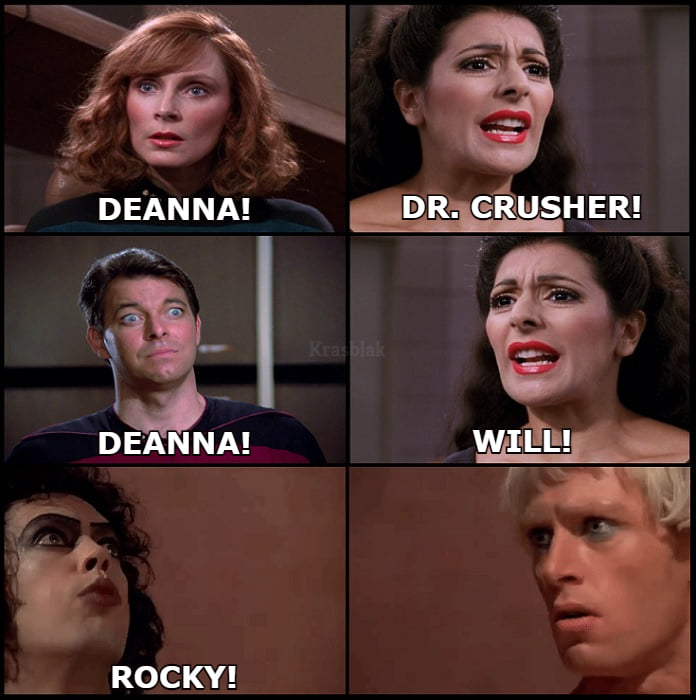
The image is a four-panel grid featuring screenshots of characters from Star Trek: The Next Generation in moments of apparent emotional distress. Each panel has a single word ("Deanna," "Dr. Crusher," "Will," "Rocky") overlaid in white capital letters, serving as a dramatic, emphatic cry.
- Panel 1: Counselor Deanna Troi (Marina Sirtis) looks upward, with a slightly furrowed brow and a pained expression. The lighting is warm, creating a sense of vulnerability.
- Panel 2: Dr. Beverly Crusher (Gates McFadden) looks directly at the viewer, eyes wide with distress and tears welling up. The lighting is red, intensifying the emotional impact.
- Panel 3: Commander William Riker (Jonathan Frakes) is also looking up with widened eyes and in distress.
- Panel 4: Troi again, lying back with a distressed expression.
- Panel 5: Riker again, looking downwards with a distressed expression.
The effect is humorous due to the melodramatic nature of the expressions and the repetition of names. It suggests a desperate calling out, perhaps in a moment of crisis or loss, though the context is lost in the meme format.
Foucauldian Genealogical Discourse Analysis
This meme, while seemingly simple, reveals how “crisis” and “emotional expression” are constructed through discourse. Foucault would analyze how the way these characters express distress – the widened eyes, the upward gaze, the dramatic lighting – are not simply natural responses, but are products of a specific historical and cultural context.
- Power/Knowledge: The framing of these scenes as “distress” is also a power dynamic. Who gets to define what constitutes a “crisis”? In the context of Star Trek, the ship’s command structure (Picard, Riker) likely dictates acceptable expressions of vulnerability. The meme amplifies these expressions, suggesting an almost parodic exaggeration of the societal expectation of emotional presentation.
- Genealogy of Distress: Tracing the history of how "distress" is represented in media (pre-Star Trek, contemporary with Star Trek, post-Star Trek) would reveal shifts in how we understand and perform emotionality. This meme taps into a recognizable trope – the dramatic cry for help – and potentially subverts it through humor.
- Disciplinary Power: Within the fictional universe, the ship's structure and protocol create a disciplinary regime. Displays of extreme emotion, while potentially understandable, could be seen as disruptive. The meme, by highlighting these moments, subtly exposes the tension between individual emotional expression and the demands of the ship's "order".
Critical Theory
From a broader Critical Theory perspective (drawing on thinkers like Adorno and Horkheimer), the meme participates in the "culture industry."
- Commodification of Emotion: The characters’ distress is extracted from the narrative context and repackaged as a humorous meme. This process commodifies their emotional experiences, transforming them into a form of entertainment.
- Loss of Authenticity: The meme reduces complex emotional states to a single, easily digestible image and word. This flattening of experience contributes to a loss of authenticity and genuine emotional connection.
- Passive Consumption: The viewer is positioned as a passive consumer of these manufactured emotions, rather than an active participant in a meaningful emotional exchange.
Marxist Conflict Theory
While not a direct application, one could argue that the meme subtly exposes the hidden conflicts within the idealized vision of Star Trek. The ship, presented as a post-scarcity utopia, still operates with a hierarchical structure.
- Power Dynamics: The distress of these characters could be linked to the stresses of maintaining this hierarchical structure. The Captain's authority, the First Officer's responsibility – these create pressures that manifest as emotional strain.
- Alienation: Even in a utopia, characters might experience alienation – from their duties, from their colleagues, from their own emotions. The meme highlights moments of vulnerability that break the facade of stoic professionalism.
- Repression of Emotion: The ship’s order requires the suppression of certain emotions. The meme can be read as a momentary release of those repressed feelings, albeit in a commodified and humorous form.
Postmodernism
This meme is strongly rooted in postmodern principles.
- Intertextuality: It relies on the viewer’s pre-existing knowledge of Star Trek and its characters. It’s a remix of existing content, creating a new meaning through juxtaposition.
- Pastiche and Parody: The meme adopts the style of melodramatic television, exaggerating it for comedic effect. It's a parody of the emotional tropes commonly found in science fiction.
- Deconstruction of Meaning: The meme strips the original scenes of their narrative context, disrupting the intended meaning. It asks the viewer to create a new meaning based on the fragmented image and the repeated names.
- Simulation and Hyperreality: The meme exists as a digital simulation of emotional distress, detached from any genuine experience. It's a hyperreal representation of feelings, amplified and distorted for entertainment.
Queer Feminist Intersectional Analysis
This is the most challenging application, but possible. It requires acknowledging that even in a progressive fictional universe like Star Trek, gender and power dynamics are still at play.
- Gendered Emotionality: The disproportionate presence of female characters (Troi and Crusher) expressing distress could be interpreted as a reinforcement of traditional gender roles, where women are perceived as more emotional than men.
- Emotional Labor: Both Troi and Crusher are in roles that require significant emotional labor – Troi as the ship’s counselor, and Crusher as the chief medical officer. The meme could be read as highlighting the emotional burden placed upon these characters.
- Intersectional Vulnerability: While the characters are relatively privileged within the Star Trek universe, they are still subject to the demands of their positions and the pressures of the ship’s command structure. This vulnerability intersects with their gender and professional roles.
- Subversion through Humor: The meme could also be seen as a subversive act, reclaiming the expression of emotion as a form of resistance against the expectations of stoicism and professionalism. The repetition of names, while humorous, could also be a way of asserting agency and demanding attention.
I hope this thorough analysis is helpful! Let me know if you’d like me to elaborate on any of these points.
simple-description (llama3.2-vision)
The meme is a still image from the TV show Star Trek: The Next Generation, featuring a character named Deanna Troi, played by actress Marina Sirtis, with a shocked expression. The image is captioned with the phrase "Deanna, I'm... happy for you, but this is Trekkie... not Trek... " followed by "Deanna: I am... what I am" and then "Deanna: I am... Trekkie...".
tesseract-ocr
2 ‘ _— | r. e 3 bi P DEANNA! > Pt een | he : tel | ” 2 OL | WILLY 7 i _ ROCKY!