First Seen
2023-05-10T21:03:41+00:00
simple-description (llama3.2-vision_11b)
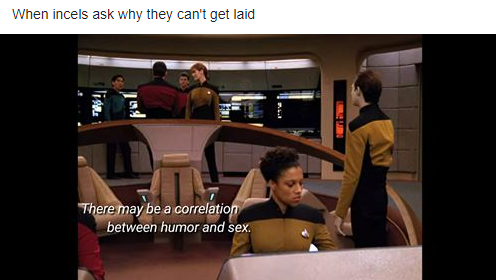
The meme is a screenshot from the TV show Star Trek: The Next Generation, where a character named Data is asking Captain Jean-Luc Picard why humans can't have sex with aliens. The caption "When humans ask why they can't have sex with aliens" is a play on the original quote, replacing "humans" with "aliens" to poke fun at the idea of humans being curious about extraterrestrial relationships.
detailed-analysis (gemma3-27b-vision)
Okay, let's break down this meme using the requested theoretical frameworks, noting where they don't quite apply as well.
Visual Description
The image is a screenshot from Star Trek: The Next Generation. It depicts a scene on the bridge of the USS Enterprise-D. Several crew members are present, visible in the background. The focus is on Counselor Deanna Troi (Marina Sirtis) sitting in her station, looking somewhat distressed. Data (Brent Spiner), the android, is standing beside her, with a slightly questioning expression. Text at the bottom of the image reads: “There may be a correlation between humor and sex.” The meme’s caption above the image reads: “When incels ask why they can't get laid.” The composition suggests a moment of serious conversation or inquiry, contrasted sharply with the crude implication of the caption.
Foucauldian Genealogical Discourse Analysis
This meme is ripe for a Foucauldian analysis. The core of the "incel" (involuntary celibate) phenomenon isn't simply about lack of sex. It's about a discourse – a way of talking about sex, relationships, and entitlement – that has developed historically.
- Power/Knowledge: The incel subculture constructs its own “knowledge” about women, sexuality, and what constitutes “fairness.” This “knowledge” is deeply tied to power dynamics. Incel rhetoric frames women as gatekeepers and positions the incel as a victim of an unjust system. This framing is a form of self-justification for resentment and often manifests as misogyny.
- Genealogy: Tracing the genealogy of this discourse would reveal its roots in anxieties surrounding masculinity, the rise of internet communities, and the history of entitlement in heterosexual relationships. The meme, by juxtaposing the Star Trek scene with incel complaints, exposes the absurd and often delusional nature of this self-constructed narrative. Star Trek often challenges traditional gender roles and power dynamics. The scene highlights the importance of emotional intelligence and empathy (Troi’s role) – concepts often lacking in incel discourse.
- Disciplinary Power: The incel discourse, through online forums and communities, exerts a form of disciplinary power. Members are encouraged to conform to a specific worldview, and those who dissent are often ostracized. This creates a closed system where problematic beliefs are reinforced.
Critical Theory
The meme speaks to several facets of Critical Theory, particularly those related to the Frankfurt School.
- The Culture Industry: The meme itself, spread through digital channels, is a product of the culture industry. It's a piece of consumable content that, while seemingly innocuous, reflects broader social anxieties and power imbalances.
- Commodification of Desire: The incel lament is rooted in a distorted understanding of desire, often framed as an entitlement rather than a reciprocal experience. This commodification of desire, where sex is seen as a right to be earned, is a key critique of modern consumer culture.
- Alienation: Incels often express a sense of alienation from society and a feeling of being misunderstood. This alienation is linked to broader societal issues such as the breakdown of traditional community structures and the emphasis on individual achievement.
Marxist Conflict Theory
While not the primary lens through which to analyze this, Marxist theory offers some insight.
- Power Dynamics: The incel phenomenon reflects a power imbalance rooted in gender and social roles. Incels perceive themselves as disadvantaged in a "mating market," framing this as a form of exploitation.
- Ideology: Incel ideology functions as a false consciousness, obscuring the true sources of social inequality. By blaming women for their lack of sexual success, incels avoid confronting broader systemic issues.
- Commodification of the Body: In a capitalist society, bodies are often commodified and valued based on their perceived attractiveness or reproductive potential. Incels feel excluded from this system, leading to resentment.
Queer Feminist Intersectional Analysis
This is perhaps the most potent framework for understanding the meme.
- Patriarchy & Misogyny: The incel phenomenon is deeply rooted in patriarchal structures and misogynistic beliefs. Incels often view women as objects to be conquered or as obstacles to their desires.
- The Construction of Masculinity: Incels often struggle with a narrow and rigid definition of masculinity, believing that their worth is tied to their ability to attract women. This reinforces harmful stereotypes and perpetuates a culture of entitlement.
- Intersectionality: The incel subculture tends to ignore the intersection of gender with other forms of oppression, such as race, class, and disability. This reinforces a privileged perspective and perpetuates harmful stereotypes.
- Rejection of Consent and Autonomy: The incel ideology often disregards women's agency and autonomy. There's a tendency to view sexual encounters as entitlements rather than reciprocal agreements. The meme, by highlighting this dynamic, exposes the problematic power imbalances at play.
Postmodernism
Postmodernism isn't as central here as the other frameworks, but there are some connections.
- Deconstruction of Meaning: The meme can be seen as a deconstruction of the traditional narrative of romantic relationships. It exposes the absurdity of the incel worldview and challenges the notion of a fixed or essential meaning of sex.
- Simulation & Hyperreality: The incel online world can be seen as a form of hyperreality, where online interactions and fantasies replace genuine human connection.
- Fragmentation & Identity: Incels often express a fragmented sense of identity, struggling to reconcile their desires with their perceived failures.
In conclusion, the meme, while seemingly simple, is a complex cultural artifact that can be analyzed through multiple theoretical lenses. Queer Feminist Intersectional Analysis and Foucauldian Discourse Analysis offer the most insightful frameworks for understanding the underlying power dynamics and problematic ideologies at play.
simple-description (llama3.2-vision)
This meme is a screenshot from a Star Trek: The Next Generation episode where a character, Lieutenant Worf, is being asked about his lack of intimacy with his wife. The meme is captioned "When you're asked to explain why you haven't had sex in months" and features a quote from the episode: "In the Klingon Empire, it is not a question of if you will be married, but to whom."
tesseract-ocr
= ‘= - i k ers =i? | 4 71 a era ae eatery y ene ees a el