First Seen
2023-05-10T21:03:40+00:00
simple-description (llama3.2-vision_11b)
The meme is a screenshot of a Star Trek: The Next Generation episode, where the character Data is singing "So You Like to Sing and Dance" from the musical West Side Story. The meme shows Data's awkward and humorous performance, with the caption "So you like to sing and dance..." implying that Data is trying to be cool but is actually quite awkward.
detailed-analysis (gemma3-27b-vision)
Okay, let's break down this meme/image collage through the lenses of several theoretical frameworks.
Visual Description
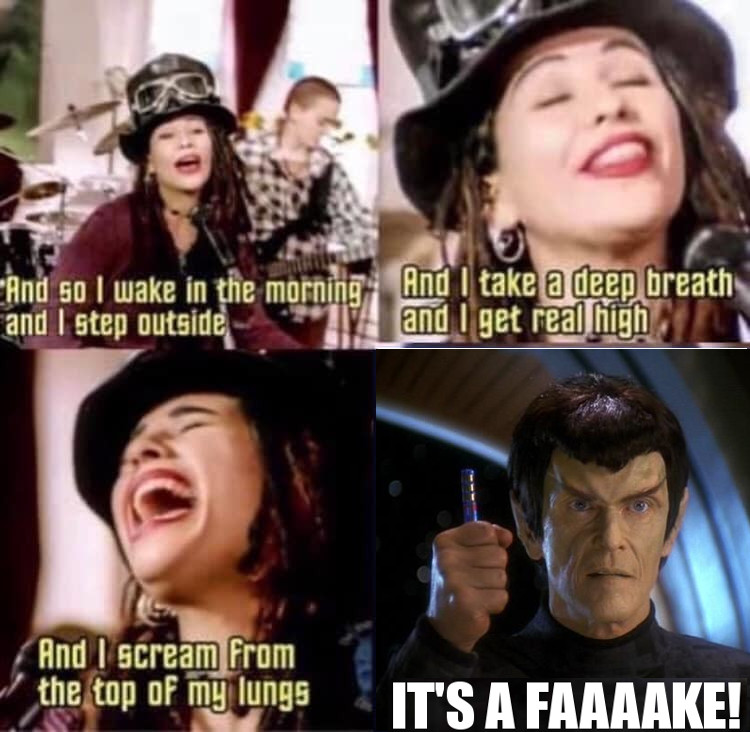
The image is a four-panel meme utilizing screenshots from different sources.
- Panel 1: A person with dark hair, wearing a beanie, is standing and reaching their hands up. Text reads, "And so I wake in the morning and I step outside."
- Panel 2: The same person is visible, eyes closed, in a more exaggerated pose with the text "And I take a deep breath and I get real high."
- Panel 3: A close-up of the same person screaming, mouth wide open, with the text "And I scream from the top of my lungs."
- Panel 4: A still image of Spock from Star Trek, holding a device (a tribble scanner), with a stern expression and the text "IT'S A FAAAAAKE!"
The overall visual style is reminiscent of internet meme culture – relying on juxtaposition, altered imagery, and the use of text to create humor and/or convey a message. The contrast between the emotional, exaggerated expressions and the stoic, logical expression of Spock create an ironic contrast.
Postmodernism
This meme functions beautifully as a piece of postmodern expression.
- Pastiche & Intertextuality: The meme relies on the viewer's existing knowledge of both the source material of the 'screaming' person and the Star Trek universe. It blends these contexts into a new, fragmented text. This is a hallmark of pastiche – appropriating and recombining existing cultural elements.
- Irony and Self-Referentiality: The juxtaposition of the overly dramatic statements and Spock’s blunt declaration of “IT’S A FAAAAAKE!” relies heavily on irony. It’s commenting on the performance of emotion, the gap between expressed feelings and reality, and even the performance of authenticity itself. The meme knows it’s constructed and artificial.
- Deconstruction of Grand Narratives: The meme implicitly challenges any "grand narrative" about emotional expression or authenticity. It’s suggesting that everything is constructed, performative, and open to scrutiny. There's no inherent "truth" to feeling; it's all subjective and potentially a facade.
Foucauldian Genealogical Discourse Analysis
Through a Foucauldian lens, the meme can be interpreted as examining the discourse around authenticity and emotional expression.
- Power/Knowledge: The meme implicates that what we perceive as "genuine" emotion is often produced through social and cultural forces. The person is performing an image of exhilaration, and Spock's intervention reveals this performance. This relates to Foucault's notion that power operates through the creation of discourse. Spock, as an emblem of logic and rationality, exercises power by dismantling the performance and labeling it "fake."
- Genealogy of Emotion: One could trace the “genealogy” of this performance back to cultural scripts—the way in which we’ve been taught to express certain feelings. The meme challenges the notion that these expressions are natural or spontaneous. It suggests that they are historical and contingent, tied to specific power structures.
- Discipline & Surveillance: Spock’s “IT’S A FAAAAAKE!” can be seen as an act of surveillance and disciplinary power. He’s exposing the artifice and policing the boundaries of “genuine” emotion.
Queer Feminist Intersectional Analysis
This is where the analysis gets more complex, and relies on interpretation.
- Performance & Gender: The person in the first three panels could be read as embodying a hyper-feminine or queer performance of emotion. Traditionally, emotional expression has been gendered, with women and queer people often expected to be more demonstrative. Spock’s dismissal of the expression could be interpreted as a silencing of this performative identity.
- Authenticity & Subjectivity: Queer theory frequently challenges the notion of a fixed, authentic self. The meme's deconstruction of authenticity resonates with this idea. If the self is fluid and constructed, then the distinction between "real" and "fake" becomes blurred.
- Intersectionality: The meme doesn't explicitly address issues of race, class, or other intersecting identities. However, it's important to consider how these identities might shape the way in which emotional expression is perceived and validated. What is considered “authentic” for one group may be different for another.
Important Notes:
- Interpretation is Subjective: These analyses are inherently interpretive. There is no single “correct” way to understand this meme.
- Complexity: This meme, while seemingly simple, can be layered with meaning. These theoretical frameworks help us to unpack those layers.
Let me know if you’d like me to elaborate on any of these points or explore another theoretical lens!
simple-description (llama3.2-vision)
The meme is a humorous take on a classic 80s song, "Don't Stop Believin'" by Journey. The meme replaces the iconic "Just a small town girl, living in a lonely world" lyrics with a more...unconventional...version: "Just a stoner girl, living in a haze world". The text is accompanied by a photo of a person in a stoner-like state, with a goofy expression.
tesseract-ocr
‘ ae = Fo r » —\X 6 a o a? Sa q , a | AN! UA re And so | wake in the morning ag And | takefaloeen\breathy Ee mmm | ee CURIE: (0: 4 j Sa | i } \ ~ \ 4 ta ee ‘ eA TY (a