First Seen
2023-05-10T21:03:40+00:00
simple-description (llama3.2-vision_11b)
This meme is a screenshot of a Twitter conversation between the Star Trek actors William Shatner and Chris Pine, who play Captain James T. Kirk and his son in the rebooted Star Trek films. The meme is captioned "Dad, I'm trying to live my best life" and shows Shatner responding to Pine's tweet about a fan convention, where he's being asked to do a "Kirk vs. Kirk" panel. The meme is a lighthearted and humorous take on the Star Trek franchise.
detailed-analysis (gemma3-27b-vision)
Okay, here's an analysis of the Twitter screenshot, broken down into the sections you requested, applying relevant theoretical frameworks where appropriate. I will note when a section doesn't apply, as some of these frameworks simply aren't a natural fit for the image content.
1. Visual Description
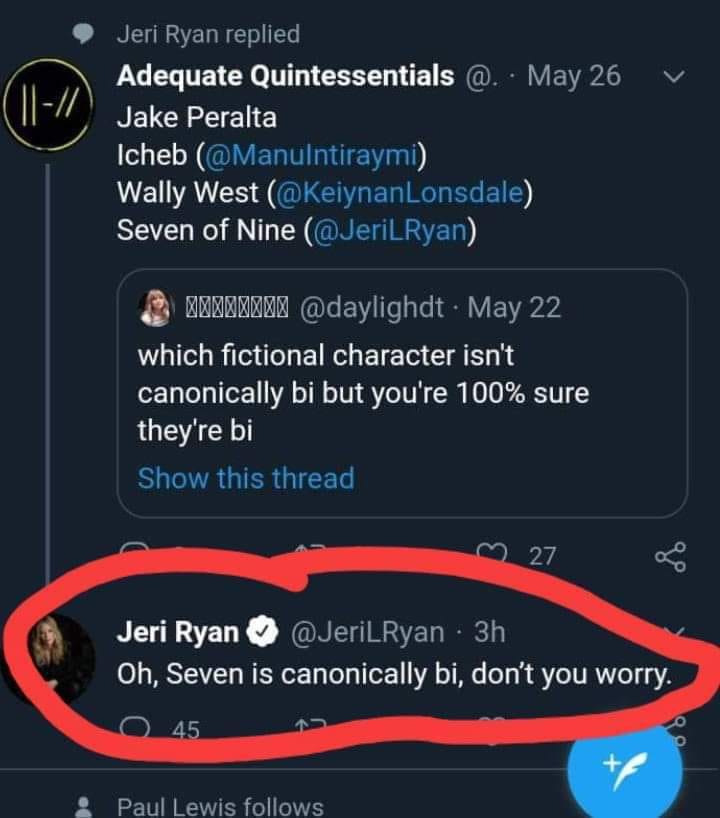
The image is a screenshot of a Twitter exchange. It displays a thread originating from a tweet asking "which fictional character isn't canonically bi but you're 100% sure they're bi?". Below that, a reply from a user named "Jeri Ryan" (@JeriRyan) states, "Oh, Seven is canonically bi, don't you worry."
The image includes user handles, dates/times of posts (May 22 and May 26, and 3h before the image capture), and indicators of engagement (likes, retweets, replies) through icons. There’s a list of four twitter handles preceding the original post which may indicate people mentioned or tagged in the original post.
A circular profile image with a shadowed portrait of a woman is displayed with Jeri Ryan's name and handle. A small blue icon indicating a verified user is also displayed.
2. Foucauldian Genealogical Discourse Analysis
This is arguably the most applicable framework here.
- Discourse and Power: The conversation revolves around the discourse of fictional character sexuality – specifically, bisexuality. The act of defining whether a character is or isn't canonically bi is an exercise of power. The power lies in the ability to define and categorize sexuality, even within a fictional context. Those who make claims about a character's sexuality (like Jeri Ryan) are participating in the construction of this discourse.
- Genealogy: A genealogical approach would ask: how did the concept of "canon" (official, accepted storyline) emerge? How did the discussion of LGBTQ+ representation within media become such a central topic? The concept of “canon” itself is historically contingent; it evolved with fandom culture, media franchises, and the increasing demand for diverse representation.
- Normalization/Pathologization: The very act of asking "which character isn't bi" implies an expectation that many are. This could be seen as a normalization of bisexuality within fandom and media, which is a positive development. However, the initial question also carries a trace of the historical pathologization of non-heteronormative identities – the implication that bisexuality needs proof or justification.
- Knowledge/Power: Jeri Ryan, as the actress who portrayed Seven of Nine on Star Trek: Voyager, wields a particular power in this discourse. Her statement ("Seven is canonically bi") carries weight because she knows the character intimately – or, at least, is positioned as an authority on the character. This highlights how knowledge is inextricably linked to power.
3. Critical Theory
This analysis can be applied, though less directly than Foucauldian discourse.
- Ideology: The discussion exposes an underlying ideology about representation. There's an expectation that fictional media should reflect the diversity of sexual orientation and that characters deserve to be recognized for their LGBTQ+ identities.
- Hegemony: The conversation might be seen as a micro-level example of challenging hegemonic norms. The dominant (historical) norm has been to portray characters as overwhelmingly heterosexual. The demand for LGBTQ+ representation challenges this hegemony.
- Subculture and Resistance: Fandom itself can be considered a subculture, and the passionate discussion of character sexuality within fandom is a form of cultural resistance to dominant norms.
4. Marxist Conflict Theory
This framework doesn’t apply particularly well to this image. While a very stretched argument could be made that the struggle for LGBTQ+ representation represents a conflict over cultural capital, it’s not a natural fit. Conflict theory focuses on material conditions and class struggle, and this image primarily concerns representation and cultural meaning.
5. Postmodernism
Applicable, but nuanced.
- Deconstruction of Meaning: Postmodernism emphasizes the instability of meaning. The question of whether a character is "canonically bi" suggests that even "official" narratives are open to interpretation and negotiation. The very idea of a fixed "canon" is challenged.
- Simulacra and Simulation: The conversation takes place within a digital space—a simulation of reality. The characters being discussed are themselves simulations (fictional constructs). This highlights the increasingly blurred lines between reality and representation.
- Meta-Narratives: The discussion itself is a meta-narrative—a conversation about narratives.
6. Queer Feminist Intersectional Analysis
This is a very strong fit.
- Intersectionality: The conversation implicitly addresses the intersection of sexuality (bisexuality) with representation within media.
- Queer Representation: The focus on whether a character is canonically bi is central to queer representation and the visibility of LGBTQ+ identities.
- Feminist Critique of Representation: While not explicitly feminist in this snapshot, demanding diverse representation is a feminist project. Historically, media has been dominated by male gaze and heteronormative narratives.
- Challenging the Binary: Bisexuality itself challenges the traditional binary of heterosexuality and homosexuality, and this conversation is part of broader efforts to destabilize those rigid categories.
In conclusion:
The image is deceptively complex. It’s a seemingly simple exchange about a fictional character, but it opens up broader questions about power, representation, sexuality, and the construction of meaning in a digital age. The theoretical frameworks of Foucauldian discourse, queer feminism, and postmodernism offer the most compelling tools for analyzing this image.
simple-description (llama3.2-vision)
The meme is a screenshot of a Twitter conversation between two users. The original tweet is from @draculaboy, who asks if the name "Lol" is a valid name in the context of a medieval setting. The response from @Lol is a humorous and sarcastic remark about the name being "valid" because it's a common abbreviation for "Laugh Out Loud."
tesseract-ocr
Mere) [Le] Adequate Quintessentials @.- May 26 v ee Jake Peralta Icheb (@Manulntiraymi) Wally West (@KeiynanLonsdale) Seven of Nine (@JeriLRyan) Fi YMCH VOU Te NAT ate anaes which fictional character isn't canonically bi but you're 100% sure atnT-\VAKw)] Show this thread = ey Ci Jeri Ryan @ @JeriLRyan - 3h Oh, Seven is canonically bi, don’t you worry. ew 4 & Paul Lewis follows